
Why in News?
The Government of Andhra Pradesh has introduced a Draft Population Management Policy aimed at addressing the state’s declining fertility rate and preparing for future demographic challenges.
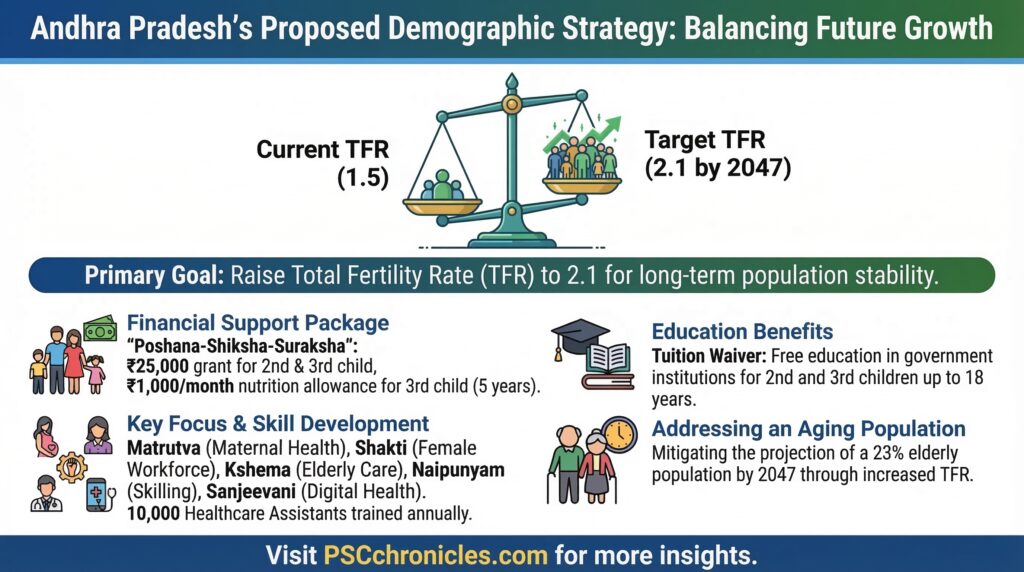
The policy seeks to increase the Total Fertility Rate (TFR) from the current 1.5 to the replacement level of 2.1 by 2047, ensuring balanced population growth and preventing issues such as a shrinking workforce and a rapidly ageing population.
Key features:
- Core Objective: Increase the TFR from 1.5 to 2.1 by 2047 to prevent a future demographic crisis and address the shrinking, aging workforce.
- “Poshana – Shiksha – Suraksha” Package: Under the policy, the state government intends to provide a cash incentive of Rs 25,000 on the birth of a second or third child. In case of the third child, Rs 1,000 per month is proposed to be given for the first five years for ensuring nutritional supplements
- Educational Incentives: Free education is proposed for the second and third child till 18 years of age in government institutions.
- Focus Areas: The policy focuses on “Matrutva” (focused on maternal health), “Shakti” (aiming for greater female participation in workforce), “Kshema” (elderly care), “Naipunyam” (skilling), and “Sanjeevani” (digital health).
- Health care assistants: The policy also seeks to train at least 10,000 healthcare assistants every year, equipped mainly to handle the needs of adolescents and elderly.
Need for the policy:
- Low TFR: The proposed policy is a direct response to the state’s falling fertility rates, which is among the lowest in the country, well below the replacement level fertility of 2.1. The total fertility rate (TFR) of Andhra Pradesh has dropped to 1.5, meaning that, on an average, a woman in the state is producing only 1.5 children.
- Low median age: The median age of the population is 32.5 years, compared to 28.4 years for the country as a whole. Nearly 10 per cent of its population is above the age of 60, which is projected to rise to 23 per cent by 2047.
- Female participation in the workforce is about 31 per cent — much lower than the 37 per cent national average.