India has been accorded the Vice Presidency of the Financial Action Task Force (FATF) for the first time. Vivek Aggarwal, India’s nominee, has been appointed as the FATF Vice President — a landmark in India’s growing role in global financial governance.
Key Facts for Prelims: FATF
Established: 1989 at the G7 Summit in Paris
Nature: Independent, inter-governmental policy-making body (not a UN agency, not an enforcement body)
BRICS member nations unanimously adopted the ‘Indore Declaration’ — a joint agricultural charter — at the 16th BRICS Agriculture Ministers’ Meeting held in Indore, Madhya Pradesh. The declaration aims to boost global farm cooperation among emerging economies.
The BRICS Technical Meeting of the Disaster Risk Reduction Working Group commenced in Puri, Odisha, on June 3, 2026, under India’s BRICS Presidency 2026.
The meeting is important for exams because it connects three areas:
International relations: BRICS and Global South cooperation
Disaster management: disaster risk reduction and climate resilience
Governance: Odisha’s disaster management model
Key Facts for Prelims
Point
Exam-Relevant Fact
Event
BRICS Disaster Risk Reduction Working Group technical meeting
Place
Puri, Odisha
Dates
June 3-5, 2026
Hosted under
India’s BRICS Presidency 2026
Main focus
Disaster risk reduction, climate resilience, early warning, resilient infrastructure
Why Odisha?
Known for cyclone preparedness, early warning systems, evacuation planning and disaster response
Static link
Sendai Framework for Disaster Risk Reduction 2015-2030
Why the Puri Meeting Matters?
The Puri meeting highlights disaster risk reduction as a major area of BRICS cooperation. This is important because climate change is increasing the frequency and intensity of extreme weather events such as cyclones, floods, heatwaves and droughts.
For India, the meeting is significant because:
India is holding the BRICS Chairship in 2026.
India’s BRICS theme is Building for Resilience, Innovation, Cooperation and Sustainability.
Disaster risk reduction fits directly under the Resilience pillar.
Odisha’s cyclone management model is being showcased internationally.
Odisha Model of Disaster Management
Odisha is frequently cited as an important case study in disaster preparedness because the state has improved its ability to manage cyclones and other natural disasters.
Important features:
Multi-hazard early warning systems
Cyclone shelters and evacuation planning
Community-level preparedness
Coordination between state agencies and local administration
Use of technology for alerts and response
Focus on reducing loss of life during cyclones
What is BRICS?
BRICS is an intergovernmental grouping of major emerging economies. It began as BRIC with Brazil, Russia, India and China. South Africa joined later, making it BRICS.
For exams, BRICS is important because it represents:
Voice of the Global South
Reform of global governance institutions
South-South cooperation
Alternative development finance through the New Development Bank
Cooperation in economy, technology, health, agriculture, climate, disaster management and security
BRICS Membership
The original BRICS members are Brazil, Russia, India, China and South Africa.
Recent expansion added Egypt, Ethiopia, Iran, United Arab Emirates and Indonesia.
Institutional Pillars of BRICS
New Development Bank
The New Development Bank was established by BRICS countries. The agreement for establishing the bank was signed during the 6th BRICS Summit in Fortaleza, Brazil, in 2014.
Headquarters: Shanghai, China
Focus: Infrastructure and sustainable development projects
Earlier known as: BRICS Development Bank
Membership: Open beyond BRICS countries
Exam importance: Alternative development finance institution linked to Global South
Contingent Reserve Arrangement
The BRICS Contingent Reserve Arrangement was also signed in Fortaleza, Brazil, in 2014.
Purpose:
Provides financial support during short-term balance of payments pressure
Helps member countries face global liquidity shocks
Acts as a financial safety mechanism
India and BRICS 2026
India is holding the BRICS Chairship in 2026 and will host the 18th BRICS Summit in 2026.
India’s BRICS 2026 theme is Building for Resilience, Innovation, Cooperation and Sustainability.
India’s focus areas include disaster risk reduction, agriculture and food security, health cooperation, energy security, supply chain resilience, innovation and emerging technologies, and reform of global governance institutions.
Interconnected Static Subject: Sendai Framework
The Sendai Framework for Disaster Risk Reduction 2015-2030 is a global framework adopted in Sendai, Japan, in 2015.
Its four priorities are:
Understanding disaster risk
Strengthening disaster risk governance
Investing in disaster risk reduction for resilience
Enhancing disaster preparedness for effective response and Build Back Better in recovery
Response happens after disaster; DRR focuses on reducing risk before disaster
NDB vs CRA
NDB funds development projects; CRA provides liquidity support
BRICS vs BIMSTEC
BRICS is a global/emerging economy grouping; BIMSTEC is a Bay of Bengal regional grouping
Sendai Framework vs Paris Agreement
Sendai deals with disaster risk reduction; Paris Agreement deals with climate change
Odisha Model
Known mainly for disaster preparedness, early warning and cyclone response
Saudi Arabia in BRICS
Membership/status should be checked with latest official/exam source due to differing reporting
Practice MCQs
1. The BRICS Disaster Risk Reduction Working Group technical meeting in June 2026 was held in which Indian city?
A. Bhubaneswar B. Puri C. Visakhapatnam D. New Delhi
Answer: B. Puri
Explanation: The BRICS Disaster Risk Reduction Working Group technical meeting commenced in Puri, Odisha, on June 3, 2026.
2. The New Development Bank was established by BRICS countries through an agreement signed at which summit?
A. Durban Summit, 2013 B. Fortaleza Summit, 2014 C. Ufa Summit, 2015 D. Goa Summit, 2016
Answer: B. Fortaleza Summit, 2014
Explanation: The agreement establishing the New Development Bank was signed during the 6th BRICS Summit at Fortaleza, Brazil, in 2014.
3. The Sendai Framework is primarily related to:
A. Climate finance B. Disaster risk reduction C. Nuclear disarmament D. Biodiversity conservation
Answer: B. Disaster risk reduction
Explanation: The Sendai Framework for Disaster Risk Reduction 2015-2030 provides global priorities for reducing disaster risks and losses.
4. Which of the following best describes the BRICS Contingent Reserve Arrangement?
A. A global environmental treaty B. A defence cooperation pact C. A financial safety mechanism for liquidity and balance of payments pressure D. A permanent BRICS Parliament
Answer: C. A financial safety mechanism for liquidity and balance of payments pressure
Explanation: CRA was created to help BRICS countries manage short-term liquidity and balance of payments pressures.
5. Which Indian state is being highlighted for its disaster management model in connection with the BRICS DRR meeting in Puri?
A. Gujarat B. Odisha C. Kerala D. Maharashtra
Answer: B. Odisha
Explanation: Odisha’s disaster management model, especially cyclone preparedness and early warning, is being showcased during the BRICS DRR meeting.
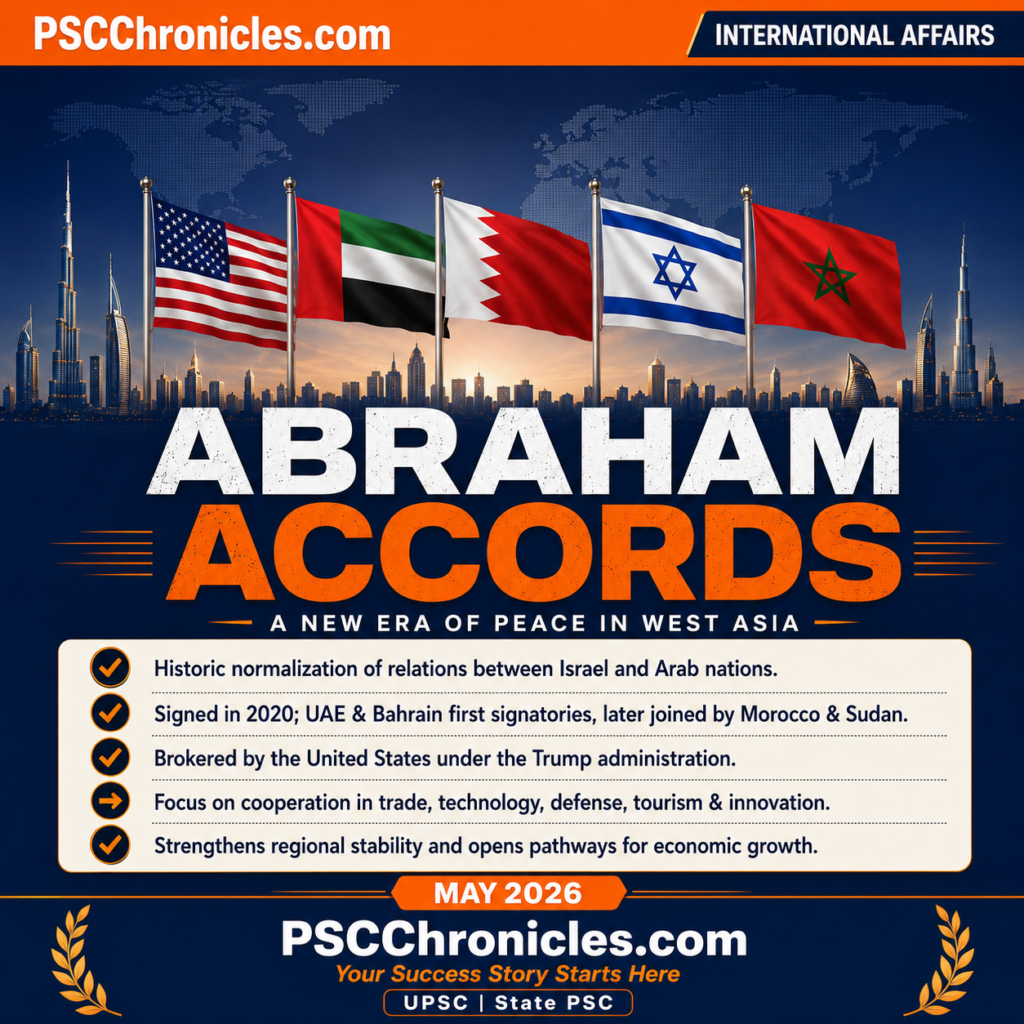
US President Donald Trump stated that countries such as Saudi Arabia, Qatar, Egypt, Turkiye, and Pakistan should normalize relations with Israel under an expanded Abraham Accords 2026 framework.
The proposal was linked to broader negotiations aimed at ending the Iran-Israel conflict in West Asia
The statement has renewed global attention on the Abraham Accords, which were originally brokered by the United States in 2020 to establish diplomatic and economic relations between Israel and Arab nations. The accords reshaped Middle East diplomacy and altered long-standing regional alignments.
Key Facts About Abraham Accords 2026
Aspect
Details
Agreement Name
Abraham Accords
Brokered By
United States
Year of Original Signing
2020
Initial Signatories
Israel, UAE, Bahrain
Later Signatories
Sudan, Morocco
Current Context
Linked by Trump to Iran peace negotiations
Core Objective
Israel normalization with Arab nations
Strategic Impact
Shift in West Asian geopolitical alliances
Formation of I2U2 Group
The Abraham Accords also contributed to the emergence of the I2U2 Group, comprising India, Israel, UAE, and the USA.
Practice MCQs
Q1. The Abraham Accords were originally signed in: a) 2018 b) 2019 c) 2020 d) 2022
Answer: (c) — The agreements were brokered by the United States in 2020.
Q2. Which among the following was NOT an initial signatory to the Abraham Accords? a) Israel b) UAE c) Bahrain d) Morocco
Answer: (d) — Morocco joined later after the initial agreements.
Q3. The I2U2 Group includes which of the following countries? a) India, Israel, UAE, USA b) India, Iran, UAE, USA c) India, Israel, UK, USA d) India, Israel, UAE, UK
Answer: (a) — I2U2 consists of India, Israel, UAE, and the USA.
Q4. The Abraham Accords mainly relate to: a) Nuclear disarmament b) Climate financing c) Israel normalization with Arab nations d) Global trade reforms
Answer: (c) — The accords aim at normalizing relations between Israel and Arab countries.
To study more current affairs from exam point of view, Click here
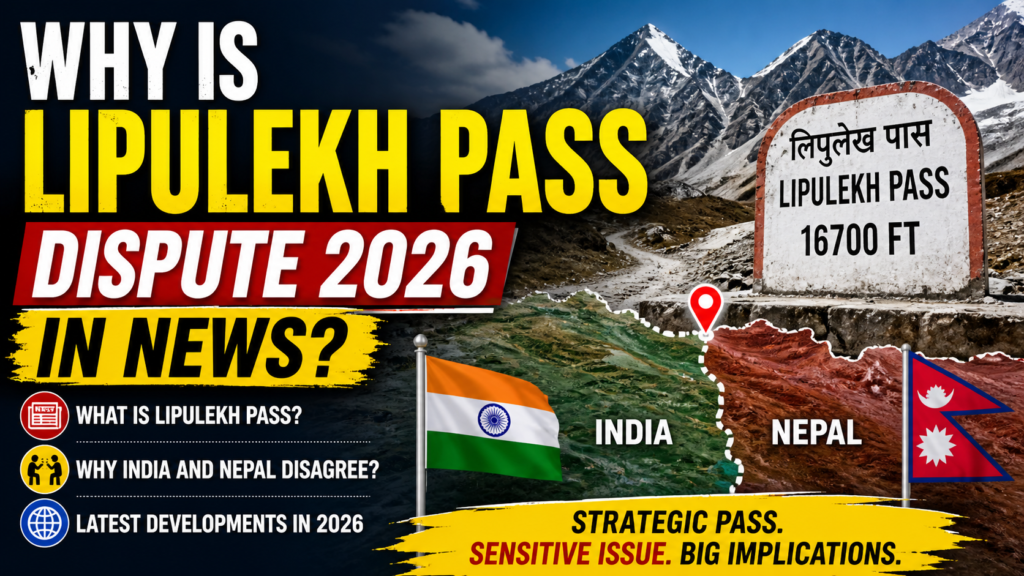
The Lipulekh Pass Dispute has come into focus after Nepal objected to India and China planning to conduct the Kailash Mansarovar Yatra through the Lipulekh Pass. The Nepal government, led by Balen Shah, raised concerns over sovereignty and territorial claims.
What is the Lipulekh Pass Dispute?
The Lipulekh Pass Dispute revolves around differing interpretations of the India-Nepal border near the tri-junction area.
Key Points of the Dispute
Nepal claims that the Lipulekh Pass falls within its territory based on historical maps and river origins.
India maintains that the area has traditionally been under its administrative control.
The dispute intensified after India inaugurated a road to Lipulekh in 2020 to facilitate the Kailash Mansarovar Yatra.
The issue also involves China, as the pass connects to Tibet (China-controlled region).
About Lipulekh Pass
Geographical Features
Located in Pithoragarh district, Uttarakhand.
Situated at an altitude of approximately 5,334 meters (17,500 feet).
Lies at the tri-junction of India, Nepal, and Tibet (China).
Part of the Kumaon Himalayas.
River Association
Associated with the Kali River (Mahakali/Sharda).
The river forms a major part of the India-Nepal boundary.
The origin of this river is central to the boundary dispute.
Strategic and Economic Importance
Serves as a key route for the Kailash Mansarovar Yatra.
Connects India to Taklakot (Purang) in Tibet.
Holds strategic military importance due to proximity to China.
Facilitates trade and pilgrimage routes.
Historical Background: Treaty of Sugauli
The roots of the Lipulekh Pass Dispute lie in the Treaty of Sugauli.
Signed on 2 December 1815.
Agreement between the British East India Company and the Kingdom of Nepal.
Ended the Anglo-Nepalese War (1814–1816).
Defined the Kali River as the western boundary of Nepal.
Core Issue
The dispute arises due to different interpretations of the Kali River’s origin:
Nepal claims the river originates from Limpiyadhura, placing Lipulekh within Nepal.
India considers the origin near Kalapani, placing Lipulekh within Indian territory.
Practice Questions
Which river forms the basis of the India-Nepal boundary dispute in the Lipulekh region? a) Ganga b) Brahmaputra c) Kali River d) Indus
The Treaty of Sugauli (1815) was signed between Nepal and which entity? a) British Crown b) East India Company c) Mughal Empire d) China
Lipulekh Pass is located in which Indian state? a) Himachal Pradesh b) Uttarakhand c) Sikkim d) Arunachal Pradesh
The Lipulekh Pass connects India to which Tibetan town? a) Lhasa b) Shigatse c) Taklakot d) Gyantse
To study current affairs from exam point of view, Click here
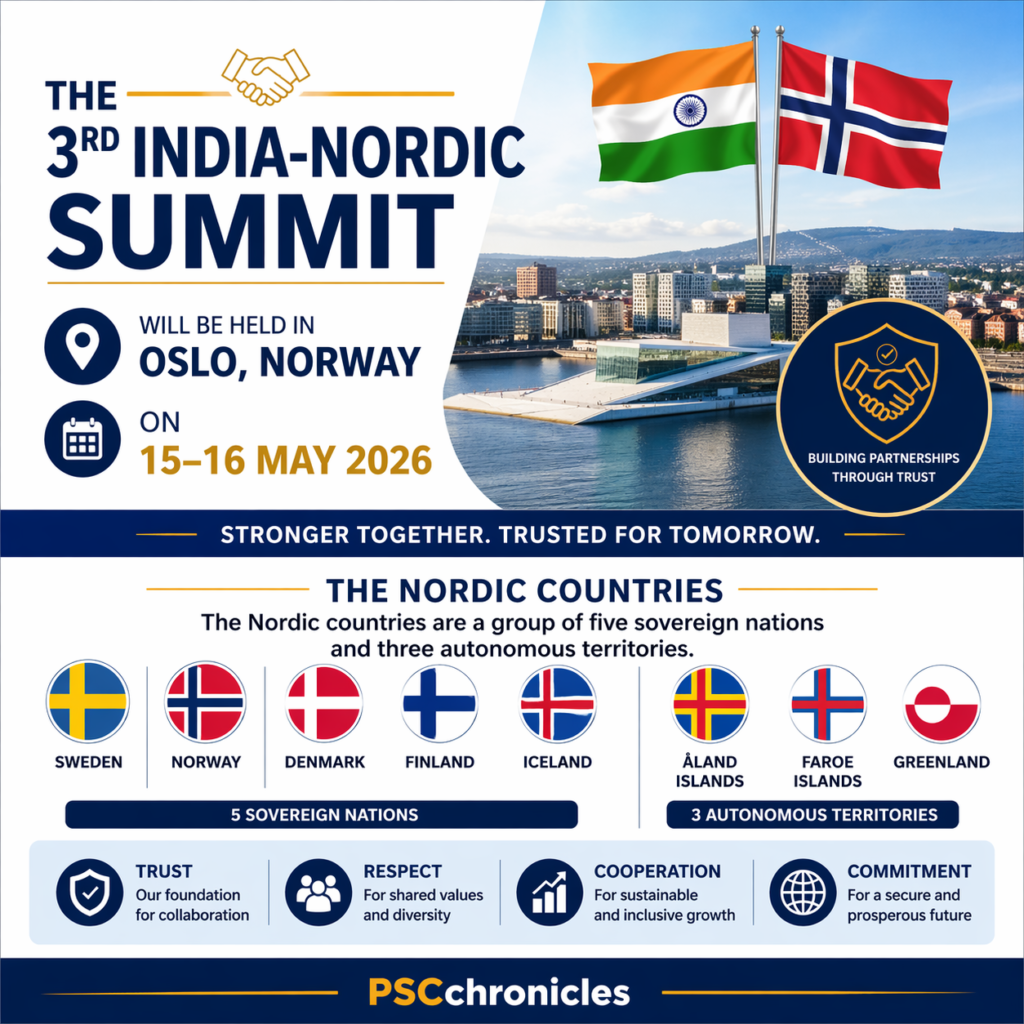
The 3rd India-Nordic Summit will be held in Oslo, Norway, on 15–16 May 2026. It aims to strengthen cooperation between India and Nordic nations in emerging global sectors such as sustainability, climate change, and Arctic governance
What is the India-Nordic Summit?
A high-level diplomatic platform between India and Nordic countries
Focuses on economic, technological, and environmental cooperation
Previous summits:
1st Summit – 2018 (Stockholm)
2nd Summit – 2022 (Virtual)
Nordic Countries
Nordic countries refer to a region in Northern Europe and the North Atlantic, comprising five sovereign states—Denmark, Finland, Iceland, Norway, and Sweden—along with the autonomous territories of Greenland, the Faroe Islands, and Åland.
They share common history, cultural values, close political cooperation, and a strong, tax-funded welfare model.
To study International issues from exam point of view, Click here
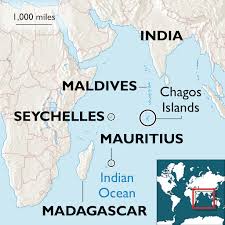
United Kingdom has paused its plan to transfer sovereignty of the Chagos Islands to Mauritius due to concerns raised by the United States.
Historical Background
1965: UK separated Chagos Islands from Mauritius before its independence
Created a new territory called British Indian Ocean Territory (BIOT)
1968–1973: Around 2,000 Chagossians were forcibly displaced to Mauritius and Seychelles
Purpose: Establish a joint UK-US military base at Diego Garcia
In 2019, the International Court of Justice ruled:
Separation of Chagos Islands from Mauritius was illegal
UK should end its administration “as rapidly as possible”
UN General Assembly also supported Mauritius’ claim
UK had earlier agreed in principle to transfer sovereignty to Mauritius However, the plan is now paused due to lack of formal approval from the United States.
To study Current affairs related to international issues, Click here
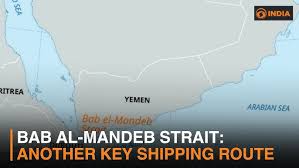
Iran has warned that its regional allies may block the Bab al-Mandeb Strait, escalating tensions in a crucial global maritime route. This comes amid disruptions already seen in the Strait of Hormuz, raising serious concerns about global trade and energy security.
Bab al-Mandeb Strait
The Bab al-Mandeb Strait, meaning “Gate of Tears” in Arabic, is a vital maritime chokepoint.
Connects:
Red Sea (northwest)
Gulf of Aden & Indian Ocean (southeast)
Bordering Countries:
Yemen (Arabian Peninsula – Northeast)
Djibouti & Eritrea (Africa – Southwest)
Strategic & Economic Importance
Global Trade Route
Acts as a key link between:
Mediterranean Sea → Suez Canal → Red Sea → Indian Ocean
Essential for trade between Europe, Asia, and Africa
Energy Security
Around 12% of global seaborne oil trade passes through
About 8% of global LNG shipments transit this route
Impact of Possible Closure
Ships may reroute via Cape of Good Hope (South Africa)
Leads to: Longer travel time, Higher fuel and logistics costs and worsen inflation and energy crisis globally
For more current affairs on International relations, Click here
The Ministry of Home Affairs has released PRAHAAR, India’s first comprehensive National Counter-Terrorism Policy and Strategy. It introduces a “zero tolerance” approach and shifts India toward a proactive, intelligence-led security framework.