Why in News?
The AP BC Reservation Commission 2026, headed by Rajeev Ranjan Mishra, is expected to submit its report to the Andhra Pradesh government by July 15, 2026
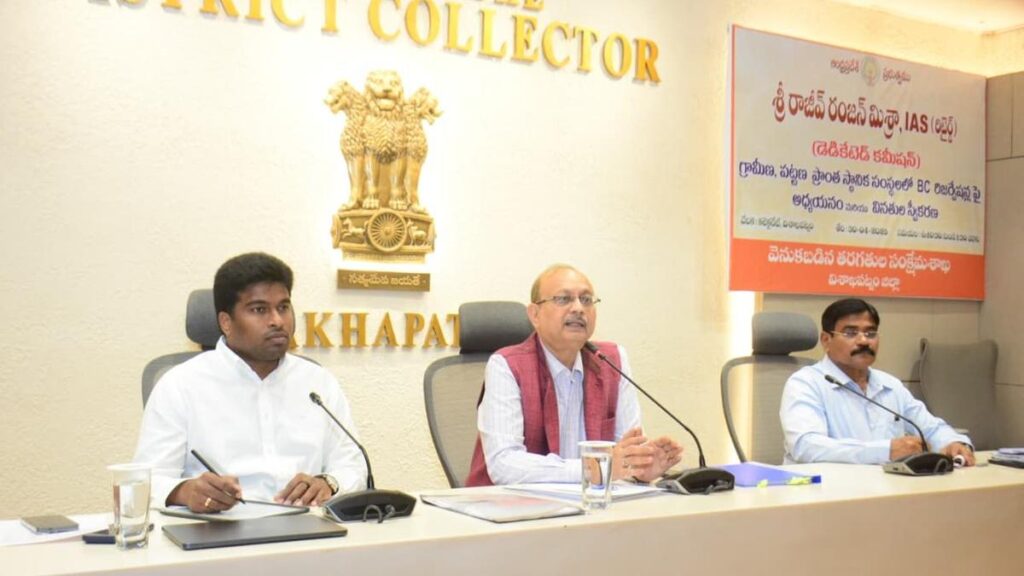
- The single-member commission was constituted to conduct an empirical study on the nature and extent of backwardness among Backward Classes (BCs) for determining political reservations in local body elections.
- The exercise assumes significance as the state government seeks to provide 34% reservation for BCs in local self-government institutions.
Its key tasks include:
- Assessing the socio-economic status of BC communities.
- Determining the BC population ratio in constituencies.
- Providing data to justify political reservations in local body elections.
- Ensuring compliance with Supreme Court guidelines on reservation policies.
Interconnected concept: Triple Test
The “Triple Test” is a three-condition procedural framework mandated by the Supreme Court of India that a state government must satisfy before providing Other Backward Classes (OBC) reservations in local body elections (panchayats and municipalities)
The concept was first outlined by a Constitution Bench in the case of K. Krishna Murthy v. Union of India (2010) and later solidified as a mandatory rule in Vikas Kishanrao Gawali v. State of Maharashtra (2021)
- Set up a dedicated Commission: States must appoint a special committee to conduct a rigorous empirical inquiry into the nature and implications of backwardness in local bodies.
- Specify proportion of reservation: States must specify the exact quota required for each local body based on the Commission’s data to avoid aggregate over-reservation.
- Adhere to the 50% cap: The total reservation for Scheduled Castes (SCs), Scheduled Tribes (STs), and OBCs combined must not exceed 50% of the total seats
The AP BC Reservation Commission 2026 has been constituted to fulfill the first requirement of the Triple Test.
Constitutional Basis
Political reservations in Panchayats and Municipalities are governed by:
- Article 243D – Reservation in Panchayats.
- Article 243T – Reservation in Municipalities.
Quick revision
| Topic | Fact |
|---|---|
| Commission Name | Rajeev Ranjan Mishra Commission |
| Objective | Empirical study on Backward Classes (BCs) |
| Purpose | Determine BC reservations in local body elections |
| Proposed BC Reservation | 34% |
| Legal Requirement | Compliance with Supreme Court’s Triple Test |
| Triple Test – Step 1 | Dedicated Commission for empirical inquiry |
| Triple Test – Step 2 | Reservation proportion based on Commission recommendations |
| Triple Test – Step 3 | Total SC/ST/OBC reservations not to exceed 50% |
| Constitutional Provision (Panchayats) | Article 243D |
| Constitutional Provision (Municipalities) | Article 243T |
| Key Data Collected | BC population ratio and socio-economic status |
| Importance | Provides legal basis for BC political reservations |
Q1. The Rajeev Ranjan Mishra Commission (AP BC Reservation commission 2026) in Andhra Pradesh was constituted primarily for which purpose?
a) Delimitation of constituencies
b) BC reservation empirical study
c) Caste census
d) Municipal finance reforms
Answer: (b) BC reservation empirical study — The commission was formed to assess backwardness for local body reservations.
Q2. Which constitutional provision deals with reservation in Panchayats?
a) Article 243G
b) Article 243W
c) Article 243D
d) Article 280
Answer: (c) Article 243D — It provides for reservations in Panchayats.
Q3. The first condition of the Triple Test requires:
a) State-wide caste census
b) Parliamentary approval
c) Dedicated commission and empirical inquiry
d) Constitutional amendment
Answer: (c) Dedicated commission and empirical inquiry — This is the first requirement laid down by the Supreme Court.
Q4. The AP government aims to provide what percentage of reservation for BCs in local bodies?
a) 27%
b) 30%
c) 34%
d) 50%
Answer: (c) 34% — The proposed reservation is 34%.
To study current affairs from exam point of view, Click here
To know more about Triple test click here