📰 Today's Current AffairsRead Now →
📷 Follow on Instagram

Supreme court of India Practice Questions for UPSC and State PSC exams

Supreme court -Practice Questions

1. Supreme Court of India was established under:


2. Original Constitution provided for Supreme Court with:


3. Present sanctioned strength of Supreme Court (2026) is:


4. Judges of Supreme Court are appointed by President under Article:


5. Minimum qualifications for SC judge under Article 124(3):


6. Retirement age of Supreme Court judge:


7. Oath of Supreme Court judge is administered by:


8. Salary of SC judges is charged upon:


9. Procedure for removal of SC judge is given in:


10. Special majority for removal means:


11. First judge against whom impeachment motion was moved:


12. Collegium system for appointments was propounded in:


13. Third Judges Case (1998) expanded collegium to:


14. NJAC was struck down in:


15. 99th Constitutional Amendment Act related to:


16. Supreme Court is a Court of Record under:


17. Power to punish for contempt includes:


18. Original jurisdiction of SC under Article 131 covers disputes between:


19. Article 131 does NOT cover:


20. Writ jurisdiction of Supreme Court is under:


21. High Courts’ writ jurisdiction is under:


22. Supreme Court’s appellate jurisdiction in constitutional matters is under:


23. Civil appeals lie under Article 133 if:


24. Criminal appeals to SC under Article 134 include:


25. Special Leave Petition is under:


26. Article 136 is:


27. Advisory jurisdiction is under:


28. In re Kerala Education Bill (1958) and Ayodhya (1993) are examples of:


29. Power of review is under:


30. Curative petition was evolved in:


31. Power to do complete justice is under:


32. Law declared by SC is binding on all courts under:


33. All authorities shall act in aid of SC under:


34. SC can transfer cases between High Courts under:


35. Seat of Supreme Court is in Delhi under Article:


36. Acting Chief Justice is appointed under:


37. Ad hoc judges can be appointed under Article 127 when:


38. Retired SC/HC judges may sit under Article 128:


39. Supreme Court Rules are made under:


40. Minimum number of judges to decide substantial constitutional question under Article 145(3):


41. Master of Roster is:


42. First Chief Justice of India:


43. First woman judge of Supreme Court:


44. Longest serving Chief Justice:


45. Shortest tenure CJI:


46. Current Chief Justice as of April 2026:


47. First Dalit Chief Justice:


48. Supreme Court’s power of judicial review is based on:


49. Basic Structure doctrine propounded in:


50. Public Interest Litigation in India was pioneered by:


51. Minerva Mills case (1980) reaffirmed:


52. Supreme Court can issue writs for:


53. Which writ means ‘to have the body’?


54. Mandamus means:


55. Certiorari is issued to:


56. Prohibition is issued to:


57. Quo Warranto means:


58. Contempt of Court Act was enacted in:


59. Supreme Court’s jurisdiction over tribunals:


60. Independence of judiciary ensured by:


61. Judges’ conduct cannot be discussed in Parliament except on removal motion under:


62. Article 71 gives SC jurisdiction over:


63. First woman to be appointed directly from bar to SC:


64. Supreme Court’s power to grant bail under Article 136 is:


65. Doctrine of prospective overruling first applied in:


66. Largest bench in SC history:


67. Supreme Court established Fast Track Special Courts monitoring under Article 142 in:


68. Supreme Court Legal Services Committee provides:


69. Who administers oath to President?


70. Supreme Court can sit in benches to decide cases involving interpretation of Constitution with minimum:


71. Appeal against SC judgment lies to:


72. Independence of SC judges protected from post-retirement appointments except:


73. First SC judgment delivered on:


74. Supreme Court’s emblem features:


75. Language of Supreme Court proceedings under Article 348:


76. Supreme Court can make rules for:


77. Public Interest Litigation relaxation of locus standi means:


78. Supreme Court collegium for HC transfers includes:


79. Supreme Court declared right to privacy as fundamental right in:


80. Supreme Court struck down Section 66A IT Act in:


81. Navtej Singh Johar case (2018) decriminalized:


82. Joseph Shine case (2018) struck down:


83. Supreme Court upheld abrogation of Article 370 in:


84. Supreme Court’s power under Article 142 cannot:


85. Salaries of judges are determined by:


86. Supreme Court has power to review its own judgment within:


87. Curative petition must be certified by:


88. Supreme Court exercises superintendence over:


89. Transfer of judges from one HC to another is made by President after consultation with:


90. Supreme Court’s judgment in S.P. Gupta (First Judges) held:


91. Second Judges Case overruled S.P. Gupta and established:


92. Supreme Court can issue directions to government under Article 142 in matters of:


93. Supreme Court Legal Aid is available to persons with annual income less than:


94. Supreme Court’s contempt power is:


95. Appeal by special leave can be filed against:


96. Supreme Court’s decision in Indira Gandhi v Raj Narain (1975) related to:


97. Supreme Court sits in benches to decide cases involving interpretation of Constitution with minimum:


98. First sitting of Supreme Court after inauguration was presided by:


99. Supreme Court has power to do complete justice even if it requires:


100. Supreme Court’s registry is headed by:


Supreme court of India-MCQs

To study more current affairs from exam point of view, Click here

To practice more Questions from exam point of view, Click here
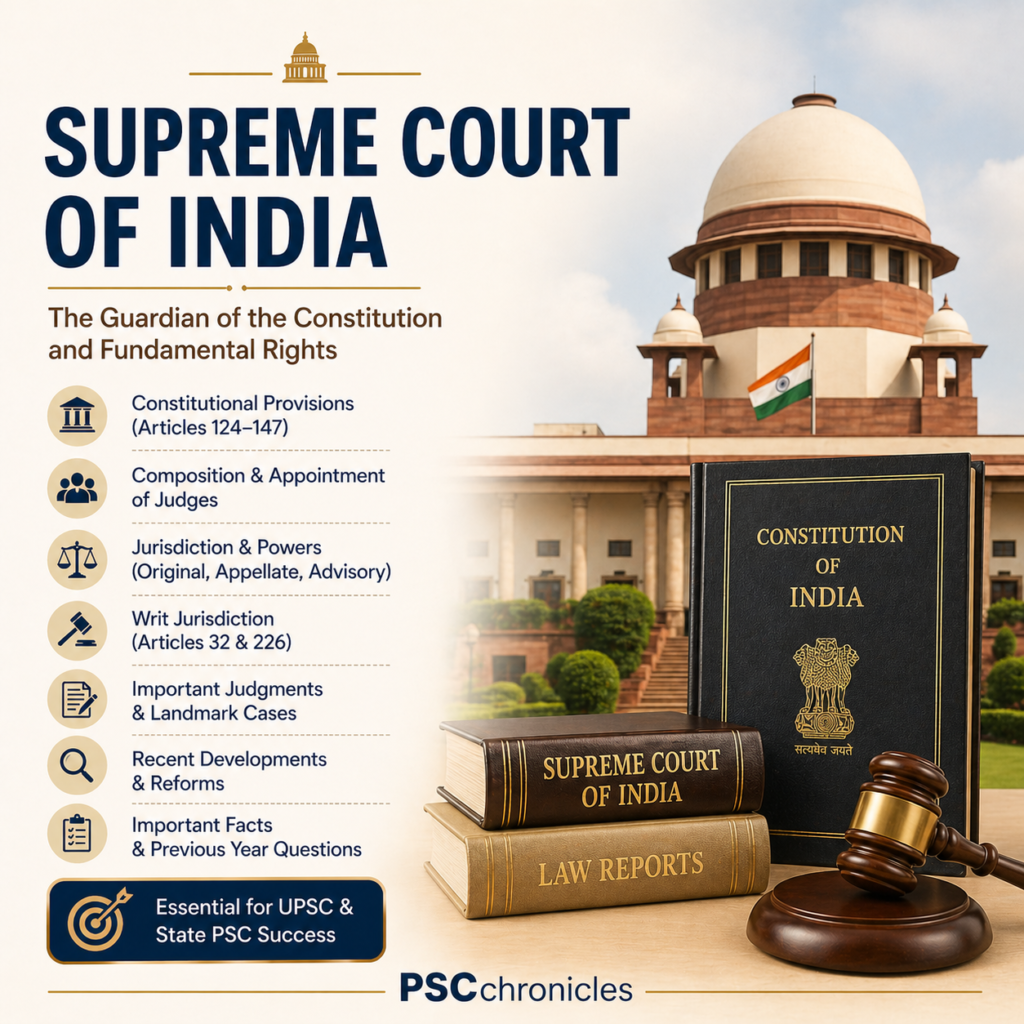
supreme court mcqs

Leave a Comment

Your email address will not be published. Required fields are marked *