📰 Today's Current Affairs — Read Now →
📷 Follow on Instagram

Daily Current Affairs

GEF Approves $372 Million for Biodiversity Projects

Why in News?

The Global Environment Facility (GEF) has approved $372 million funding for 36 environmental projects in developing countries. The move supports global efforts to achieve biodiversity targets under the Kunming-Montreal Global Biodiversity Framework (2022)

global environment facility

Global Environment Facility:

Established in 1991, the Global Environment Facility (GEF) is the world’s largest multilateral fund dedicated to the environment. It serves as an independent financial mechanism for several major international conventions, helping developing countries and transition economies address urgent environmental challenges. 

GEF Supports 5 Major International Conventions:

  • Convention on Biological Diversity (CBD)
  • UN Framework Convention on Climate Change (UNFCCC)
  • UN Convention to Combat Desertification (UNCCD)
  • Stockholm Convention on Persistent Organic Pollutants (POPs)
  • Minamata Convention on Mercury

Kunming-Montreal Global Biodiversity Framework (KMGBF):

Kunming-Montreal Global Biodiversity Framework (KMGBF), also known as The Biodiversity Plan, is a landmark international agreement adopted on 19 December 2022 during the 15th Conference of the Parties (COP15) to the UN Convention on Biological Diversity (CBD). It is often described as the “Paris Agreement for Nature,” serving as the global roadmap to halt and reverse biodiversity loss by 2030

It has four global goals:

  • Restore and protect ecosystems & species
  • Ensure sustainable use of biodiversity
  • Fair and equitable sharing of genetic resource benefits
  • Mobilize finance, technology, and capacity-building
Exam Tip

KMGBF = 4 Goals (2050) + 23 Targets (2030) + 30×30 Target

https://www.downtoearth.org.in/wildlife-biodiversity/gef-clears-372-million-for-environment-projects-biodiversity-in-sharp-focus: GEF Approves $372 Million for Biodiversity Projects

GEF Approves $372 Million for Biodiversity Projects Read More »
High Seas Treaty -Biodiversity Beyond National Jurisdiction (BBNJ), enters into force:

Why in News?

The High Seas Treaty, officially called the Biodiversity Beyond National Jurisdiction (BBNJ) Agreement, came into force on 17 January 2026. It is the first legally binding global agreement aimed at protecting marine biodiversity in areas beyond national jurisdiction

bbnj

Biodiversity Beyond National Jurisdiction (BBNJ) Agreement:

Biodiversity Beyond National Jurisdiction (BBNJ) Agreement, also known as the High Seas Treaty, is a legally binding international treaty under the United Nations Convention on the Law of the Sea (UNCLOS) designed to ensure the conservation and sustainable use of marine life in international waters

The agreement has four main pillars:

  • Marine Genetic Resources (MGRs): Ensures fair sharing of benefits (monetary and non-monetary) from marine resources in international waters.
  • Area-Based Management Tools (ABMTs): Enables creation of Marine Protected Areas (MPAs) to help achieve the 30% ocean protection target by 2030.
  • Environmental Impact Assessments (EIAs): Establishes global norms to assess environmental impacts of activities in the high seas.
  • Capacity Building & Technology Transfer: Supports developing countries in marine research and sustainable use of ocean resources.
https://www.pib.gov.in/PressReleaseIframePage.aspx?PRID=2031611&reg=3&lang=2#:~:text=Press%20Release:Press%20Information%20Bureau,implementation%20of%20the%20BBNJ%20Agreement.: High Seas Treaty -Biodiversity Beyond National Jurisdiction (BBNJ), enters into force:

High Seas Treaty -Biodiversity Beyond National Jurisdiction (BBNJ), enters into force: Read More »

Mission Sudarshan Chakra: India Building Counter-Drone Grid

Why in News?

India is developing a joint Counter Unmanned Aerial Systems (CUAS) grid to tackle rising threats from hostile and rogue drones. This initiative is part of the broader Mission Sudarshan Chakra, aimed at strengthening India’s air defence network.

mission sudarshan chakra

Mission Sudarshan Chakra:

Mission Sudarshan Chakra is a comprehensive 10-year national security initiative launched by Prime Minister Narendra Modi on August 15, 2025, during the 79th Independence Day address. It aims to build an indigenous, AI-enabled, multi-layered air and missile defence shield for India by 2035.

It consists of Multi-Layer Interceptor Systems. They are

  • Project Kusha: An indigenous Long-Range Surface-to-Air Missile (LRSAM) system featuring three missile variants—M1 (150 km), M2 (250 km), and M3 (350–400 km)—designed to rival the S-400.
  • Ballistic Missile Defence (BMD): A two-tier system for tracking and destroying ballistic missiles both inside (endo) and outside (exo) the atmosphere.
  • Integrated Air Defence Weapon System (IADWS): A tactical layer consisting of QRSAM (Quick Reaction SAM), VSHORADS (Very Short Range), and 5 kW laser-based Directed Energy Weapons (DEW).
Exam Tip:

Mission Sudarshan Chakra = India’s version of multi-layered air defence shield

https://indianexpress.com/article/india/drdo-air-defence-system-mission-sudarshan-chakra-10208827/: Mission Sudarshan Chakra: India Building Counter-Drone Grid

Mission Sudarshan Chakra: India Building Counter-Drone Grid Read More »

President Murmu Undertakes Submarine Sortie on INS Vagsheer

Why in News?

President Droupadi Murmu undertook a historic submarine sortie aboard INS Vagsheer at Karwar Naval Base. She became only the second Indian President after Dr. APJ Abdul Kalam (2006) to experience a submarine dive.

president sorties ins vaghasheer

INS Vagsheer:

  • Sixth and final submarine of Project-75 (Kalvari-class).
  • Built by Mazagon Dock Shipbuilders Limited (MDL), Mumbai Technology collaboration with Naval Group, France

Background: Project -75 (Kalvari-Class Submarines)

Project-75 (P-75) is a major Indian Navy program for the indigenous construction of six Kalvari-class diesel-electric attack submarines. These vessels are based on the Scorpène-class design from the French firm Naval Group (formerly DCNS) and were built at Mazagon Dock Shipbuilders Limited (MDL) in Mumbai through a Transfer of Technology (ToT) agreement

The list of Six submarines are:

  • INS Kalvari (2017)
  • INS Khanderi (2019)
  • INS Karanj (2021)
  • INS Vela (2021)
  • INS Vagir (2023)
  • INS Vagsheer (2025)
Exam Tip:

Project-75 = Kalvari-class submarines (6 total)

Kalvari-class = Diesel-electric (NOT nuclear submarines)

https://www.pib.gov.in/PressReleasePage.aspx?PRID=2209213&reg=3&lang=2: President Murmu Undertakes Submarine Sortie on INS Vagsheer

President Murmu Undertakes Submarine Sortie on INS Vagsheer Read More »

PSLV-C62 / EOS-N1 mission failed due to anomaly during upper-stage flight:

Why in News?

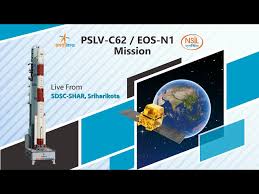
The PSLV-C62 mission carrying the EOS-N1 satellite was declared unsuccessful due to an anomaly during the upper-stage flight. This raises concerns as it is the second consecutive failure of PSLV, India’s trusted launch vehicle

pslv c62

Key Highlights:

  • Mission Name: PSLV-C62
  • Launch Vehicle: Polar Satellite Launch Vehicle (PSLV)
  • Payload: 16 satellites
  • Main Satellite: EOS-N1 (Anvesha)
  • Failure Reason: Anomaly during upper-stage flight (PS4 stage)
  • Previous Failure: PSLV-C61 (May 2025, third-stage issue)
EOS-N1 (Anvesha)

EOS-N1, also known as Anvesha, was a highly advanced hyperspectral Earth-observation satellite developed by DRDO.  
It was intended to serve as a critical strategic asset for national security, capable of “seeing” through camouflage by identifying materials based on their unique spectral fingerprints.

Exam Tip:

Remember: PSLV = 4 stages → Solid + Liquid + Solid + Liquid

https://theprint.in/science/isro-pslv-c62-eos-n1-satellite/2825191/: PSLV-C62 / EOS-N1 mission failed due to anomaly during upper-stage flight:

PSLV-C62 / EOS-N1 mission failed due to anomaly during upper-stage flight: Read More »

India to Establish First State-Funded BSL-4 Lab in Gujarat

Why in News?

Union Home Minister laid the foundation stone for a Bio-Safety Level 4 (BSL-4) Containment Facility in Gandhinagar, Gujarat, marking a significant step in strengthening India’s high-risk pathogen research infrastructure.

bsl

Biosafety levels: Explained

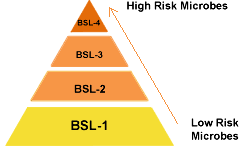
  • BSL-1 (Lowest Level): Handles organisms that do not cause disease in healthy humans, such as non-pathogenic E. coli. Standard precautions like hand hygiene and basic protective gear are sufficient.
  • BSL-2: Deals with pathogens causing moderate illness (e.g., Staphylococcus aureus, Hepatitis viruses). Requires restricted access, proper waste management, PPE, and biosafety cabinets.
  • BSL-3: Involves pathogens that can cause severe or potentially fatal diseases and spread through aerosols, such as Mycobacterium tuberculosis, SARS-CoV, and MERS-CoV. Enhanced containment and ventilation systems are essential.
  • BSL-4 (Highest Level): Reserved for highly dangerous pathogens with high fatality rates and no available treatment, such as Ebola and Marburg viruses. These labs feature complete isolation, full-body positive-pressure suits, and stringent decontamination protocols.

Biosafety level laboratories are specifically designed to study the world’s most dangerous and highly infectious pathogens, many of which have no known vaccines or effective treatments.

Exam Tip

Remember the sequence: BSL-1 → BSL-2 → BSL-3 → BSL-4 (increasing risk and containment)

https://indianexpress.com/article/explained/explained-health/gujarat-bsl-4-lab-10474986/: India to Establish First State-Funded BSL-4 Lab in Gujarat

India to Establish First State-Funded BSL-4 Lab in Gujarat Read More »

🇮🇳 First ‘Made in India’ C-295 Aircraft to Roll Out Soon

Why in News?

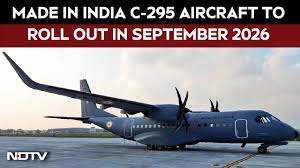
The first ‘Made in India’ C-295 military transport aircraft is expected to roll out before September. This marks a major milestone in India’s defence indigenisation and Make in India initiative.

c 295 aircraft

Key Highlights:

The ‘Made in India’ C-295 programme represents a major milestone in defence manufacturing, as it marks the first instance of a complete military aircraft being produced in India by a private company, Tata Advanced Systems Limited (TASL).

  • India signed a ₹21,935 crore deal in 2021 with Airbus Defence and Space to procure 56 C-295 aircraft. The project is a joint collaboration between Airbus and TASL.
  • 16 aircraft will be delivered in fly-away condition from Spain. The remaining 40 aircraft will be manufactured in India by Tata Advanced Systems Limited (TASL).
  • This is the first time a private Indian company is manufacturing a complete military aircraft in India.
  • The manufacturing facility is located in Vadodara, Gujarat.
Background:

The C-295 aircraft is a medium tactical transport aircraft used for logistics, troop transport, and medical evacuation. It will replace the ageing Avro aircraft of the Indian Air Force (IAF)

https://indianexpress.com/article/explained/made-in-india-c295-aircraft-defence-capabilities-10491194/: 🇮🇳 First ‘Made in India’ C-295 Aircraft to Roll Out Soon

🇮🇳 First ‘Made in India’ C-295 Aircraft to Roll Out Soon Read More »

SHANTI Bill Passed by Parliament to Reform Nuclear Law

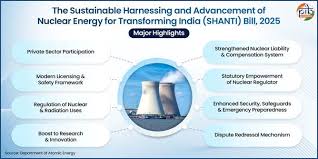
Parliament has cleared the Sustainable Harnessing and Advancement of Nuclear Energy in India (SHANTI) Bill.

shanti bill

key features

  • Opening of Nuclear Sector: The SHANTI Bill brings a major shift by allowing private and foreign participation in India’s nuclear power sector, which was earlier fully controlled by the government
  • Private Participation & Licensing: Under the Bill, private Indian companies can now obtain licences to build, own, and operate nuclear power plants. It also permits foreign suppliers to participate in the sector
  • Government Control & Ownership Pattern: The Bill allows up to 49% private participation, while ensuring 51% government control over critical areas such as: Nuclear fuel production, Heavy water manufacturing etc
  • End of NPCIL Monopoly: Earlier, the Nuclear Power Corporation of India Limited (NPCIL) had exclusive control over nuclear plant operations. The Bill removes this monopoly and allows private players and joint ventures to operate nuclear power plants
  • Liability Provisions

₹3,000 crore → Large plants (3600 MW)
₹1,500 crore → Medium plants (1500–3600 MW)
₹100 crore → Small Modular Reactors (150 MW)

Exam Tip:

SHANTI Bill = Private entry + End of NPCIL monopoly + SMRs + Fixed liability

https://www.pib.gov.in/PressNoteDetails.aspx?NoteId=156593&ModuleId=3&reg=3&lang=2: SHANTI Bill Passed by Parliament to Reform Nuclear Law

SHANTI Bill Passed by Parliament to Reform Nuclear Law Read More »

Isro successfully fires improved 3rd stage of SSLV rocket

Why in News?

ISRO successfully tested an improved version of the third stage (SS3) of its Small Satellite Launch Vehicle (SSLV).

sslv

SSLV

The SSLV is a three-stage, all-solid launch vehicle developed by ISRO. It is specifically designed to provide cost-effective, on-demand launch services for small satellites (10 kg to 500 kg) into Low Earth Orbit (LEO).

Payload CapacityUp to 500 kg to 500 km planar orbit; 300 kg to Sun-Synchronous Orbit (SSO).
Stages3 stages (all solid fuel) + a liquid-based Velocity Trimming Module (VTM) for precise orbit injection
Integration TimeQuick turnaround of 72 hours (vs. 70 days for PSLV).
ManpowerCan be integrated by a team of only 6 people.
Exam TIP
  • Remember the difference:
    SSLV → Small satellites, low cost, quick launch
    PSLV → Polar missions, versatile
    GSLV → Heavy payloads, geostationary orbit
https://www.indiatoday.in/science/story/isro-successfully-fires-improved-third-stage-of-newly-developed-sslv-rocket-2844418-2025-12-31: Isro successfully fires improved 3rd stage of SSLV rocket

Isro successfully fires improved 3rd stage of SSLV rocket Read More »

Reservation in Private Colleges: Article 15(5)

Why in News?

The Opposition, led by Congress, has demanded that the Centre ensure proper implementation of reservation policies in private educational institutions. It emphasized that regulatory bodies in higher education must monitor the enforcement of Article 15(5) of the Constitution.

article 15 (5)

Concepts from exam Point of view:

Article 15(5) of the Indian Constitution, added by the 93rd Amendment in 2005, empowers the state to make special provisions—including reservations—for the admission of socially and educationally backward classes, Scheduled Castes (SCs), and Scheduled Tribes (STs) in educational institutions, including private unaided institutions, excluding minority schools.

  • Exclusion: It explicitly excludes minority educational institutions referred to in Article 30(1).

Article 15(6), inserted by the 103rd Constitutional Amendment Act, 2019, enables special provisions (reservation) for Economically Weaker Sections (EWS).

  • It allows up to 10% reservation in educational institutions (including private, aided/unaided) except minority institutions. This is in addition to existing reservations, specifically targeting those not covered by 15(4) or 15(5).
https://www.thehindu.com/news/national/any-higher-education-regulator-must-oversee-article-155-implementation-says-congress/article70529251.ece: Reservation in Private Colleges: Article 15(5)

Reservation in Private Colleges: Article 15(5) Read More »