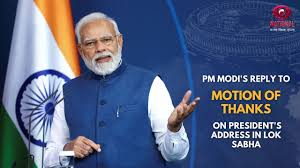
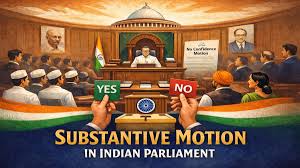
The Lok Sabha passed the Motion of Thanks on the President’s Address without a reply from Prime Minister. This happened amid continuous protests by the Opposition, making it an unusual parliamentary development.
Key Highlights
Motion of Thanks passed in Lok Sabha without the Prime Minister’s customary reply.
Normally, the PM responds to debates before the motion is put to vote.
Opposition protests disrupted proceedings.
Despite disruptions, the motion was adopted by majority.
What is Motion of Thanks?
A formal parliamentary motion expressing gratitude to the President for the address. Moved in:
Droupadi Murmu addressed the joint sitting of Parliament at the beginning of the Budget Session 2026. The address outlined the government’s roadmap for achieving a Viksit Bharat and highlighted major policy priorities
President’s Address – Constitutional Basis
Governed by:
Article 87
Mandatory occasions:
First session after general elections to Lok Sabha
First session of each year (Budget Session)
Purpose:
Outlines government policies, achievements, and future agenda
Acts as a policy direction statement for Parliament
The 23rd Foundation Day of the National Commission for Scheduled Tribes (NCST) was recently celebrated in New Delhi. It highlights the role of NCST in protecting the rights of Scheduled Tribes (STs) in India.
National Commission for Scheduled Tribes
NCST is a constitutional body established under Article 338A of the Indian Constitution.
It works for the protection, welfare, and development of Scheduled Tribes.
Formed after the Constitution (89th Amendment) Act, 2003.
Separation of Commissions (2003):
Earlier: A single body for SCs & STs
After Amendment:
National Commission for Scheduled Castes (NCSC) – Article 338
National Commission for Scheduled Tribes (NCST) – Article 338A
Composition of NCST:
Chairperson
Vice-Chairperson
3 other Members
Appointment & Tenure:
Appointed by the President of India
Tenure: 3 years
Functions of NCST
Investigate and monitor safeguards for STs
Inquire into complaints regarding deprivation of rights
Advise on planning process for socio-economic development
The Supreme Court of India has scheduled final hearings from May 5, 2026 on more than 250 petitions challenging the Citizenship (Amendment) Act, 2019 (CAA). The petitions question the constitutional validity of the Act, especially on grounds of alleged religious discrimination.
Key Highlights:
The CAA amends the Citizenship Act, 1955.
It provides fast-track Indian citizenship to certain migrants facing religious persecution.
Eligible communities: Hindus, Sikhs, Buddhists, Jains, Parsis, and Christians.
Countries covered: Afghanistan, Bangladesh, and Pakistan.
Cut-off date: Migrants must have entered India on or before 31 December 2014.
It reduces the residency requirement for citizenship from 11 years to 5 years for eligible migrants.
Over 250 petitions challenge the Act’s constitutionality, mainly citing violation of Article 14 (Right to Equality). The Supreme Court will now conduct final hearings, which could have major constitutional implications
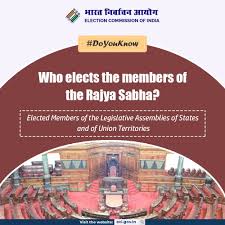
The Election Commission of India (ECI) has issued notification for elections to 37 Rajya Sabha seats, with polling scheduled in March 2026, as the terms of these members are expiring in April.
Rajya Sabha – Key Features:
Maximum Strength: 245 members
233 elected from States & UTs
12 nominated by the President
Nature of House:
Permanent body (cannot be dissolved)
Ensures continuity in Parliament
Tenure:
Each member serves 6 years
1/3rd members retire every 2 years (biennial elections)
Based on Article 83(1)
Composition & Representation:
Allocation of seats is based on population.
Governed by the Fourth Schedule of the Constitution.
Nominated Members (Article 80(3)):
12 members nominated by the President of India.
Chosen from fields like:
Literature
Science
Art
Social Service
They may join a political party within 6 months of taking their seat
The Supreme Court has asked the Union Government to submit a report on actions taken following its landmark 2024 Constitution Bench verdict allowing sub-classification within SC/ST categories for reservation.
SC/ST sub-classification:
SC/ST sub-classification is the process of dividing the Scheduled Castes (SC) or Scheduled Tribes (ST) categories into smaller sub-groups to ensure that reservation benefits reach the most disadvantaged communities within them
This concept, often called “quota within a quota,” was validated by a landmark 6:1 majority ruling of a seven-judge Supreme Court bench in August 2024 in the case of State of Punjab v. Davinder Singh
What is the Supreme Court Verdict (2024)?
A 7-judge Constitution Bench upheld the validity of sub-classification within SC/ST categories. It ruled that:
SC/ST groups are not homogeneous.
States can provide preferential treatment to the most backward sub-castes.
The judgment overturned the 2004 E.V. Chinnaiah case, which had disallowed such sub-classification.
Constitutional Provisions Involved:
Article 341 – Scheduled Castes
Empowers the President to notify SCs for each State/UT.
Done in consultation with the Governor.
Parliament alone can modify the list (include/exclude groups).
Key Clarification by Supreme Court:
Article 341 defines who is included in SC list.
It does not prevent internal classification for reservation benefits.
Sub-classification does not violate Article 14 (Right to Equality)
The 16th Finance Commission (16th FC), chaired by Arvind Panagariya, tabled its report for the award period 2026–2031. The central highlight is the retention of 41% vertical devolution of central taxes to states while introducing a landmark 10% weightage for GDP contribution in the horizontal distribution formula
Key Highlights:
Vertical Devolution:
vertical devolution refers to the distribution of the net proceeds of central taxes between the Union (Central) government and all the State governments collectively
Retained at 41% of the divisible tax pool (same as 15th Finance Commission).
Applicable for the award period 2026–31.
Horizontal Devolution Changes:
Horizontal devolution refers to the allocation of central tax revenues among individual states in a federation
Introduction of 10% weightage for GDP contribution.
Aims to reward economically productive and efficient states.
What is Finance commission?
The Finance Commission is a constitutional body under Article 280 of the Indian Constitution. It is constituted every 5 years to recommend:
Distribution of tax revenues between Centre and States (vertical devolution)
Distribution among States (horizontal devolution)
Exam Tip:
Article 280 – Finance Commission.
Difference between vertical & horizontal devolution
The Karnataka Governor has reserved the Karnataka Hate Speech and Hate Crimes (Prevention) Bill, 2025 for the President’s assent, citing constitutional and legal concerns. This brings focus on the Governor’s discretionary powers under the Indian Constitution.
Constitutional Provisions related to governor assent:
In the Indian Constitution, the primary provisions regarding a Governor’s assent to bills passed by the State Legislature are found in Articles 200 and 201. These articles outline the Governor’s choices and the subsequent role of the President
Article 200:
When a Bill is presented, the Governor has four main options:
Grant Assent: The bill becomes law.
Withhold Assent: The bill does not become law; however, recent rulings state this cannot be used indefinitely (the “pocket veto”).
Return the Bill: Non-money bills can be returned for reconsideration “as soon as possible”. If re-passed by the legislature, the Governor must give assent.
Reserve for President: Mandatory if the bill threatens the High Court’s position, or discretionary if it violates the Constitution, DPSP, or national interest.
Article 201:
When a Bill is reserved, the President may assent, withhold assent, or return it for reconsideration (non-money bills). Unlike the Governor, if the state legislature re-passes a bill returned by the President, the President is not obliged to grant assent
Grounds for Reservation of Bills:
he Governor may reserve a bill. If the bill
Endangers the High Court’s powers
Is against constitutional provisions
Falls under matters requiring prior presidential sanction