📰 Today's Current Affairs — Read Now →
📷 Follow on Instagram

Daily Current Affairs

Telangana rolling out 6-Circuit Tourism Strategy 2026

Why in News?

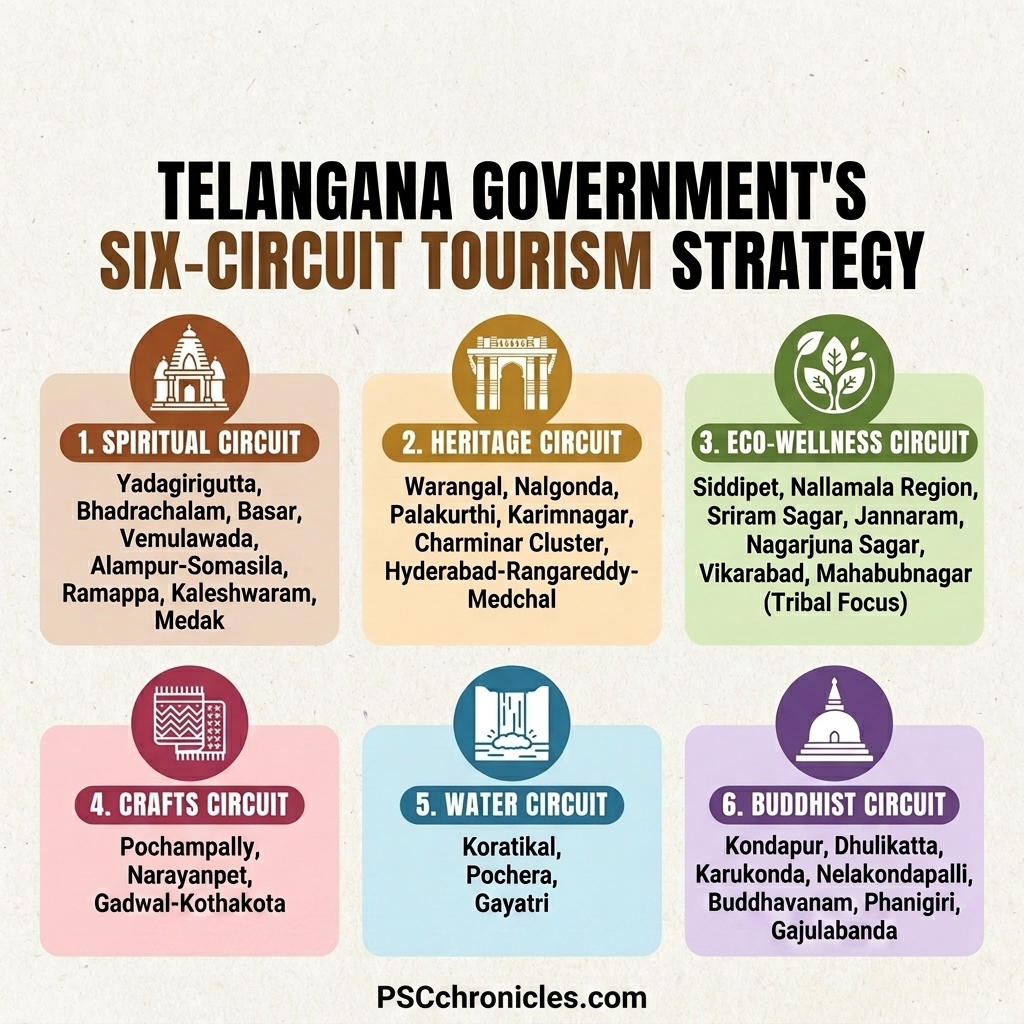
Telangana government has introduced a comprehensive tourism development strategy based on six thematic circuits. The initiative aims to boost tourism, attract investments, and enhance infrastructure, positioning Telangana as a major destination for both domestic and international travelers.
telangana government rolling 202604211603

Six Tourism Circuits Explained

Spiritual Circuit

Focus: Religious tourism and pilgrimage development
Major locations:

  • Yadagirigutta
  • Bhadrachalam
  • Basar
  • Vemulawada
  • Alampur–Somasila
  • Ramappa
  • Kaleshwaram
  • Medak

Heritage Circuit

Focus: Historical monuments and cultural legacy
Key areas:

  • Warangal
  • Nalgonda
  • Palakurthi
  • Karimnagar
  • Charminar cluster
  • Hyderabad–Rangareddy–Medchal region

Eco-Wellness & Tribal Circuit

Focus: Nature tourism and wellness tourism

Eco-Wellness Locations:

  • Siddipet
  • Nallamala region
  • Sriram Sagar
  • Jannaram

Tribal Tourism Locations:

  • Nagarjuna Sagar
  • Vikarabad
  • Mahabubnagar

Crafts Circuit

Focus: Traditional handloom and handicrafts
Key hubs:

  • Pochampally (famous for Ikat)
  • Narayanpet
  • Gadwal–Kothakota

Water Circuit

Focus: Waterfalls and scenic spots
Key locations:

  • Kuntala (Koratikal)
  • Pochera
  • Gayatri waterfalls

Buddhist Circuit

Focus: Ancient Buddhist heritage
Important sites:

  • Kondapur
  • Dhulikatta
  • Karukonda
  • Nelakondapalli
  • Buddhavanam
  • Phanigiri
  • Gajulabanda

To study Telangana current affairs from exam point of view, Click here

Telangana rolling out 6-Circuit Tourism Strategy 2026 Read More »
AP Pashu Kisan Credit Card Scheme 2026 – Explained

Why in News?

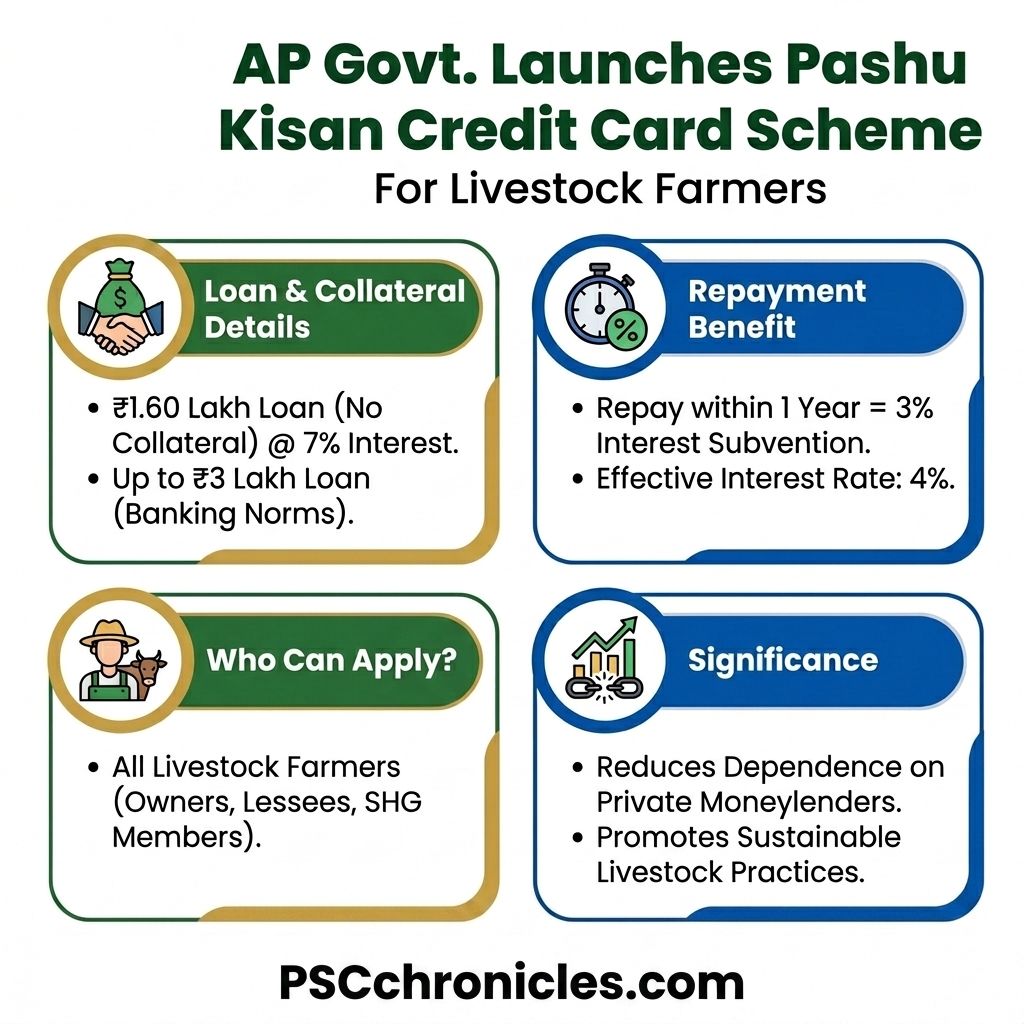
Andhra Pradesh government has introduced the Pashu Kisan Credit Card (PKCC) Scheme to support livestock farmers. This scheme provides easy and affordable credit to improve the animal husbandry sector and reduce financial stress on farmers.

pashu kisan credit 202604210704

PKCC Scheme

  • The PKCC Scheme aims to provide institutional credit to farmers engaged in livestock activities.

Key Features of the Scheme

Loan Facilities
  • Up to ₹1.60 lakh loan without collateral
  • Interest rate: 7% per annum
  • Loans up to ₹3 lakh available as per banking norms
Interest Subvention Benefit
  • Farmers who repay within 1 year get a 3% interest subsidy
  • Effective interest rate reduces to 4%
Eligibility Criteria
  • Open to:
    • Land-owning farmers
    • Tenant farmers
    • Members of Self-Help Groups (SHGs)
Coverage
  • All livestock farmers across Andhra Pradesh can apply

Significance of the Scheme

  • Reduces dependency on private moneylenders
  • Ensures low-interest institutional credit
  • Encourages scientific and sustainable livestock practices
  • Strengthens the rural economy and dairy sector
  • Promotes financial inclusion in agriculture

To study AP current affairs from exam point of view, Click here

AP Pashu Kisan Credit Card Scheme 2026 – Explained Read More »

Parliament Adjourned Sine Die: Key Concepts Explained

Why in News?

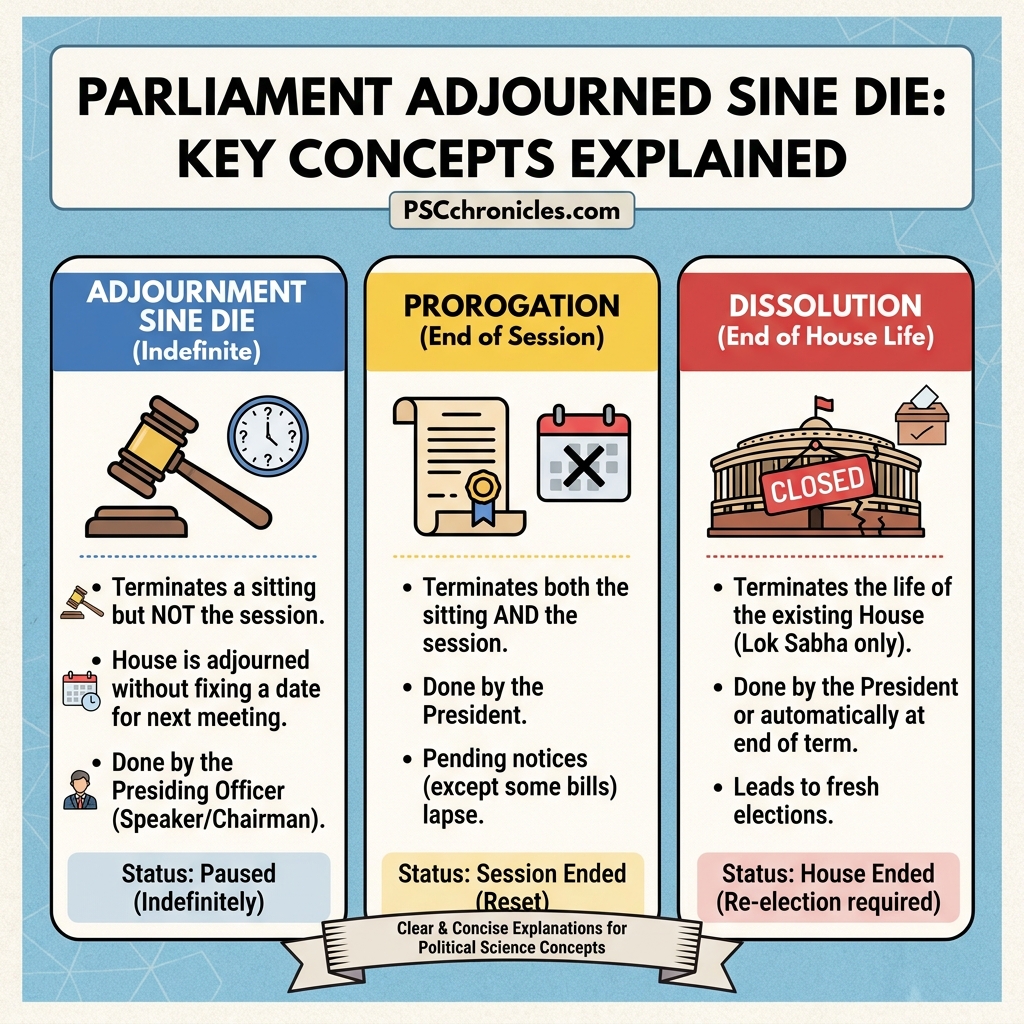
The extended Budget Session of the Indian Parliament was recently adjourned sine die, following the defeat of a key Constitutional Amendment Bill in the Lok Sabha. This development highlights important parliamentary procedures frequently asked in competitive exams.

adjournment sine die

Key Parliamentary Concepts Explained

1. Adjournment Sine Die

  • Meaning: Termination of a sitting of the House without fixing a date for the next meeting.
  • Authority:
    • In Lok Sabha → Lok Sabha Speaker
    • In Rajya Sabha → Rajya Sabha Chairman
  • Important Point:
    • It ends only the sitting, not the entire session.
  • Effect on Bills:
    • Pending Bills and business do NOT lapse.

2. Adjournment

  • Meaning: Suspension of a sitting for a fixed time (hours, days, or weeks).
  • Authority: Presiding Officer of the House.
  • Example: Lunch break or postponement to next day.

3. Prorogation

  • Meaning: Formal termination of a session of Parliament.
  • Authority:
    • President of India
  • Key Feature:
    • Usually occurs after adjournment sine die.
  • Effect on Bills:
    • Bills do NOT lapse (except certain notices).

Comparison Table: Key Differences

FeatureAdjournmentAdjournment Sine DieProrogation
MeaningSuspension for fixed timeSuspension without dateEnd of session
AuthorityPresiding OfficerPresiding OfficerPresident of India
Time PeriodSpecificIndefiniteFinal termination
Effect on BillsContinueContinueContinue

To study more Polity current affairs from exam point of view, Click here

Parliament Adjourned Sine Die: Key Concepts Explained Read More »

Rajya Sabha Reconstitutes Panel of Vice-Chairpersons

Why in News?

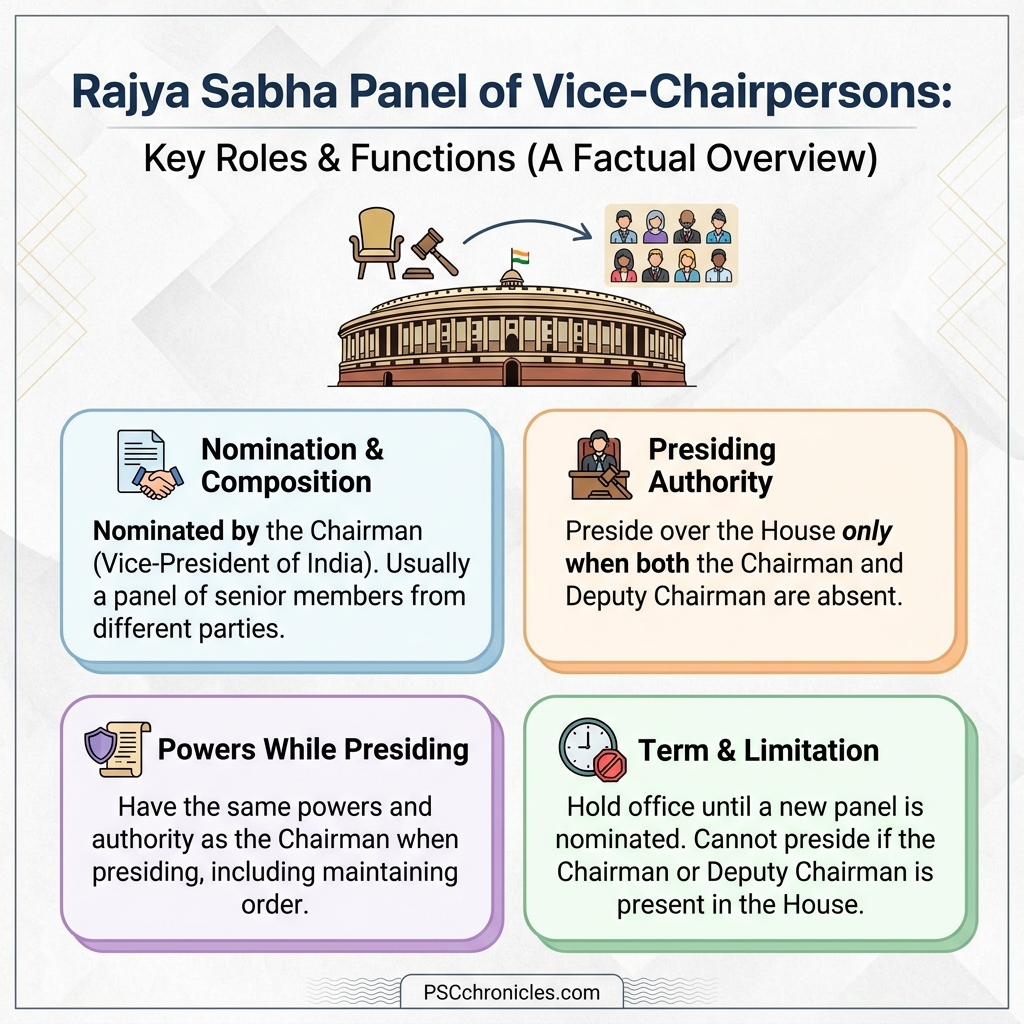
The Rajya Sabha has reconstituted its Panel of Vice-Chairpersons, nominating six members from different political parties. This ensures smooth functioning of the House in the absence of regular presiding officers.

rajya sabha panel of vice chairpersons

What is the Panel of Vice-Chairpersons?

The Panel of Vice-Chairpersons is a group of members nominated to preside over the Rajya Sabha when regular presiding officers are unavailable.

Nominating Authority

  • Chairman of Rajya Sabha (Vice President of India)

Membership

  • Selected from among Rajya Sabha members

Size of Panel

  • Usually not more than 6 members
  • Sometimes extended to 8 members for broader representation

Political Diversity

  • Members are chosen from different political parties

Important Limitation

  • A panel member cannot preside if:
    • The offices of Chairman and Deputy Chairman are vacant
  • In such a case:
    • The President of India appoints a member to perform duties until a new presiding officer is elected

To study polity current affairs, from exam point of view, Click here

Rajya Sabha Reconstitutes Panel of Vice-Chairpersons Read More »

India Targets 100 GW Nuclear Power by 2047

Why in News?

India has announced plan to expand its nuclear power capacity from 8.8 GW to 100 GW by 2047, aiming for over a ten-fold increase. This move is crucial for achieving energy security and climate goals

small modular reactor

Strategic Pillars to Achieve the Target

1. National Nuclear Energy Mission

  • Introduced in Union Budget 2025–26
  • Allocation: ₹20,000 crore
  • Focus: Development of indigenous nuclear technologies

2. Small Modular Reactors (SMRs)

  • Target: At least 5 indigenous SMRs by 2033
  • Key innovation in nuclear sector

What are SMRs?

  • Capacity: Up to 300 MW per module
  • About 1/3rd size of traditional reactors
Features of SMRs
  • Compact Size
    • Suitable for smaller or remote locations
  • Modular Construction
    • Factory-built components → faster installation
    • Construction time: 3–5 years (vs 10+ years for large plants)
  • Passive Safety Systems
    • Uses natural forces (gravity, convection)
    • No need for active cooling systems during emergencies

3. Private Sector Participation

  • Proposed reforms in:
    • Atomic Energy Act
    • Civil Liability for Nuclear Damage Act
  • Objective:
    • Encourage private investment
    • Promote global partnerships

To study more Environment current affairs from exam point of view, Click here

India Targets 100 GW Nuclear Power by 2047 Read More »

Harivansh Gets Third Term as Rajya Sabha Deputy Chairman

Why in News?

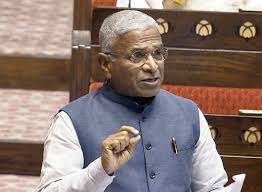
Harivansh Narayan Singh has been elected unopposed as the Deputy Chairman of the Rajya Sabha for a third consecutive term. This marks a historic moment as he becomes the first nominated member to hold this position.

harivansh narayan singh

Deputy Chairman of the Rajya Sabha 

The Deputy Chairman of the Rajya Sabha is a constitutional position established under Article 89 of the Indian Constitution. Unlike the Chairman (the Vice-President), who is an ex-officio presiding officer and not a member of the House, the Deputy Chairman is elected by the Rajya Sabha from amongst its own members

  • Election: Members of the Rajya Sabha elect the Deputy Chairman from among themselves by a simple majority (majority of members present and voting).
  • Tenure: The term is generally co-terminus with their membership in the Rajya Sabha (usually 6 years).
  • Vacation of Office: According to Article 90, the office becomes vacant if the holder:
    • Ceases to be a member of the Rajya Sabha.
    • Resigns by writing to the Chairman.
    • Is removed by a resolution passed by an effective majority (majority of all the then members) after a 14-day notice

To study Polity current affairs from exam point of view, Click here

Harivansh Gets Third Term as Rajya Sabha Deputy Chairman Read More »

Lok Sabha Rejects 131st Amendment Bill-2026

Why in News?

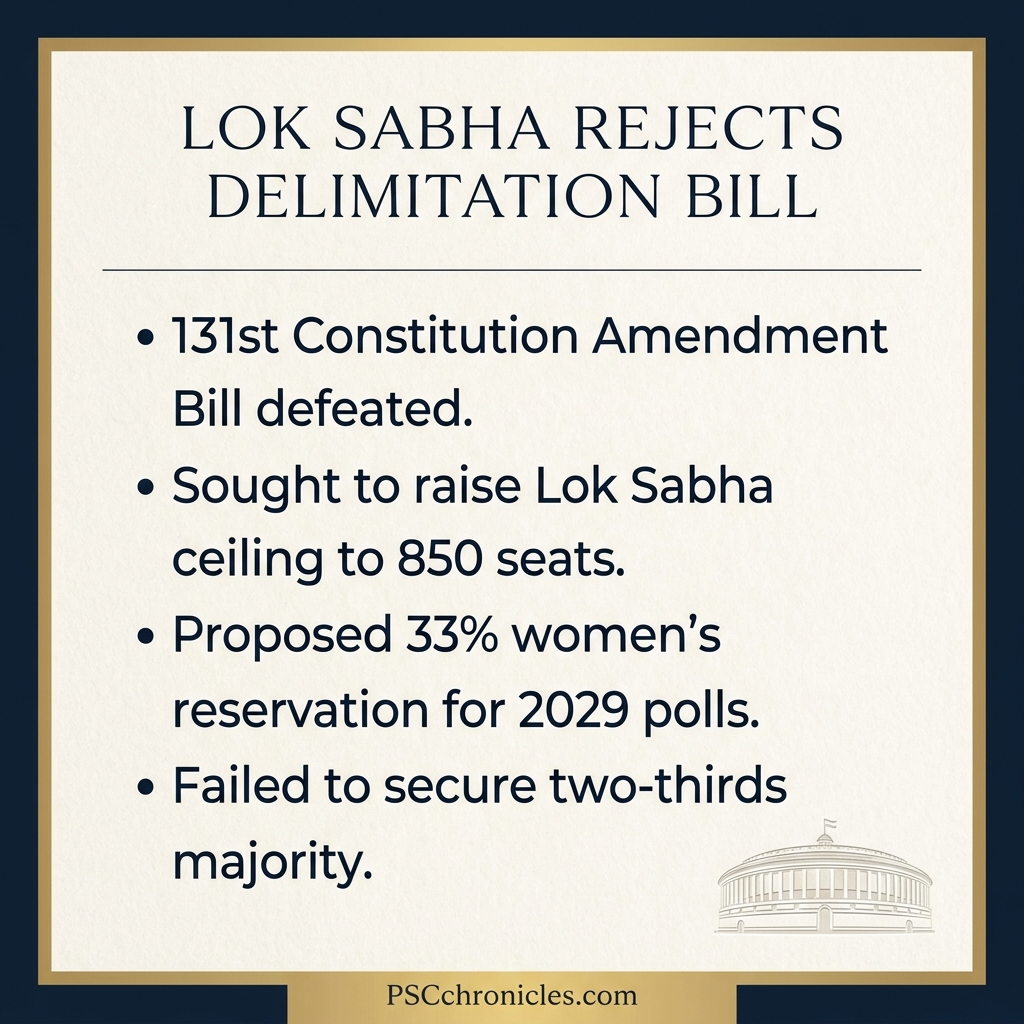
The Lok Sabha recently rejected the 131st Amendment Bill, which proposed increasing the strength of the House and implementing 33% reservation for women. The bill failed as it could not secure the required special majority.

loksabha rejectes delimitation

Key Highlights of the Bill

  • Purpose of the Bill
    • Increase Lok Sabha strength to 850 seats
    • Implement 33% reservation for women before the 2029 general elections
  • Outcome
    • The bill was defeated in Lok Sabha
    • Failed to secure the required special majority
  • Aftermath
    • Government withdrew:
      • Delimitation Bill, 2026
      • Union Territories Laws (Amendment) Bill, 2026

What is Special Majority?

A Special Majority in Parliament refers to a higher level of approval required for important decisions, especially constitutional amendments under Article 368.

  • It refers to any voting requirement other than simple, absolute, or effective majorities, typically requiring at least a two-thirds majority of members present and voting. I

Delimitation Controversy Explained

What is Delimitation?

  • It is the process of redrawing boundaries of constituencies based on population changes.
  • Usually based on Census data.
Core Issue in This Case
  • The bill linked women’s reservation to a new delimitation exercise based on the 2011 Census.
  • Opposition raised concerns that:
    • Southern states (with controlled population growth) may lose representation
    • Northern states may gain more seats

To study polity from exams point of view, Click here

Lok Sabha Rejects 131st Amendment Bill-2026 Read More »

AP Animal Shelters Plan 2026: 5 Per District Explained

Why in News?

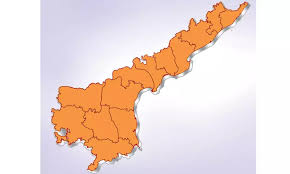
Andhra Pradesh government has announced a major initiative to improve animal welfare and public safety by setting up five animal shelters in every district. This step addresses the rising issue of stray and abandoned animals, especially in urban and semi-urban areas

ap map

Key Highlights of the Scheme

  • 5 Shelters per District
    Every district in Andhra Pradesh will have five dedicated animal shelters.
  • Purpose
    • Manage stray, abandoned, and seized animals
    • Reduce road accidents and public safety risks
    • Ensure humane treatment of animals
  • Location
    • Shelters will be set up near constituency headquarters for easy access and monitoring.
  • Funding Source
    • Funded under the Viksit Bharat – Guarantee for Rozgar and Ajeevika Mission (Gramin) (VB-G RAM G).

What is VB-G RAM G Scheme?

The Viksit Bharat – Guarantee for Rozgar and Ajeevika Mission (Gramin) (VB-G RAM G) is a major rural employment scheme introduced in 2025, replacing the Mahatma Gandhi National Rural Employment Guarantee Act (MGNREGA).

📌 Key Features

  • Increased Employment Guarantee
    • Provides 125 days of wage employment per rural household (earlier 100 days under MGNREGA)
  • Funding Pattern
    • 60:40 (Centre : State)
    • 90:10 for special category states
    • 100% central funding for Union Territories without legislatures
  • Agricultural Pause
    • Introduces a 60-day work pause during peak farming seasons
      👉 Helps prevent labour shortages in agriculture
  • Focus Areas (4 Pillars)
    • Water security
    • Rural infrastructure (linked with PM Gati Shakti)
    • Livelihood assets
    • Climate resilience

To study AP current affairs for AP government exams, Click here

AP Animal Shelters Plan 2026: 5 Per District Explained Read More »

Women’s Reservation Act 2026: 33% Quota Comes into Force

Why in News:

The Women’s Reservation Act, 2023 officially came into force on April 16, 2026, marking a major step toward improving women’s representation in Indian politics. This law provides 33% reservation for women in key legislative bodies.

nari shakti vandan adhiniyam

What is the Women’s Reservation Act?

  • The Act is formally known as the Constitution (One Hundred and Sixth Amendment) Act, 2023.
  • Popularly called the Nari Shakti Vandan Adhiniyam.
  • Notified by the Union Ministry of Law and Justice on April 16, 2026.

Key Features of the Act

1. Reservation Provision

  • Provides 33% reservation for women in: Lok sabha and State Legislative Assemblies

2. Exclusions

  • Does NOT apply to: Rajya Sabha and State Legislative Councils (Legislative Council/Upper Houses)

3. Rotation of Seats

  • Reserved seats will rotate after delimitation.
  • Ensures fair distribution of reservation across constituencies.

4. Duration

  • Reservation will be in force for 15 years.
  • Parliament may extend it if required.

5. Implementation Timeline

  • Act passed in 2023.
  • Came into effect on April 16, 2026 through official notification.

To study Polity current affairs from exam point of view, Click here

Women’s Reservation Act 2026: 33% Quota Comes into Force Read More »

Supreme Court on Ashoka Chakra Guidelines (2026 Explained)

Why in News?

The Supreme Court of India declined to entertain a petition seeking the formulation of guidelines for displaying the Ashoka Chakra on the national flag. The Court chose not to intervene, indicating no need for additional directions.

ashoka chakra

Key Highlights of the Case

  • The petition requested the Court to direct the Central Government to frame specific rules for the display of the Ashoka Chakra.
  • The Supreme Court refused to entertain the plea.
  • The Court did not find sufficient grounds to issue directions in this matter.
  • Existing provisions under the Flag Code of India already govern the use and display of the national flag

Ashoka Chakra – Key Facts

  • Inspired from the Lion Capital of Ashoka at Sarnath (Mauryan period)
  • Adopted on 22 July 1947.
  • Located at the center of the white band in the Indian National Flag
  • Color: Navy Blue
  • Shape: 24-spoked wheel

To study more Polity current affairs, from exam point of view, Click here

Supreme Court on Ashoka Chakra Guidelines (2026 Explained) Read More »