📰 Today's Current Affairs — Read Now →
📷 Follow on Instagram

Polity Current Affairs

Supreme Court on Ashoka Chakra Guidelines (2026 Explained)

Why in News?

The Supreme Court of India declined to entertain a petition seeking the formulation of guidelines for displaying the Ashoka Chakra on the national flag. The Court chose not to intervene, indicating no need for additional directions.

ashoka chakra

Key Highlights of the Case

  • The petition requested the Court to direct the Central Government to frame specific rules for the display of the Ashoka Chakra.
  • The Supreme Court refused to entertain the plea.
  • The Court did not find sufficient grounds to issue directions in this matter.
  • Existing provisions under the Flag Code of India already govern the use and display of the national flag

Ashoka Chakra – Key Facts

  • Inspired from the Lion Capital of Ashoka at Sarnath (Mauryan period)
  • Adopted on 22 July 1947.
  • Located at the center of the white band in the Indian National Flag
  • Color: Navy Blue
  • Shape: 24-spoked wheel

To study more Polity current affairs, from exam point of view, Click here

Supreme Court on Ashoka Chakra Guidelines (2026 Explained) Read More »
Supreme Court Seeks Replies on RTE Implementation

Why in News?

The Supreme Court of India has asked the Centre, States, and Union Territories to respond to a Public Interest Litigation (PIL) demanding effective implementation of the Right to Education (RTE) Act.

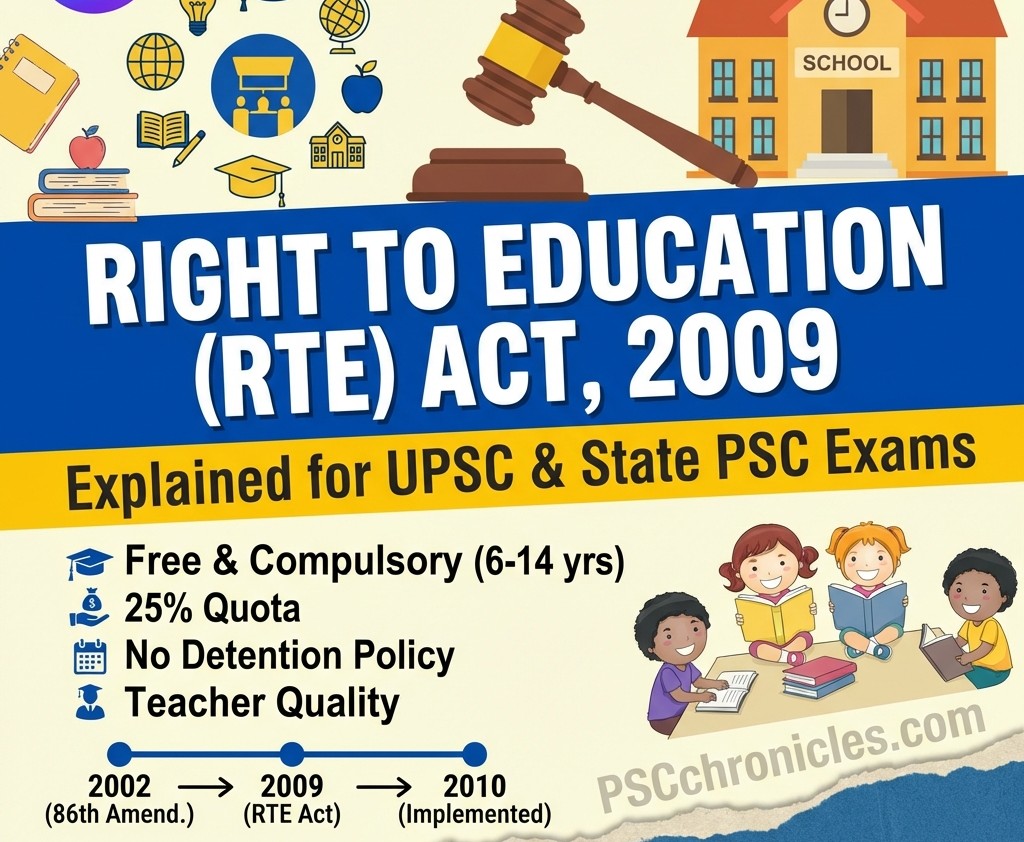
right to education explained

Understanding Public Interest Litigation (PIL):

  • PIL allows any individual or organization to approach the court in the interest of the public, especially for marginalized sections.

Key Features

  • Relaxation of Locus Standi: Anyone can file a case, not just the affected party.
  • Epistolary Jurisdiction: Courts may accept letters/postcards as petitions.
  • Suo Motu Action: Courts can initiate cases on their own.

Historical Background

  • Introduced during the late 1970s–1980s.
  • Key contributors:
    • Justice P. N. Bhagwati
    • Justice V. R. Krishna Iyer
  • Considered a major tool of judicial activism in India.

Right to Education (RTE) Act, 2009 – Key Points

Constitutional Basis

  • Article 21A: Makes education a Fundamental Right (6–14 years).
  • 86th Constitutional Amendment Act, 2002 introduced this provision.
  • Supporting provisions:
    • Article 45: Early childhood care (DPSP)
    • Article 51A(k): Duty of parents to provide education

Major Provisions

  • Free & Compulsory Education for children aged 6–14 years (Classes I–VIII)
  • 25% Reservation in private unaided schools for:
    • Economically Weaker Sections (EWS)

To study Polity current affairs from exam point of view, Click here

Supreme Court Seeks Replies on RTE Implementation Read More »

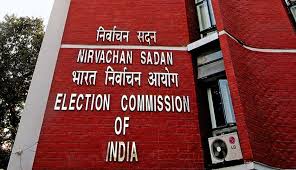
Chairs of both Houses reject notice seeking CEC’s removal

Why in News?

Chairpersons of both Houses of Parliament rejected a notice submitted by Opposition Members of Parliament seeking the removal of the Chief Election Commissioner (CEC). It sought the removal of the current Chief Election Commissioner Gyanesh Kumar

election commission of india

Constitutional Provision: Article 324(5)

  • Article 324 deals with the Election Commission of India (ECI).
  • Clause (5) ensures security of tenure for the CEC.
  • It states that:
    • The CEC can be removed only in the same manner and on the same grounds as a Supreme Court Judge.

Grounds for Removal of CEC:

The CEC can be removed only on:

  • Proven misbehaviour
  • Incapacity

These conditions ensure independence and prevent arbitrary removal.

Procedure for Removal of CEC

The process is similar to the removal of a Supreme Court Judge and follows the Judges (Inquiry) Act, 1968. The procedure is as follows

1. Initiation of Motion
  • Requires:
    • At least 100 Lok Sabha MPs, OR
    • At least 50 Rajya Sabha MPs
Admission & Investigation
  • The motion is submitted to:
    • Lok Sabha Speaker or Rajya Sabha Chairman
  • If admitted, a 3-member inquiry committee is formed:
    • A Supreme Court Judge
    • A Chief Justice of a High Court
    • A Distinguished jurist
3. Parliamentary Approval
  • If charges are proven:
    • Both Houses must pass the motion with a Special Majority:
      • Majority of total membership AND
      • Two-thirds of members present and voting
4. Final Removal
  • After Parliament passes the motion:
    • The President of India issues the final removal order.

To Know more about Election commission of India, Click here

Chairs of both Houses reject notice seeking CEC’s removal Read More »

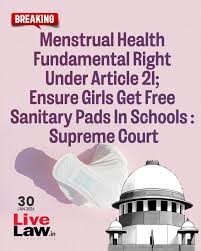
Right to Menstrual Health as Fundamental Right: Supreme Court Expands Article 21 in Jaya Thakur Case

Why in News

Dr. Jaya Thakur vs Union of India, the Supreme Court recognized the right to menstrual health as a fundamental right under Article 21.

right to menstrual health as fundamental right

Key Highlights

Right to Menstrual Health is now part of:

  • Right to Life and Personal Liberty (Article 21)

Key Directions by Supreme Court:

  • Provision of free sanitary pads in schools
  • Establishment of separate toilets for girls

Article 21:

  • States:
    • “No person shall be deprived of his life or personal liberty except according to procedure established by law.”
  • Applicability:
    • Available to citizens and foreigners (except enemy aliens)

Judicial Evolution of Article 21

  • A.K. Gopalan v. State of Madras (1950)
    • Took a narrow interpretation
    • Focused only on procedure established by law
  • Maneka Gandhi v. Union of India (1978)
    • Introduced “fair, just and reasonable” procedure
    • Expanded Article 21 to include due process of law
    • Linked Article 21 with Articles 14 & 19
https://www.downtoearth.org.in/health/menstrual-health-now-a-fundamental-right-its-gender-inclusive-constitutional-justice: Right to Menstrual Health as Fundamental Right: Supreme Court Expands Article 21 in Jaya Thakur Case

Right to Menstrual Health as Fundamental Right: Supreme Court Expands Article 21 in Jaya Thakur Case Read More »

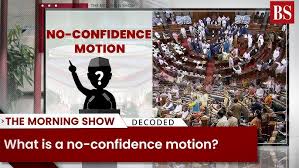
No-Confidence Motion Against Lok Sabha Speaker: Removal Process, Articles & Key Facts (UPSC/PSC Notes)

Why in News?

Opposition parties have submitted a no-confidence motion seeking the removal of Lok Sabha Speaker . The notice has met the minimum support requirement, and the motion may be taken up after the mandatory 14-day notice period.

no confidence motion

Procedure for Removal of Speaker

Article 94(c) → Provides for removal of the Lok Sabha Speaker through a resolution passed by the House.

Notice Requirement

  • Minimum 14 days’ written notice must be given

Support for Admission

  • At least 50 Members of Parliament (MPs) must support the motion

Presiding Restriction

  • Speaker cannot preside during the proceedings
  • However, can participate and defend himself (Article 96)

Voting Requirement

  • Requires Effective Majority:
    • Majority of all existing members of Lok Sabha

Outcome

  • If passed → Speaker removed immediately
  • If rejected → Speaker continues in office
  • Even after removal → continues as MP
https://www.ndtv.com/india-news/oppositions-no-confidence-motion-against-speaker-defeated-in-lok-sabha-11200786: No-Confidence Motion Against Lok Sabha Speaker: Removal Process, Articles & Key Facts (UPSC/PSC Notes)

No-Confidence Motion Against Lok Sabha Speaker: Removal Process, Articles & Key Facts (UPSC/PSC Notes) Read More »

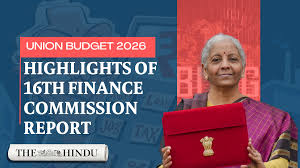
16th Finance Commission Recommendations 2026 – Key Highlights, Devolution Formula & Fiscal Reforms (UPSC/PSC Notes)

Why in News?

The 16th Finance Commission (FC) report was tabled in Parliament on February 1, 2026, along with the Union Budget. The Government has accepted key tax devolution and grant recommendations for the period 2026–27 to 2030–31.

16th finance commission recommendations

Key Recommendations:

1. Vertical Devolution (Centre–State Share)

  • 41% of divisible tax pool allocated to States
  • Unchanged from the 15th Finance Commission
  • Ensures continuity and fiscal stability for States

2. Grants-in-Aid (2026–27)

  • Total allocation: ₹1.4 lakh crore
  • Includes:
    • Grants to Rural Local Bodies (Panchayats)
    • Grants to Urban Local Bodies (Municipalities)
    • Disaster management funding

Horizontal Devolution Formula (2026–31)

Criterion 15th FC Weight (2021–26)
16th FC Weight (2026–31)
Income Distance
45.0%
42.5%
Population (2011 Census)15.0%
17.5%
Demographic Performance12.5%10.0%
Area15%10%
Forest & Ecology10%10%
Contribution to GDP (New)–10%
Tax and Fiscal Effort2.5%–

Background:

The Finance Commission is a constitutional body under Article 280. Constituted every 5 years by the President of India. Functions:

  • Recommend tax sharing (Centre–State)
  • Suggest grants-in-aid
  • Promote fiscal federalism

16th Finance Commission

  • Chairman: Dr. Arvind Panagariya
  • Award Period: 2026–27 to 2030–31
https://www.pib.gov.in/PressReleasePage.aspx?PRID=2221390&reg=3&lang=2: 16th Finance Commission Recommendations 2026 – Key Highlights, Devolution Formula & Fiscal Reforms (UPSC/PSC Notes)

16th Finance Commission Recommendations 2026 – Key Highlights, Devolution Formula & Fiscal Reforms (UPSC/PSC Notes) Read More »

National Commission for Scheduled Tribes (NCST) – 23rd Foundation Day | Article 338A, Functions & Composition

Why in News?

The 23rd Foundation Day of the National Commission for Scheduled Tribes (NCST) was recently celebrated in New Delhi. It highlights the role of NCST in protecting the rights of Scheduled Tribes (STs) in India.

national commission for scheduled tribes

National Commission for Scheduled Tribes

  • NCST is a constitutional body established under Article 338A of the Indian Constitution.
  • It works for the protection, welfare, and development of Scheduled Tribes.
  • Formed after the Constitution (89th Amendment) Act, 2003.

Separation of Commissions (2003):

  • Earlier: A single body for SCs & STs
  • After Amendment:
    • National Commission for Scheduled Castes (NCSC) – Article 338
    • National Commission for Scheduled Tribes (NCST) – Article 338A
Composition of NCST:
  • Chairperson
  • Vice-Chairperson
  • 3 other Members
Appointment & Tenure:
  • Appointed by the President of India
  • Tenure: 3 years
Functions of NCST
  • Investigate and monitor safeguards for STs
  • Inquire into complaints regarding deprivation of rights
  • Advise on planning process for socio-economic development
  • Present reports to the President annually
https://www.pib.gov.in/PressReleasePage.aspx?PRID=2230380&reg=3&lang=1: National Commission for Scheduled Tribes (NCST) – 23rd Foundation Day | Article 338A, Functions & Composition

National Commission for Scheduled Tribes (NCST) – 23rd Foundation Day | Article 338A, Functions & Composition Read More »

Supreme Court Hearing on CAA Petitions from May 5 – Key Points for UPSC & PSC Exams

Why in News?

The Supreme Court of India has scheduled final hearings from May 5, 2026 on more than 250 petitions challenging the Citizenship (Amendment) Act, 2019 (CAA). The petitions question the constitutional validity of the Act, especially on grounds of alleged religious discrimination.

citizenship amendment act

Key Highlights:

  • The CAA amends the Citizenship Act, 1955.
  • It provides fast-track Indian citizenship to certain migrants facing religious persecution.
  • Eligible communities: Hindus, Sikhs, Buddhists, Jains, Parsis, and Christians.
  • Countries covered: Afghanistan, Bangladesh, and Pakistan.
  • Cut-off date: Migrants must have entered India on or before 31 December 2014.
  • It reduces the residency requirement for citizenship from 11 years to 5 years for eligible migrants.
  • Over 250 petitions challenge the Act’s constitutionality, mainly citing violation of Article 14 (Right to Equality). The Supreme Court will now conduct final hearings, which could have major constitutional implications
https://www.indiatoday.in/india/law-news/story/supreme-court-caa-final-hearing-may-5-iuml-plea-petitions-2870995-2026-02-19: Supreme Court Hearing on CAA Petitions from May 5 – Key Points for UPSC & PSC Exams

Supreme Court Hearing on CAA Petitions from May 5 – Key Points for UPSC & PSC Exams Read More »

Kerala Renaming to ‘Keralam’ Approved – Article 3 & State Name Change Procedure Explained for Exams

Why in News?

Union Cabinet has approved a proposal to rename Kerala as “Keralam”, initiating the constitutional process under Article 3 of the Indian Constitution.

keralam

Constitutional Basis:

Article 3 – Alteration of State Name

Parliament has the power to:

  • Form new states
  • Alter boundaries
  • Increase or decrease area
  • Change the name of a state

Article 4 – Supplemental Provisions

  • Any law under Article 3:
    • Amends the First Schedule (list of states)
    • Amends the Fourth Schedule (Rajya Sabha seats)
  • Such changes:
    • Are not considered Constitutional Amendments
    • Passed by simple majority

Step-by-Step Procedure to Change State Name:

  1. Presidential Recommendation:
    • Bill can be introduced in Parliament only with prior approval of the President.
  2. Reference to State Legislature:
    • President refers the Bill to the concerned State Legislature for its opinion.
  3. Non-Binding Opinion:
    • State’s views are not binding on Parliament.
  4. Parliamentary Approval:
    • Bill passed by simple majority in both Houses.
  5. Presidential Assent:
    • After approval, the President signs the Bill → Name change becomes official.
https://ddnews.gov.in/en/union-cabinet-approves-proposal-to-rename-kerala-as-keralam/: Kerala Renaming to ‘Keralam’ Approved – Article 3 & State Name Change Procedure Explained for Exams

Kerala Renaming to ‘Keralam’ Approved – Article 3 & State Name Change Procedure Explained for Exams Read More »

Rajya Sabha Elections 2026 – 37 Seats Notified | Composition, Tenure & Articles Explained

Why in News?

The Election Commission of India (ECI) has issued notification for elections to 37 Rajya Sabha seats, with polling scheduled in March 2026, as the terms of these members are expiring in April.

rajya sabha elections

Rajya Sabha – Key Features:

Maximum Strength: 245 members

  • 233 elected from States & UTs
  • 12 nominated by the President

Nature of House:

  • Permanent body (cannot be dissolved)
  • Ensures continuity in Parliament

Tenure:

  • Each member serves 6 years
  • 1/3rd members retire every 2 years (biennial elections)
  • Based on Article 83(1)

Composition & Representation:

  • Allocation of seats is based on population.
  • Governed by the Fourth Schedule of the Constitution.

Nominated Members (Article 80(3)):

  • 12 members nominated by the President of India.
  • Chosen from fields like:
    • Literature
    • Science
    • Art
    • Social Service
  • They may join a political party within 6 months of taking their seat
https://ddnews.gov.in/en/eci-announces-march-16-polling-for-37-rajya-sabha-seats-across-10-states/: Rajya Sabha Elections 2026 – 37 Seats Notified | Composition, Tenure & Articles Explained

Rajya Sabha Elections 2026 – 37 Seats Notified | Composition, Tenure & Articles Explained Read More »