Why in News?
The Supreme Court of India has asked the Centre, States, and Union Territories to respond to a Public Interest Litigation (PIL) demanding effective implementation of the Right to Education (RTE) Act.
Understanding Public Interest Litigation (PIL):
- PIL allows any individual or organization to approach the court in the interest of the public, especially for marginalized sections.
Key Features
- Relaxation of Locus Standi: Anyone can file a case, not just the affected party.
- Epistolary Jurisdiction: Courts may accept letters/postcards as petitions.
- Suo Motu Action: Courts can initiate cases on their own.
Historical Background
- Introduced during the late 1970s–1980s.
- Key contributors:
- Justice P. N. Bhagwati
- Justice V. R. Krishna Iyer
- Considered a major tool of judicial activism in India.
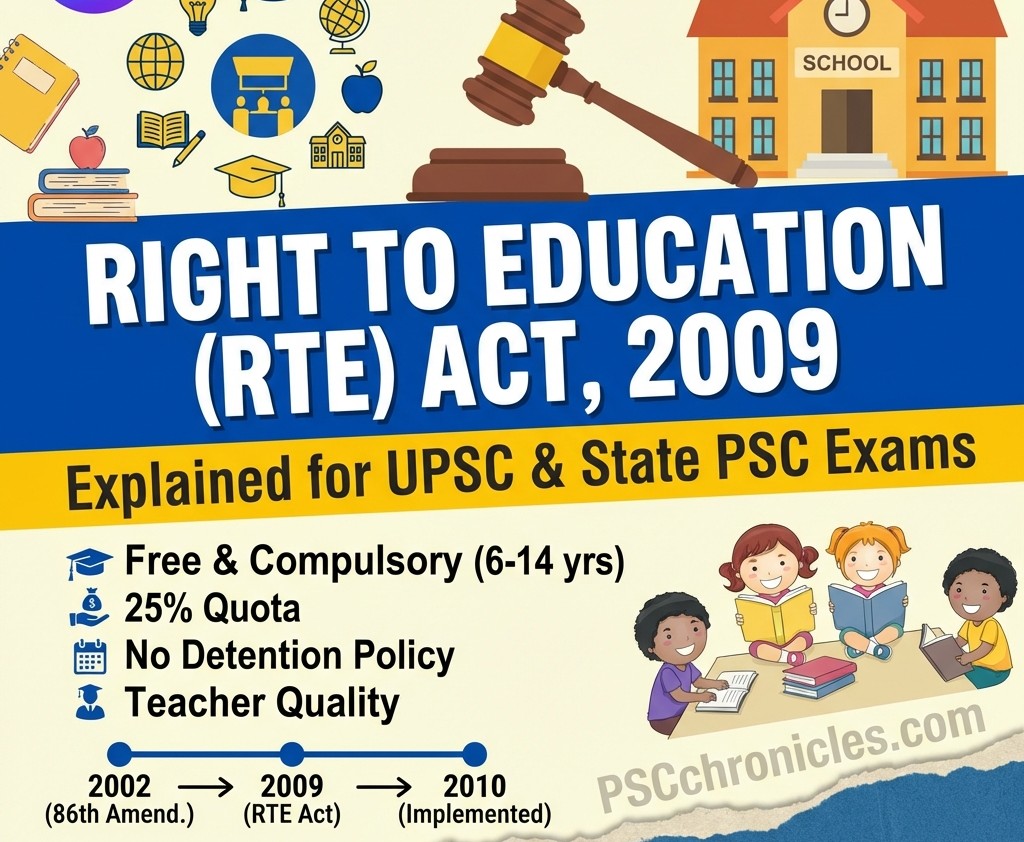
Right to Education (RTE) Act, 2009 – Key Points
Constitutional Basis
- Article 21A: Makes education a Fundamental Right (6–14 years).
- 86th Constitutional Amendment Act, 2002 introduced this provision.
- Supporting provisions:
- Article 45: Early childhood care (DPSP)
- Article 51A(k): Duty of parents to provide education
Major Provisions
- Free & Compulsory Education for children aged 6–14 years (Classes I–VIII)
- 25% Reservation in private unaided schools for:
- Economically Weaker Sections (EWS)
To study Polity current affairs from exam point of view, Click here