πŸ“° Today's Current AffairsRead Now →
📷 Follow on Instagram

Polity Current Affairs

NITI Aayog 11th Governing Council Meeting: Key Facts for UPSC Prelims 2025

Prime Minister Narendra Modi chaired the 11th Governing Council Meeting of NITI Aayog at the Rashtrapati Bhavan Cultural Centre, New Delhi. The meeting focused on entrepreneurship, skill enhancement, and creating sustainable employment opportunities across the country β€” key pillars of India’s economic transformation agenda.

Why in News?

PM Modi chaired the 11th NITI Aayog Governing Council Meeting, bringing together Chief Ministers of all states and UTs in a platform of cooperative federalism. The agenda centred on promoting entrepreneurship, skilling, and sustainable employment β€” critical areas for India’s demographic dividend.

Key Facts for Prelims: NITI Aayog

  • Full form: National Institution for Transforming India
  • Nature: Neither constitutional nor statutory β€” created by an executive (Union Cabinet) resolution
  • Established: January 1, 2015
  • Replaced: The Planning Commission (which had functioned for 65 years since 1950)
  • Key Shift: From Planning Commission’s rigid top-down approach β†’ NITI Aayog’s bottom-up cooperative model giving states a direct voice
  • Promotes: Cooperative federalism, competitive federalism among states

Composition of NITI Aayog Governing Council

  • Chairperson: Prime Minister of India
  • Vice-Chairperson: Dr. Suman Bery
  • CEO: B.V.R. Subrahmanyam
  • Full-time Members: Prof. Ramesh Chand, Dr. V.K. Paul, Shri V.K. Saraswat, Dr. Arvind Virmani
  • Special Invitees: Cabinet Ministers nominated by PM
  • Governing Council includes: Chief Ministers of all 28 states, Chief Ministers of UTs with legislatures (Delhi, Puducherry, J&K), and Lieutenant Governors of UTs without legislatures

Static/Exam Links: NITI Aayog vs Planning Commission

AspectPlanning CommissionNITI Aayog
Established1950 (executive resolution)2015 (executive resolution)
ApproachTop-down, centralisedBottom-up, cooperative
NatureNon-constitutional, non-statutoryNon-constitutional, non-statutory
Fund AllocationHad power to allocate funds to statesNo fund allocation power
State RoleStates were consulted minimallyStates are equal partners (Governing Council)
FocusFive-Year Plans15-year vision, 7-year strategy, 3-year action plan

Key NITI Aayog Initiatives (Exam-relevant)

  • Atal Innovation Mission (AIM): Promotes innovation and entrepreneurship ecosystem
  • Aspirational Districts Programme: Transforms under-developed districts across India
  • SATH (Sustainable Action for Transforming Human Capital): Education and health sector reform with states
  • SDG India Index: Tracks India’s progress on Sustainable Development Goals

Quick Revision Table

ParameterDetail
Meeting11th Governing Council Meeting
Chaired byPM Narendra Modi
Focus AreasEntrepreneurship, skilling, employment
NITI Aayog EstablishedJanuary 1, 2015
NatureNon-constitutional, non-statutory
ReplacedPlanning Commission (est. 1950)
ChairpersonPrime Minister of India
Vice-ChairpersonDr. Suman Bery
CEOB.V.R. Subrahmanyam
Governing CouncilCMs of all states + UTs with legislature + LGs of UTs without legislature

Trap / Confusing Points

❌ Common Trapβœ… Correct Fact
NITI Aayog is a statutory bodyNITI Aayog is neither constitutional nor statutory β€” created by executive (Cabinet) resolution
Planning Commission was a statutory bodyPlanning Commission was also non-statutory β€” both created by executive orders
NITI Aayog allocates funds to states like Planning CommissionNITI Aayog has no fund allocation power; funds go via Finance Commission and Union Budget
NITI Aayog was established by ParliamentEstablished by Union Cabinet resolution, not by Parliament
All LGs attend the Governing CouncilOnly LGs of UTs without legislature attend; UTs with legislature send their CMs

5 Practice MCQs

1. NITI Aayog was established on which date?
a. August 15, 2014
b. January 1, 2015
c. March 31, 2015
d. November 26, 2014
Ans: B
NITI Aayog was established on January 1, 2015 via a Union Cabinet resolution, replacing the Planning Commission which had existed since 1950.

2. What is the nature of NITI Aayog?
a. Constitutional body
b. Statutory body under an Act of Parliament
c. Non-constitutional, non-statutory executive body
d. Quasi-judicial body
Ans: C
NITI Aayog is created by an executive (Cabinet) resolution, making it neither constitutional nor statutory β€” same as the Planning Commission it replaced.

3. Who is the ex-officio Chairperson of NITI Aayog?
a. President of India
b. Vice-President of India
c. Prime Minister of India
d. Finance Minister of India
Ans: C
The Prime Minister of India serves as the ex-officio Chairperson of NITI Aayog, reflecting its role as the apex policy-making body for national development.

4. Which key power does NITI Aayog NOT have compared to the Planning Commission?
a. Conducting research on economic policy
b. Providing policy recommendations to states
c. Allocating funds directly to states
d. Monitoring implementation of government schemes
Ans: C
Unlike the Planning Commission, NITI Aayog has no power to allocate funds to states. This was a deliberate design choice to make it an advisory-collaborative body rather than a controlling one.

5. The Governing Council of NITI Aayog includes which of the following?
a. Chief Ministers of states only
b. Chief Ministers of states + LGs of all UTs
c. Chief Ministers of all states + CMs of UTs with legislatures + LGs of UTs without legislatures
d. Only Union Cabinet Ministers
Ans: C
The Governing Council includes CMs of all 28 states, CMs of UTs with legislatures (Delhi, Puducherry, J&K), and Lt. Governors of UTs without legislatures β€” making it a true federal platform.

To learn current affairs from exam point of view, Click here

To know more about NITI Aayog and its initiatives, Click here

NITI Aayog 11th Governing Council Meeting: Key Facts for UPSC Prelims 2025 Read More Β»

Why is the Supreme Court Judges Increase in News?

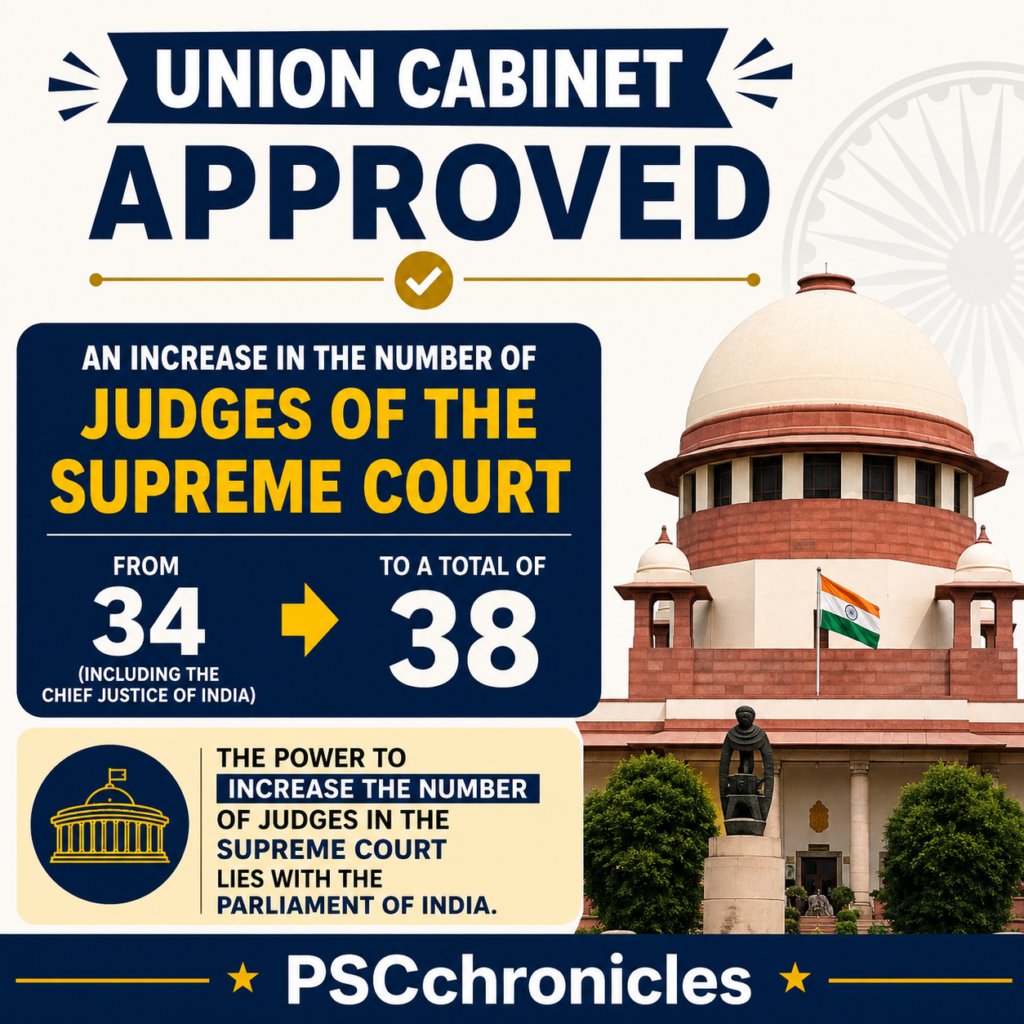
The Union Cabinet has approved the Supreme Court Judges Increase proposal, raising the sanctioned strength of judges in the Supreme Court of India from 34 to 38, including the Chief Justice of India (CJI).

The decision was taken to address the growing burden of pending cases in the judiciary. At present, nearly 92,000 cases are pending before the Supreme Court, creating delays in justice delivery.

Key Highlights of Supreme Court Judges Increase

Increase in Judicial Strength

  • Existing sanctioned strength: 34 judges
  • New proposed strength: 38 judges
  • Increase approved by: Union Cabinet
  • Objective: Faster disposal of pending cases

The move is expected to strengthen the efficiency of the apex court and reduce judicial delays.

Why Was the Increase Needed?

India’s judiciary has been facing a significant backlog of cases for several years. The Supreme Court, being the highest judicial authority, handles:

  • Constitutional matters
  • Appeals from High Courts
  • Public Interest Litigations (PILs)
  • Centre-State disputes
  • Fundamental Rights cases

The rising number of litigations and increasing complexity of cases have led to the need for more judges.

Constitutional Basis for Supreme Court Judges Increase

Article 124 of the Constitution

The power to determine the number of judges in the Supreme Court lies with the Parliament of India.

Under Article 124(1) of the Constitution:

The Supreme Court shall consist of a Chief Justice of India and such number of other judges as Parliament may by law prescribe.

This means the Constitution does not permanently fix the number of judges. Parliament can increase or decrease the strength through legislation.

Practice Questions

  1. The strength of Supreme Court judges has been increased from 34 to:
    • a) 35
    • b) 36
    • c) 38
    • d) 40
  2. Under which Article does Parliament have the power to determine the number of Supreme Court judges?
    • a) Article 32
    • b) Article 124
    • c) Article 136
    • d) Article 143
  3. The Supreme Court of India was established in:
    • a) 1947
    • b) 1949
    • c) 1950
    • d) 1952
  4. Which institution approved the increase in Supreme Court judges in 2026?
    • a) Parliament
    • b) Supreme Court Collegium
    • c) Union Cabinet
    • d) Law Commission

To study current affairs from exam point of view, Click here

Why is the Supreme Court Judges Increase in News? Read More Β»

Recusal Explained 2026

Why in News?

Justice Swarana Kanta Sharma of the Delhi High Court rejected a plea filed by Arvind Kejriwal seeking her recusal from the Delhi excise policy case. The issue brings attention to the important judicial concept of recusal.

recusal

What is Recusal?

Recusal refers to the voluntary withdrawal of a judge or judicial authority from a case due to a possible conflict of interest, ensuring fairness and impartiality in the judicial process.

Key Features of Recusal

Purpose

  • Maintain judicial impartiality
  • Ensure fair trial
  • Uphold public confidence in courts

Reasons for Recusal

A judge may step aside when:

  • There is a personal relationship with parties involved
  • Financial interests are connected to the case
  • The judge had prior professional involvement

Process & Nature

  • Voluntary decision by the judge (based on conscience)
  • Can be requested by parties, but final decision rests with the judge
  • Not strictly governed by codified law (guided by judicial ethics)

To study polity current affairs from exam point of view, Click here

Recusal Explained 2026 Read More Β»

Parliament Adjourned Sine Die: Key Concepts Explained

Why in News?

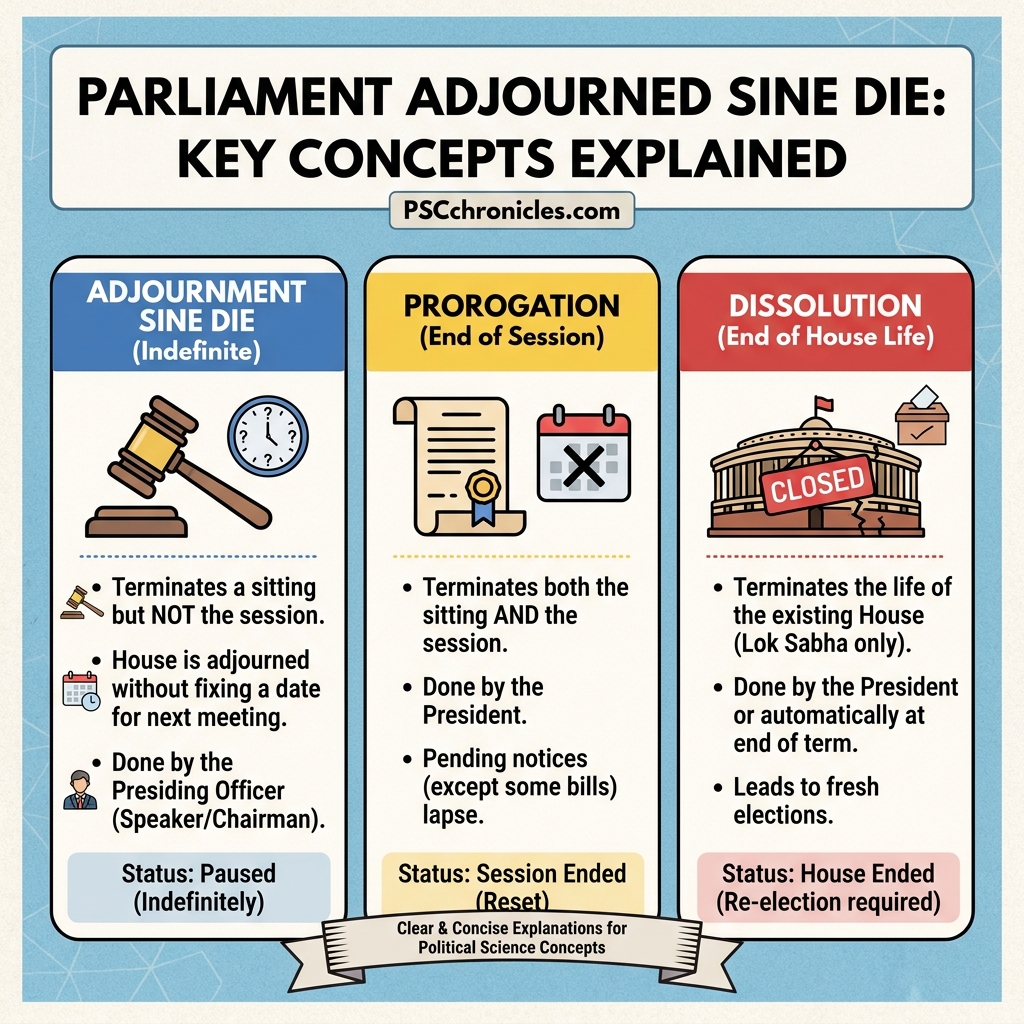
The extended Budget Session of the Indian Parliament was recently adjourned sine die, following the defeat of a key Constitutional Amendment Bill in the Lok Sabha. This development highlights important parliamentary procedures frequently asked in competitive exams.

adjournment sine die

Key Parliamentary Concepts Explained

1. Adjournment Sine Die

  • Meaning: Termination of a sitting of the House without fixing a date for the next meeting.
  • Authority:
    • In Lok Sabha β†’ Lok Sabha Speaker
    • In Rajya Sabha β†’ Rajya Sabha Chairman
  • Important Point:
    • It ends only the sitting, not the entire session.
  • Effect on Bills:
    • Pending Bills and business do NOT lapse.

2. Adjournment

  • Meaning: Suspension of a sitting for a fixed time (hours, days, or weeks).
  • Authority: Presiding Officer of the House.
  • Example: Lunch break or postponement to next day.

3. Prorogation

  • Meaning: Formal termination of a session of Parliament.
  • Authority:
    • President of India
  • Key Feature:
    • Usually occurs after adjournment sine die.
  • Effect on Bills:
    • Bills do NOT lapse (except certain notices).

Comparison Table: Key Differences

FeatureAdjournmentAdjournment Sine DieProrogation
MeaningSuspension for fixed timeSuspension without dateEnd of session
AuthorityPresiding OfficerPresiding OfficerPresident of India
Time PeriodSpecificIndefiniteFinal termination
Effect on BillsContinueContinueContinue

To study more Polity current affairs from exam point of view, Click here

Parliament Adjourned Sine Die: Key Concepts Explained Read More Β»

Rajya Sabha Reconstitutes Panel of Vice-Chairpersons

Why in News?

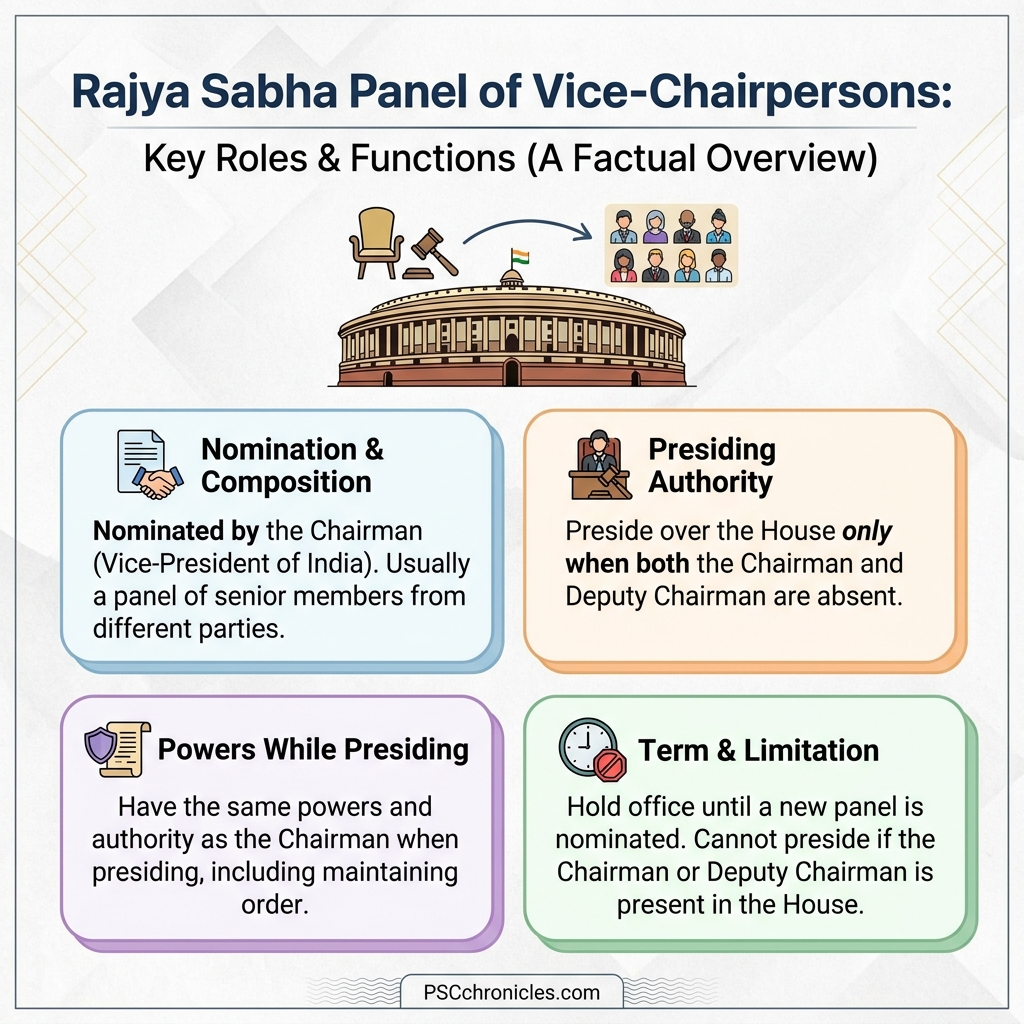
The Rajya Sabha has reconstituted its Panel of Vice-Chairpersons, nominating six members from different political parties. This ensures smooth functioning of the House in the absence of regular presiding officers.

rajya sabha panel of vice chairpersons

What is the Panel of Vice-Chairpersons?

The Panel of Vice-Chairpersons is a group of members nominated to preside over the Rajya Sabha when regular presiding officers are unavailable.

Nominating Authority

  • Chairman of Rajya Sabha (Vice President of India)

Membership

  • Selected from among Rajya Sabha members

Size of Panel

  • Usually not more than 6 members
  • Sometimes extended to 8 members for broader representation

Political Diversity

  • Members are chosen from different political parties

Important Limitation

  • A panel member cannot preside if:
    • The offices of Chairman and Deputy Chairman are vacant
  • In such a case:
    • The President of India appoints a member to perform duties until a new presiding officer is elected

To study polity current affairs, from exam point of view, Click here

Rajya Sabha Reconstitutes Panel of Vice-Chairpersons Read More Β»

Harivansh Gets Third Term as Rajya Sabha Deputy Chairman

Why in News?

Harivansh Narayan Singh has been elected unopposed as the Deputy Chairman of the Rajya Sabha for a third consecutive term. This marks a historic moment as he becomes the first nominated member to hold this position.

harivansh narayan singh

Deputy Chairman of the Rajya SabhaΒ 

The Deputy Chairman of the Rajya Sabha is a constitutional position established underΒ Article 89Β of the Indian Constitution. Unlike the Chairman (the Vice-President), who is anΒ ex-officioΒ presiding officer and not a member of the House, the Deputy Chairman isΒ elected by the Rajya Sabha from amongst its own members

  • Election:Β Members of the Rajya Sabha elect the Deputy Chairman from among themselves by aΒ simple majorityΒ (majority of members present and voting).
  • Tenure:Β The term is generally co-terminus with their membership in the Rajya Sabha (usuallyΒ 6 years).
  • Vacation of Office:Β According toΒ Article 90, the office becomes vacant if the holder:
    • Ceases to be a member of the Rajya Sabha.
    • Resigns by writing to the Chairman.
    • Is removed by a resolution passed by anΒ effective majorityΒ (majority of all theΒ thenΒ members) after a 14-day notice

To study Polity current affairs from exam point of view, Click here

Harivansh Gets Third Term as Rajya Sabha Deputy Chairman Read More Β»

Lok Sabha Rejects 131st Amendment Bill-2026

Why in News?

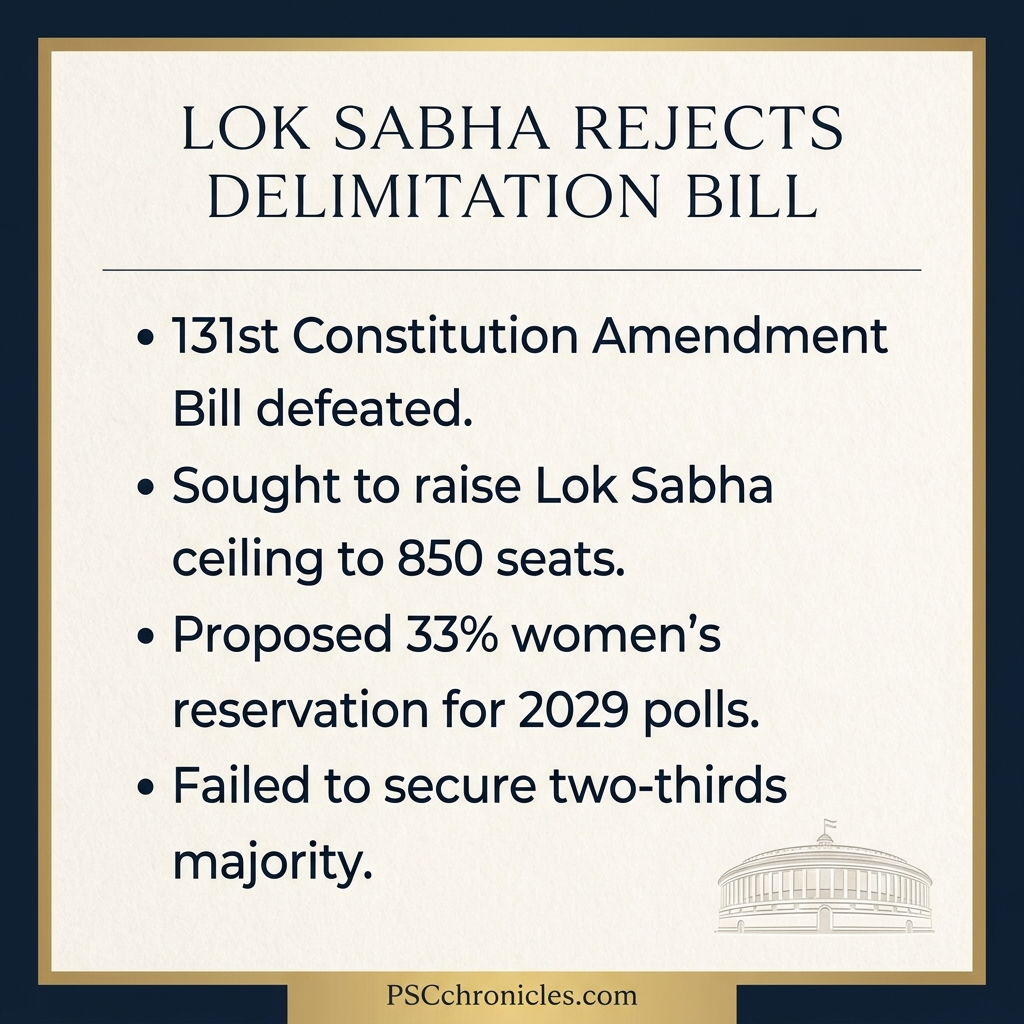
The Lok Sabha recently rejected the 131st Amendment Bill, which proposed increasing the strength of the House and implementing 33% reservation for women. The bill failed as it could not secure the required special majority.

loksabha rejectes delimitation

Key Highlights of the Bill

  • Purpose of the Bill
    • Increase Lok Sabha strength to 850 seats
    • Implement 33% reservation for women before the 2029 general elections
  • Outcome
    • The bill was defeated in Lok Sabha
    • Failed to secure the required special majority
  • Aftermath
    • Government withdrew:
      • Delimitation Bill, 2026
      • Union Territories Laws (Amendment) Bill, 2026

What is Special Majority?

A Special Majority in Parliament refers to a higher level of approval required for important decisions, especially constitutional amendments under Article 368.

  • ItΒ refers toΒ any voting requirement other than simple, absolute, or effective majorities, typically requiring at least a two-thirds majority of members present and voting. I

Delimitation Controversy Explained

What is Delimitation?

  • It is the process of redrawing boundaries of constituencies based on population changes.
  • Usually based on Census data.
Core Issue in This Case
  • The bill linked women’s reservation to a new delimitation exercise based on the 2011 Census.
  • Opposition raised concerns that:
    • Southern states (with controlled population growth) may lose representation
    • Northern states may gain more seats

To study polity from exams point of view, Click here

Lok Sabha Rejects 131st Amendment Bill-2026 Read More Β»

Gerrymandering Explained

Why in New?

Leaders from parties like Congress and the DMK have accused the government of using the Women’s Reservation Act as a “cover” for gerrymandering.

gerrymandering

Gerrymandering is the practice of manipulating electoral constituency boundaries to favor a particular political party, group, or candidate.

  • It distorts fair representation in elections
  • Often done during the process of delimitation (redrawing constituencies)
  • Undermines the principle of free and fair elections

Types of Gerrymandering

1. Packing

  • Concentrating opposition voters into a few constituencies
  • Example: One party wins overwhelmingly in few seats, wasting votes

2. Cracking

  • Splitting opposition voters across many constituencies
  • Prevents them from forming a majority anywhere

3. Kidnapping

  • Moving a strong opponent’s voters into another constituency
  • Weakens their electoral base

To study more polity current affair, from exam point of view, Click here

Gerrymandering Explained Read More Β»

Women’s Reservation Act 2026: 33% Quota Comes into Force

Why in News:

The Women’s Reservation Act, 2023 officially came into force on April 16, 2026, marking a major step toward improving women’s representation in Indian politics. This law provides 33% reservation for women in key legislative bodies.

nari shakti vandan adhiniyam

What is the Women’s Reservation Act?

  • The Act is formally known as the Constitution (One Hundred and Sixth Amendment) Act, 2023.
  • Popularly called the Nari Shakti Vandan Adhiniyam.
  • Notified by the Union Ministry of Law and Justice on April 16, 2026.

Key Features of the Act

1. Reservation Provision

  • Provides 33% reservation for women in: Lok sabha and State Legislative Assemblies

2. Exclusions

  • Does NOT apply to: Rajya Sabha and State Legislative Councils (Legislative Council/Upper Houses)

3. Rotation of Seats

  • Reserved seats will rotate after delimitation.
  • Ensures fair distribution of reservation across constituencies.

4. Duration

  • Reservation will be in force for 15 years.
  • Parliament may extend it if required.

5. Implementation Timeline

  • Act passed in 2023.
  • Came into effect on April 16, 2026 through official notification.

To study Polity current affairs from exam point of view, Click here

Women’s Reservation Act 2026: 33% Quota Comes into Force Read More Β»

Supreme Court on Ashoka Chakra Guidelines (2026 Explained)

Why in News?

The Supreme Court of India declined to entertain a petition seeking the formulation of guidelines for displaying the Ashoka Chakra on the national flag. The Court chose not to intervene, indicating no need for additional directions.

ashoka chakra

Key Highlights of the Case

  • The petition requested the Court to direct the Central Government to frame specific rules for the display of the Ashoka Chakra.
  • The Supreme Court refused to entertain the plea.
  • The Court did not find sufficient grounds to issue directions in this matter.
  • Existing provisions under the Flag Code of India already govern the use and display of the national flag

Ashoka Chakra – Key Facts

  • Inspired from the Lion Capital of Ashoka at Sarnath (Mauryan period)
  • Adopted on 22 July 1947.
  • Located at the center of the white band in the Indian National Flag
  • Color: Navy Blue
  • Shape: 24-spoked wheel

To study more Polity current affairs, from exam point of view, Click here

Supreme Court on Ashoka Chakra Guidelines (2026 Explained) Read More Β»