Why in News?
Prime Minister Narendra Modi paid tribute to Adi Shankaracharya on his Jayanti, highlighting his enduring influence on Indian philosophy and spirituality. His teachings continue to shape India’s cultural and intellectual traditions
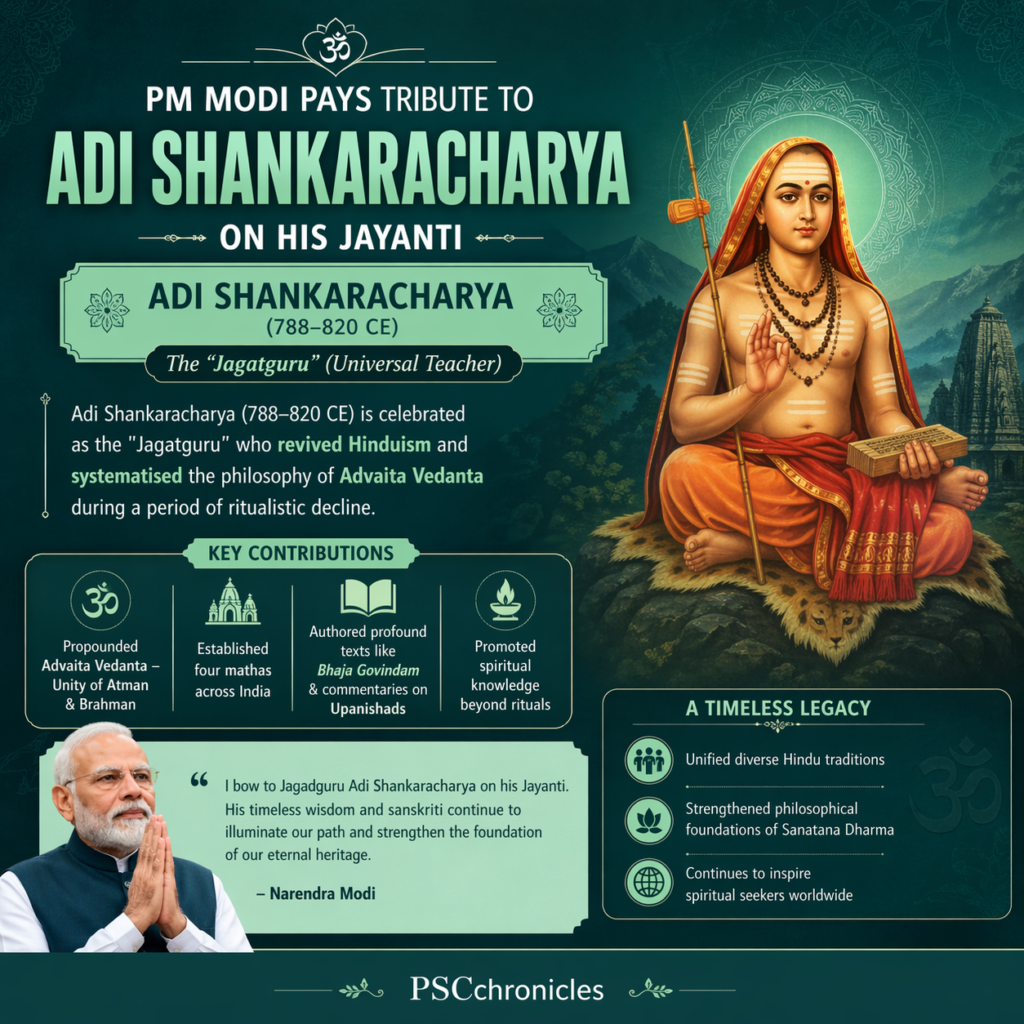
Who was Adi Shankaracharya?
Adi Shankaracharya (788–820 CE) was one of the greatest philosophers of India and is widely known as “Jagatguru” (World Teacher).
Key Contributions
- Revived Hindu philosophy during a time of excessive ritualism
- Systematised the doctrine of Advaita Vedanta
- Established four major mathas (monasteries) in India:
- Sringeri (South)
- Dwaraka (West)
- Puri (East)
- Badrinath (North)
Core Philosophy: Advaita Vedanta (Non-Dualism)
The term Advaita means “not two”, implying that reality is one and indivisible.
Three Fundamental Concepts
1. Brahman (Ultimate Reality)
- The only eternal and unchanging reality
- Formless, infinite, and beyond human perception
2. Atman (Individual Soul)
- The inner self or soul of an individual
- According to Shankaracharya, Atman = Brahman
Famous Mahavakya: “Aham Brahmasmi” (I am Brahman)
3. Maya (Illusion)
- The material world is an illusion
- It creates a false perception of diversity and separation
To study History and culture current affairs from exam point of view, Click here