πŸ“° Today's Current AffairsRead Now →
📷 Follow on Instagram

Polity Current Affairs

Kerala Renaming to β€˜Keralam’ Approved – Article 3 & State Name Change Procedure Explained for Exams

Why in News?

Union Cabinet has approved a proposal to rename Kerala as β€œKeralam”, initiating the constitutional process under Article 3 of the Indian Constitution.

keralam

Constitutional Basis:

Article 3 – Alteration of State Name

Parliament has the power to:

  • Form new states
  • Alter boundaries
  • Increase or decrease area
  • Change the name of a state

Article 4 – Supplemental Provisions

  • Any law under Article 3:
    • Amends the First Schedule (list of states)
    • Amends the Fourth Schedule (Rajya Sabha seats)
  • Such changes:
    • Are not considered Constitutional Amendments
    • Passed by simple majority

Step-by-Step Procedure to Change State Name:

  1. Presidential Recommendation:
    • Bill can be introduced in Parliament only with prior approval of the President.
  2. Reference to State Legislature:
    • President refers the Bill to the concerned State Legislature for its opinion.
  3. Non-Binding Opinion:
    • State’s views are not binding on Parliament.
  4. Parliamentary Approval:
    • Bill passed by simple majority in both Houses.
  5. Presidential Assent:
    • After approval, the President signs the Bill β†’ Name change becomes official.
https://ddnews.gov.in/en/union-cabinet-approves-proposal-to-rename-kerala-as-keralam/: Kerala Renaming to β€˜Keralam’ Approved – Article 3 & State Name Change Procedure Explained for Exams

Kerala Renaming to β€˜Keralam’ Approved – Article 3 & State Name Change Procedure Explained for Exams Read More Β»

Rajya Sabha Elections 2026 – 37 Seats Notified | Composition, Tenure & Articles Explained

Why in News?

The Election Commission of India (ECI) has issued notification for elections to 37 Rajya Sabha seats, with polling scheduled in March 2026, as the terms of these members are expiring in April.

rajya sabha elections

Rajya Sabha – Key Features:

Maximum Strength: 245 members

  • 233 elected from States & UTs
  • 12 nominated by the President

Nature of House:

  • Permanent body (cannot be dissolved)
  • Ensures continuity in Parliament

Tenure:

  • Each member serves 6 years
  • 1/3rd members retire every 2 years (biennial elections)
  • Based on Article 83(1)

Composition & Representation:

  • Allocation of seats is based on population.
  • Governed by the Fourth Schedule of the Constitution.

Nominated Members (Article 80(3)):

  • 12 members nominated by the President of India.
  • Chosen from fields like:
    • Literature
    • Science
    • Art
    • Social Service
  • They may join a political party within 6 months of taking their seat
https://ddnews.gov.in/en/eci-announces-march-16-polling-for-37-rajya-sabha-seats-across-10-states/: Rajya Sabha Elections 2026 – 37 Seats Notified | Composition, Tenure & Articles Explained

Rajya Sabha Elections 2026 – 37 Seats Notified | Composition, Tenure & Articles Explained Read More Β»

SC/ST Sub-Classification Verdict 2024 – Supreme Court Seeks Centre Report | Article 341 Explained

Why in News?

The Supreme Court has asked the Union Government to submit a report on actions taken following its landmark 2024 Constitution Bench verdict allowing sub-classification within SC/ST categories for reservation.

sc st sub classification

SC/ST sub-classification:

SC/ST sub-classificationΒ isΒ the process of dividing the Scheduled Castes (SC) or Scheduled Tribes (ST) categories into smaller sub-groups to ensure that reservation benefits reach the most disadvantaged communities within them

This concept, often called “quota within a quota,” was validated by a landmark 6:1 majority ruling of a seven-judge Supreme Court bench in August 2024 in the case of State of Punjab v. Davinder Singh

What is the Supreme Court Verdict (2024)?

A 7-judge Constitution Bench upheld the validity of sub-classification within SC/ST categories. It ruled that:

  • SC/ST groups are not homogeneous.
  • States can provide preferential treatment to the most backward sub-castes.

The judgment overturned the 2004 E.V. Chinnaiah case, which had disallowed such sub-classification.

Constitutional Provisions Involved:

Article 341 – Scheduled Castes

  • Empowers the President to notify SCs for each State/UT.
  • Done in consultation with the Governor.
  • Parliament alone can modify the list (include/exclude groups).

Key Clarification by Supreme Court:

  • Article 341 defines who is included in SC list.
  • It does not prevent internal classification for reservation benefits.
  • Sub-classification does not violate Article 14 (Right to Equality)
https://indianexpress.com/article/legal-news/sc-seeks-centres-report-on-action-taken-on-its-sc-st-sub-classification-verdict-10525491/: SC/ST Sub-Classification Verdict 2024 – Supreme Court Seeks Centre Report | Article 341 Explained

SC/ST Sub-Classification Verdict 2024 – Supreme Court Seeks Centre Report | Article 341 Explained Read More Β»

Substantive Motion in Lok Sabha – Meaning, Types & Constitutional Significance for Exams

Why in News?

A substantive motion was recently proposed in the Lok Sabha against the Leader of Opposition, seeking cancellation of membership.

substantive motion

Substantive Motion:

  • A substantive motion is an independent proposal placed before the House.
  • It seeks a definite and binding decision of the House.
  • It is complete in itself and not dependent on any other motion.
  • Admission of a substantive motion depends entirely on the Speaker’s discretion.
  • Once adopted, it reflects the formal opinion or will of the House.
  • It differs from:
    • Subsidiary motions (depend on another motion)
    • Procedural motions (relate to House functioning)

Examples of Substantive Motions in Lok Sabha:

  • Election of Speaker and Deputy Speaker
  • Motion of Thanks on the President’s Address
  • No-confidence motion / Confidence motion
  • Adjournment motion on urgent public issues
  • Resolution for removal of Speaker/Deputy Speaker
  • Motion declaring a seat vacant
  • Motions for general public interest discussions
https://www.thehindu.com/news/national/what-is-a-substantive-motion-why-bjp-wants-rahul-gandhi-disqualified-from-lok-sabha/article70627499.ece: Substantive Motion in Lok Sabha – Meaning, Types & Constitutional Significance for Exams

Substantive Motion in Lok Sabha – Meaning, Types & Constitutional Significance for Exams Read More Β»

16th Finance Commission Retains 41% Devolution, Introduces GDP Criterion – Key Highlights for Exams

Why in News?

TheΒ 16th Finance Commission (16th FC), chaired byΒ Arvind Panagariya, tabled its report for the award periodΒ 2026–2031. The central highlight is theΒ retention ofΒ 41% vertical devolutionΒ of central taxes to states while introducing a landmarkΒ 10% weightage for GDP contributionΒ in the horizontal distribution formula

16th finance commission

Key Highlights:

Vertical Devolution:

Β vertical devolutionΒ refers toΒ the distribution of the net proceeds of central taxes between the Union (Central) government and all the State governments collectively

  • Retained at 41% of the divisible tax pool (same as 15th Finance Commission).
  • Applicable for the award period 2026–31.

Horizontal Devolution Changes:

Horizontal devolution refers toΒ theΒ allocation of central tax revenues among individual statesΒ in a federation

  • Introduction of 10% weightage for GDP contribution.
  • Aims to reward economically productive and efficient states.

What is Finance commission?

The Finance Commission is a constitutional body under Article 280 of the Indian Constitution. It is constituted every 5 years to recommend:

  • Distribution of tax revenues between Centre and States (vertical devolution)
  • Distribution among States (horizontal devolution)
Exam Tip:
  • Article 280 – Finance Commission.
  • Difference between vertical & horizontal devolution
https://economictimes.indiatimes.com/news/economy/finance/16th-finance-commission-keeps-states-tax-share-at-41/articleshow/127847218.cms?from=mdr: 16th Finance Commission Retains 41% Devolution, Introduces GDP Criterion – Key Highlights for Exams

16th Finance Commission Retains 41% Devolution, Introduces GDP Criterion – Key Highlights for Exams Read More Β»

Karnataka Hate Speech Bill 2025 Reserved for President – Articles 200 & 201 Explained for Exams

Why in News?

The Karnataka Governor has reserved the Karnataka Hate Speech and Hate Crimes (Prevention) Bill, 2025 for the President’s assent, citing constitutional and legal concerns. This brings focus on the Governor’s discretionary powers under the Indian Constitution.

karnataka hate speech bill 2025

Constitutional Provisions related to governor assent:

In the Indian Constitution, the primary provisions regarding a Governor’s assent to bills passed by the State Legislature are found inΒ Articles 200 and 201. These articles outline the Governor’s choices and the subsequent role of the President

Article 200:

When a Bill is presented, the Governor has four main options:

  • Grant Assent: The bill becomes law.
  • Withhold Assent: The bill does not become law; however, recent rulings state this cannot be used indefinitely (the “pocket veto”).
  • Return the Bill: Non-money bills can be returned for reconsideration “as soon as possible”. If re-passed by the legislature, the Governor must give assent.
  • Reserve for President: Mandatory if the bill threatens the High Court’s position, or discretionary if it violates the Constitution, DPSP, or national interest.Β 

Article 201:

When a Bill is reserved, the President may assent, withhold assent, or return it for reconsideration (non-money bills). Unlike the Governor, if the state legislature re-passes a bill returned by the President, the President isΒ notΒ obliged to grant assent

Grounds for Reservation of Bills:

he Governor may reserve a bill. If the bill

  • Endangers the High Court’s powers
  • Is against constitutional provisions
  • Falls under matters requiring prior presidential sanction
https://www.ndtv.com/karnataka-news/karnataka-governor-thaawar-chand-gehlot-reserves-hate-speech-and-hate-crimes-prevention-bill-2025-for-presidential-assent-10925375: Karnataka Hate Speech Bill 2025 Reserved for President – Articles 200 & 201 Explained for Exams

Karnataka Hate Speech Bill 2025 Reserved for President – Articles 200 & 201 Explained for Exams Read More Β»

Reservation in Private Colleges: Article 15(5)

Why in News?

The Opposition, led by Congress, has demanded that the Centre ensure proper implementation of reservation policies in private educational institutions. It emphasized that regulatory bodies in higher education must monitor the enforcement of Article 15(5) of the Constitution.

article 15 (5)

Concepts from exam Point of view:

Article 15(5) of the Indian Constitution, added by the 93rd Amendment in 2005, empowers the state to make special provisionsβ€”including reservationsβ€”for the admission of socially and educationally backward classes, Scheduled Castes (SCs), and Scheduled Tribes (STs) in educational institutions, including private unaided institutions, excluding minority schools.

  • Exclusion:Β It explicitlyΒ excludes minority educational institutionsΒ referred to in Article 30(1).

Article 15(6), inserted by theΒ 103rd Constitutional Amendment Act, 2019,Β enables special provisions (reservation) for Economically Weaker Sections (EWS).

  • It allows up to 10% reservation in educational institutions (including private, aided/unaided) except minority institutions. This is in addition to existing reservations, specifically targeting those not covered by 15(4) or 15(5).
https://www.thehindu.com/news/national/any-higher-education-regulator-must-oversee-article-155-implementation-says-congress/article70529251.ece: Reservation in Private Colleges: Article 15(5)

Reservation in Private Colleges: Article 15(5) Read More Β»

Budget Session 2026: Key Concepts Explained

Why in News?

The Budget Session of Parliament 2026 is scheduled to begin on January 28 and continue till April 2

parliament budget session 2026
Concepts from Exam Point of view:

Parliamentary sessions are the designated periods when both the Lok Sabha and Rajya Sabha meet to conduct legislative business.

  • UnderΒ Article 85Β of the Indian Constitution, the President has the power to summon each House at intervals not exceeding six months, ensuring Parliament meetsΒ at least twice a year.

By established convention (not a constitutional mandate), India holds three sessions annually:

  • Budget Session (January/February to May)
  • Monsoon Session (July to August/September)
  • Winter Session (November to December)
Key terms related to Parliament session
  • Summoning:
    The President officially calls both Houses of Parliament to meet, based on the advice of the Cabinet Committee on Parliamentary Affairs (CCPA).
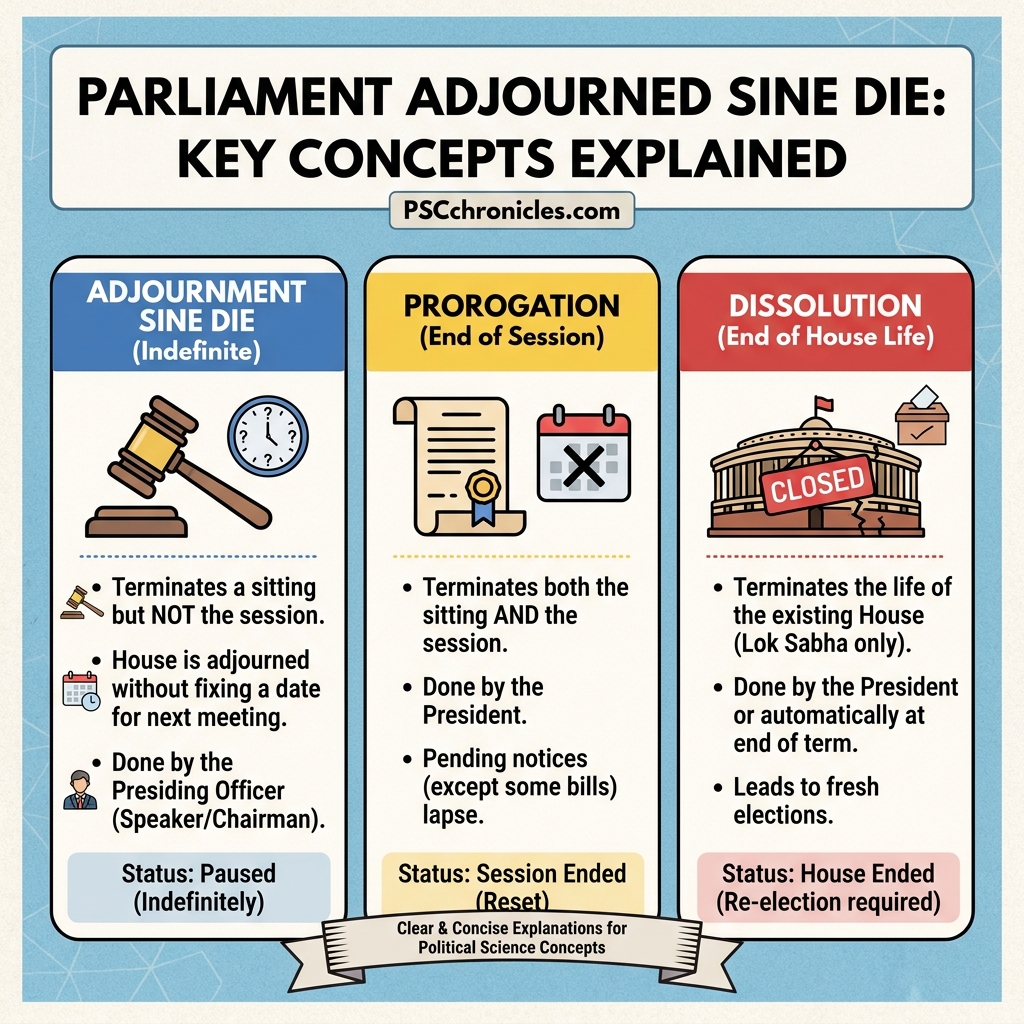
  • Adjournment:
    It is a temporary break in the proceedings of a House for a specific time (hours, days, or weeks), declared by the Speaker or Chairman. The session continues.
  • Adjournment Sine Die:
    When a House is adjourned without fixing the next meeting date, it is called adjournment sine die.
  • Prorogation:
    The President formally ends a session of Parliament under Article 85(2). Pending bills remain unaffected.
  • Dissolution:
    This applies only to the Lok Sabha. It ends the term of the House and leads to fresh elections. Most pending bills lapse after dissolution.
https://www.newsonair.gov.in/parliaments-budget-session-to-begin-january-28-continue-till-april-2/: Budget Session 2026: Key Concepts Explained

Budget Session 2026: Key Concepts Explained Read More Β»

SC Hearing on Lambada ST Status in Telangana

Why in News?

The Supreme Court has taken up a long-pending issue regarding the Scheduled Tribe (ST) status of the Lambada community in Telangana. The matter has resurfaced due to a Special Leave Petition (SLP) filed by activists challenging the inclusion of the Lambada community in the Scheduled Tribes list for Telangana.

telangana supreme court

Background:

The Lambada community was included in the ST list for Telangana region through the Scheduled Castes and Scheduled Tribes Orders (Amendment) Act, 1976. Since then, there has been continuous disagreement between Lambadas and other tribal communities.

From Exam point of view: Article 342 & SLP Explained

Special Leave Petition (SLP) – Article 136

  • SLP is a special power of the Supreme Court.. It allows the Court to hear appeals against any judgment or order from any court or tribunal (except military courts).
  • It is discretionary, meaning the Supreme Court may accept or reject it.

Article 342 – Scheduled Tribes

Clause (1): Presidential Power

The President can notify communities as Scheduled Tribes. This is done after consulting the Governor of the State.

Clause (2): Parliamentary Power

Only Parliament can include or exclude communities from the ST list. Once notified, the President cannot modify the list independently.

https://www.downtoearth.org.in/governance/can-the-decades-old-constitutional-dispute-over-lambadas-scheduled-tribe-status-in-telangana-be-resolved: SC Hearing on Lambada ST Status in Telangana

SC Hearing on Lambada ST Status in Telangana Read More Β»

Telangana Budget Session begins: Governor addressed joint sitting of both Houses

Why in News?

The Budget Session of the Telangana Legislative Assembly and Council started with Governor’s Shiv Pratap Shukla address to joint sitting of both Houses in the morning

telangana legislature

From Exam point of view: Governor’s Address Before Legislature Session – Articles 174, 175 & 176 Explained

Constitutional Provisions

  • Article 176 (Special Address):
    • Makes it mandatory for the Governor to address the State Legislature.
    • Applicable in two situations:
      • First session after general elections
      • First session of every year (Budget Session)
  • Article 175 (Right to Address & Send Messages):
    • Gives the Governor the power to address either House or both Houses.
    • Can send messages regarding pending bills or legislative matters.
  • Article 174 (Sessions of Legislature): Empowers the Governor to summon, prorogue, and dissolve the State Legislature.

Motion of Thanks: After the Governor’s address, a motion is moved in the legislature to thank the Governor. This is called the Motion of Thanks. The Motion of Thanks must be approved by the House. If it is rejected, it is treated as a vote of no-confidence. This may force the government to resign.

https://www.newsonair.gov.in/telangana-budget-session-begins-today-governor-to-address-joint-sitting-of-both-houses/: Telangana Budget Session begins: Governor addressed joint sitting of both Houses

Telangana Budget Session begins: Governor addressed joint sitting of both Houses Read More Β»