πŸ“° Today's Current AffairsRead Now →
📷 Follow on Instagram

Polity Current Affairs

Women Reservation Bill Amendments 2026: Key Highlights

Why in News?

Union Cabinet has approved amendments to fast-track the implementation of the Women’s Reservation Act (Nari Shakti Vandan Adhiniyam).

  • This move aims to ensure 33% reservation for women in Lok Sabha and State Assemblies by the 2029 General Elections, instead of delaying it further.
women reservation psc

Key Amendments Approved by Cabinet

Early Implementation:

  • Reservation will now be implemented in 2029 General Elections. Based on 2011 Census data
  • Earlier provision:
    • Required new Census + delimitation
    • Likely delay till 2034

Expansion of Lok Sabha Seats

  • Current strength: 543 seats
  • Proposed increase: 816 seats (β‰ˆ50% rise)
  • Expansion linked to population changes & representation balance

Reservation for Women

  • Out of 816 seats:
    • 273 seats reserved for women (33%)

Delimitation Based on 2011 Census

  • Constituencies will be redrawn using: 2011 Census of India

To know more about Women Reservation act, Click here

Women Reservation Bill Amendments 2026: Key Highlights Read More Β»

Chairs of both Houses reject notice seeking CEC’s removal

Why in News?

Chairpersons of both Houses of Parliament rejected a notice submitted by Opposition Members of Parliament seeking the removal of the Chief Election Commissioner (CEC). It sought the removal of the current Chief Election Commissioner Gyanesh Kumar

election commission of india

Constitutional Provision: Article 324(5)

  • Article 324 deals with the Election Commission of India (ECI).
  • Clause (5) ensures security of tenure for the CEC.
  • It states that:
    • The CEC can be removed only in the same manner and on the same grounds as a Supreme Court Judge.

Grounds for Removal of CEC:

The CEC can be removed only on:

  • Proven misbehaviour
  • Incapacity

These conditions ensure independence and prevent arbitrary removal.

Procedure for Removal of CEC

The process is similar to the removal of a Supreme Court Judge and follows the Judges (Inquiry) Act, 1968. The procedure is as follows

1. Initiation of Motion
  • Requires:
    • At least 100 Lok Sabha MPs, OR
    • At least 50 Rajya Sabha MPs
Admission & Investigation
  • The motion is submitted to:
    • Lok Sabha Speaker or Rajya Sabha Chairman
  • If admitted, a 3-member inquiry committee is formed:
    • A Supreme Court Judge
    • A Chief Justice of a High Court
    • A Distinguished jurist
3. Parliamentary Approval
  • If charges are proven:
    • Both Houses must pass the motion with a Special Majority:
      • Majority of total membership AND
      • Two-thirds of members present and voting
4. Final Removal
  • After Parliament passes the motion:
    • The President of India issues the final removal order.

To Know more about Election commission of India, Click here

Chairs of both Houses reject notice seeking CEC’s removal Read More Β»

Governor Must Follow Cabinet Advice on Remission: Madras HC

Why in News?

In a significant constitutional ruling, the Madras High Court clarified that the Governor cannot act independently in matters of remission and must follow the advice of the Council of Ministers under Article 161.

article 161 pardoning power of governor

Article 161:

Article 161Β of the Constitution of India defines theΒ pardoning power of the Governor, enabling them to grant pardons, reprieves, respites, or remissions of punishment.

Article 161 of the Constitution empowers the Governor to:

  • Grant Pardon – Complete removal of punishment
  • Grant Reprieve – Temporary suspension of punishment
  • Grant Respite – Reduced punishment due to special circumstances
  • Grant Remission – Reduction in the duration of sentence
  • Commute sentences – Change to a lesser form of punishment

Scope of Power

  • Applies only to offences against State laws
  • Similar to the President’s powers under Article 72, but limited to state jurisdiction

To read more on Pardoning Power of governor Click here

Governor Must Follow Cabinet Advice on Remission: Madras HC Read More Β»

Right to Menstrual Health as Fundamental Right: Supreme Court Expands Article 21 in Jaya Thakur Case

Why in News

Dr. Jaya Thakur vs Union of India, the Supreme Court recognized the right to menstrual health as a fundamental right under Article 21.

right to menstrual health as fundamental right

Key Highlights

Right to Menstrual Health is now part of:

  • Right to Life and Personal Liberty (Article 21)

Key Directions by Supreme Court:

  • Provision of free sanitary pads in schools
  • Establishment of separate toilets for girls

Article 21:

  • States:
    • β€œNo person shall be deprived of his life or personal liberty except according to procedure established by law.”
  • Applicability:
    • Available to citizens and foreigners (except enemy aliens)

Judicial Evolution of Article 21

  • A.K. Gopalan v. State of Madras (1950)
    • Took a narrow interpretation
    • Focused only on procedure established by law
  • Maneka Gandhi v. Union of India (1978)
    • Introduced β€œfair, just and reasonable” procedure
    • Expanded Article 21 to include due process of law
    • Linked Article 21 with Articles 14 & 19
https://www.downtoearth.org.in/health/menstrual-health-now-a-fundamental-right-its-gender-inclusive-constitutional-justice: Right to Menstrual Health as Fundamental Right: Supreme Court Expands Article 21 in Jaya Thakur Case

Right to Menstrual Health as Fundamental Right: Supreme Court Expands Article 21 in Jaya Thakur Case Read More Β»

No-Confidence Motion Against Lok Sabha Speaker: Removal Process, Articles & Key Facts (UPSC/PSC Notes)

Why in News?

Opposition parties have submitted a no-confidence motion seeking the removal of Lok Sabha Speaker . The notice has met the minimum support requirement, and the motion may be taken up after the mandatory 14-day notice period.

no confidence motion

Procedure for Removal of Speaker

Article 94(c) β†’ Provides for removal of the Lok Sabha Speaker through a resolution passed by the House.

Notice Requirement

  • Minimum 14 days’ written notice must be given

Support for Admission

  • At least 50 Members of Parliament (MPs) must support the motion

Presiding Restriction

  • Speaker cannot preside during the proceedings
  • However, can participate and defend himself (Article 96)

Voting Requirement

  • Requires Effective Majority:
    • Majority of all existing members of Lok Sabha

Outcome

  • If passed β†’ Speaker removed immediately
  • If rejected β†’ Speaker continues in office
  • Even after removal β†’ continues as MP
https://www.ndtv.com/india-news/oppositions-no-confidence-motion-against-speaker-defeated-in-lok-sabha-11200786: No-Confidence Motion Against Lok Sabha Speaker: Removal Process, Articles & Key Facts (UPSC/PSC Notes)

No-Confidence Motion Against Lok Sabha Speaker: Removal Process, Articles & Key Facts (UPSC/PSC Notes) Read More Β»

16th Finance Commission Recommendations 2026 – Key Highlights, Devolution Formula & Fiscal Reforms (UPSC/PSC Notes)

Why in News?

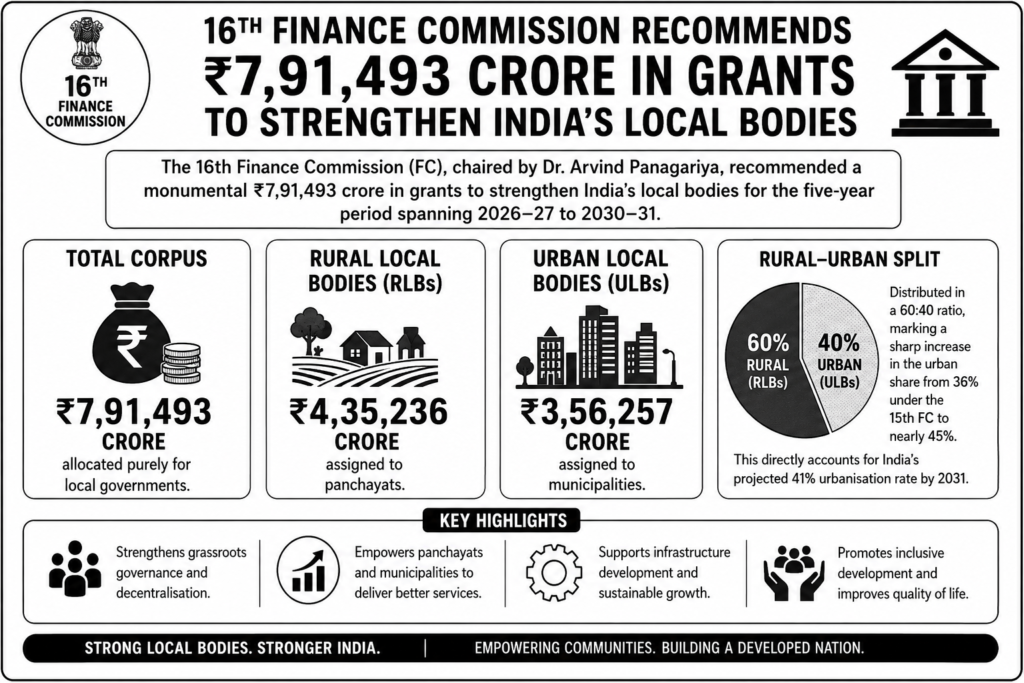
The 16th Finance Commission (FC) report was tabled in Parliament on February 1, 2026, along with the Union Budget. The Government has accepted key tax devolution and grant recommendations for the period 2026–27 to 2030–31.

16th finance commission recommendations

Key Recommendations:

1. Vertical Devolution (Centre–State Share)

  • 41% of divisible tax pool allocated to States
  • Unchanged from the 15th Finance Commission
  • Ensures continuity and fiscal stability for States

2. Grants-in-Aid (2026–27)

  • Total allocation: β‚Ή1.4 lakh crore
  • Includes:
    • Grants to Rural Local Bodies (Panchayats)
    • Grants to Urban Local Bodies (Municipalities)
    • Disaster management funding

Horizontal Devolution Formula (2026–31)

CriterionΒ 15th FC Weight (2021–26)
16th FC Weight (2026–31)
Income Distance
45.0%
42.5%
Population (2011 Census)15.0%
17.5%
Demographic Performance12.5%10.0%
Area15%10%
Forest & Ecology10%10%
Contribution to GDPΒ (New)10%
Tax and Fiscal Effort2.5%

Background:

The Finance Commission is a constitutional body under Article 280. Constituted every 5 years by the President of India. Functions:

  • Recommend tax sharing (Centre–State)
  • Suggest grants-in-aid
  • Promote fiscal federalism

16th Finance Commission

  • Chairman: Dr. Arvind Panagariya
  • Award Period: 2026–27 to 2030–31
https://www.pib.gov.in/PressReleasePage.aspx?PRID=2221390&reg=3&lang=2: 16th Finance Commission Recommendations 2026 – Key Highlights, Devolution Formula & Fiscal Reforms (UPSC/PSC Notes)

16th Finance Commission Recommendations 2026 – Key Highlights, Devolution Formula & Fiscal Reforms (UPSC/PSC Notes) Read More Β»

Motion of Thanks Passed Without PM Reply – Constitutional Significance, Article 87 Explained for UPSC, APPSC, TGPSC and other state PSC exams

Why in News?

The Lok Sabha passed the Motion of Thanks on the President’s Address without a reply from Prime Minister. This happened amid continuous protests by the Opposition, making it an unusual parliamentary development.

motion of thanks

Key Highlights

  • Motion of Thanks passed in Lok Sabha without the Prime Minister’s customary reply.
  • Normally, the PM responds to debates before the motion is put to vote.
  • Opposition protests disrupted proceedings.
  • Despite disruptions, the motion was adopted by majority.

What is Motion of Thanks?

A formal parliamentary motion expressing gratitude to the President for the address. Moved in:

  • Lok Sabha
  • Rajya Sabha

Occasions:

  • First session after General Elections
  • First session of every year (Budget Session)

Constitutional basis:

  • Article 87
https://www.thehindu.com/news/national/lok-sabha-passes-resolution-motion-of-thanks-on-president-address-pm-address/article70594740.ece: Motion of Thanks Passed Without PM Reply – Constitutional Significance, Article 87 Explained for UPSC, APPSC, TGPSC and other state PSC exams

Motion of Thanks Passed Without PM Reply – Constitutional Significance, Article 87 Explained for UPSC, APPSC, TGPSC and other state PSC exams Read More Β»

President’s Address to Parliament 2026 – Budget Session, Article 87 & Key Constitutional Provisions Explained

Why in News?

Droupadi Murmu addressed the joint sitting of Parliament at the beginning of the Budget Session 2026. The address outlined the government’s roadmap for achieving a Viksit Bharat and highlighted major policy priorities

president’s address parliament

President’s Address – Constitutional Basis

Governed by:

  • Article 87

Mandatory occasions:

  • First session after general elections to Lok Sabha
  • First session of each year (Budget Session)

Purpose:

  • Outlines government policies, achievements, and future agenda
  • Acts as a policy direction statement for Parliament
Motion of Thanks:
  • Moved after President’s Address in both Houses
  • Must be passed in Lok Sabha and Rajya Sabha

Key Implication

  • If defeated in Lok Sabha:
    • Considered as No-Confidence Motion
    • Government must resign
https://ddnews.gov.in/en/president-murmu-addresses-parliament-on-opening-day-of-budget-session-calls-2026-pivotal-for-viksit-bharat/: President’s Address to Parliament 2026 – Budget Session, Article 87 & Key Constitutional Provisions Explained

President’s Address to Parliament 2026 – Budget Session, Article 87 & Key Constitutional Provisions Explained Read More Β»

National Commission for Scheduled Tribes (NCST) – 23rd Foundation Day | Article 338A, Functions & Composition

Why in News?

The 23rd Foundation Day of the National Commission for Scheduled Tribes (NCST) was recently celebrated in New Delhi. It highlights the role of NCST in protecting the rights of Scheduled Tribes (STs) in India.

national commission for scheduled tribes

National Commission for Scheduled Tribes

  • NCST is a constitutional body established under Article 338A of the Indian Constitution.
  • It works for the protection, welfare, and development of Scheduled Tribes.
  • Formed after the Constitution (89th Amendment) Act, 2003.

Separation of Commissions (2003):

  • Earlier: A single body for SCs & STs
  • After Amendment:
    • National Commission for Scheduled Castes (NCSC) – Article 338
    • National Commission for Scheduled Tribes (NCST) – Article 338A
Composition of NCST:
  • Chairperson
  • Vice-Chairperson
  • 3 other Members
Appointment & Tenure:
  • Appointed by the President of India
  • Tenure: 3 years
Functions of NCST
  • Investigate and monitor safeguards for STs
  • Inquire into complaints regarding deprivation of rights
  • Advise on planning process for socio-economic development
  • Present reports to the President annually
https://www.pib.gov.in/PressReleasePage.aspx?PRID=2230380&reg=3&lang=1: National Commission for Scheduled Tribes (NCST) – 23rd Foundation Day | Article 338A, Functions & Composition

National Commission for Scheduled Tribes (NCST) – 23rd Foundation Day | Article 338A, Functions & Composition Read More Β»

Supreme Court Hearing on CAA Petitions from May 5 – Key Points for UPSC & PSC Exams

Why in News?

The Supreme Court of India has scheduled final hearings from May 5, 2026 on more than 250 petitions challenging the Citizenship (Amendment) Act, 2019 (CAA). The petitions question the constitutional validity of the Act, especially on grounds of alleged religious discrimination.

citizenship amendment act

Key Highlights:

  • The CAA amends the Citizenship Act, 1955.
  • It provides fast-track Indian citizenship to certain migrants facing religious persecution.
  • Eligible communities: Hindus, Sikhs, Buddhists, Jains, Parsis, and Christians.
  • Countries covered: Afghanistan, Bangladesh, and Pakistan.
  • Cut-off date: Migrants must have entered India on or before 31 December 2014.
  • It reduces the residency requirement for citizenship from 11 years to 5 years for eligible migrants.
  • Over 250 petitions challenge the Act’s constitutionality, mainly citing violation of Article 14 (Right to Equality). The Supreme Court will now conduct final hearings, which could have major constitutional implications
https://www.indiatoday.in/india/law-news/story/supreme-court-caa-final-hearing-may-5-iuml-plea-petitions-2870995-2026-02-19: Supreme Court Hearing on CAA Petitions from May 5 – Key Points for UPSC & PSC Exams

Supreme Court Hearing on CAA Petitions from May 5 – Key Points for UPSC & PSC Exams Read More Β»