Why is the Supreme Court Judges Increase in News?
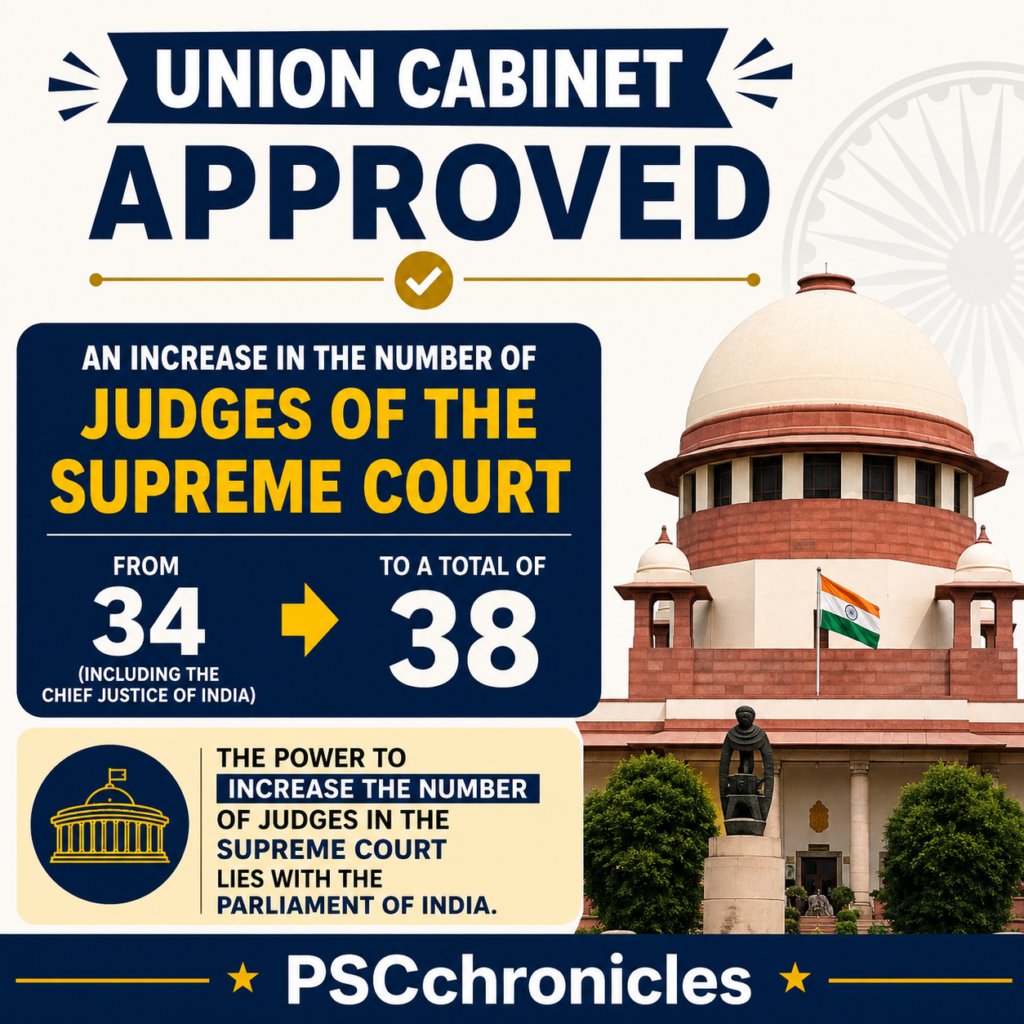
The Union Cabinet has approved the Supreme Court Judges Increase proposal, raising the sanctioned strength of judges in the Supreme Court of India from 34 to 38, including the Chief Justice of India (CJI).
The decision was taken to address the growing burden of pending cases in the judiciary. At present, nearly 92,000 cases are pending before the Supreme Court, creating delays in justice delivery.
Key Highlights of Supreme Court Judges Increase
Increase in Judicial Strength
- Existing sanctioned strength: 34 judges
- New proposed strength: 38 judges
- Increase approved by: Union Cabinet
- Objective: Faster disposal of pending cases
The move is expected to strengthen the efficiency of the apex court and reduce judicial delays.
Why Was the Increase Needed?
India’s judiciary has been facing a significant backlog of cases for several years. The Supreme Court, being the highest judicial authority, handles:
- Constitutional matters
- Appeals from High Courts
- Public Interest Litigations (PILs)
- Centre-State disputes
- Fundamental Rights cases
The rising number of litigations and increasing complexity of cases have led to the need for more judges.
Constitutional Basis for Supreme Court Judges Increase
Article 124 of the Constitution
The power to determine the number of judges in the Supreme Court lies with the Parliament of India.
Under Article 124(1) of the Constitution:
The Supreme Court shall consist of a Chief Justice of India and such number of other judges as Parliament may by law prescribe.
This means the Constitution does not permanently fix the number of judges. Parliament can increase or decrease the strength through legislation.
Practice Questions
- The strength of Supreme Court judges has been increased from 34 to:
- a) 35
- b) 36
- c) 38
- d) 40
- Under which Article does Parliament have the power to determine the number of Supreme Court judges?
- a) Article 32
- b) Article 124
- c) Article 136
- d) Article 143
- The Supreme Court of India was established in:
- a) 1947
- b) 1949
- c) 1950
- d) 1952
- Which institution approved the increase in Supreme Court judges in 2026?
- a) Parliament
- b) Supreme Court Collegium
- c) Union Cabinet
- d) Law Commission
To study current affairs from exam point of view, Click here
Why is the Supreme Court Judges Increase in News? Read More »