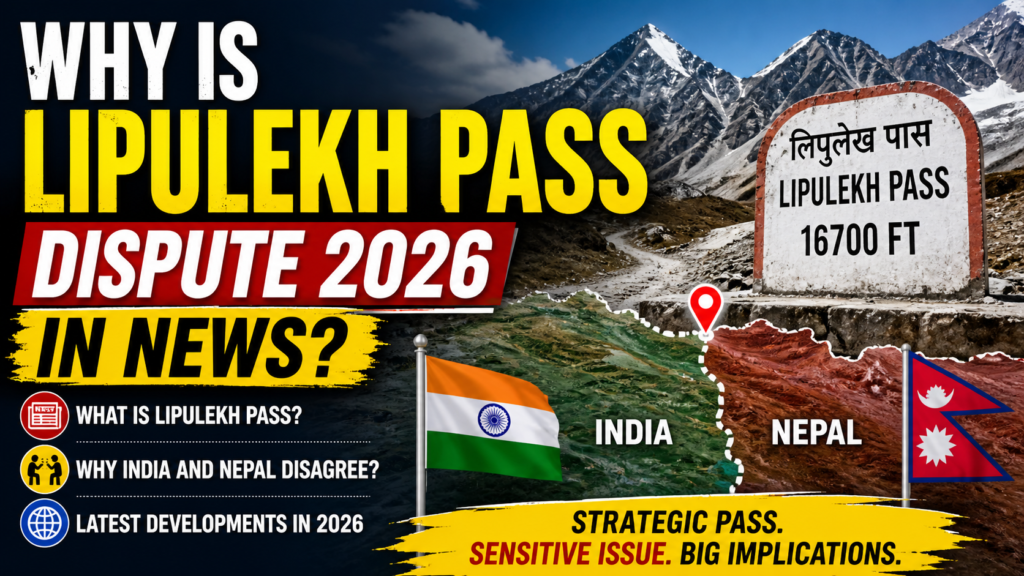
The Lipulekh Pass Dispute has come into focus after Nepal objected to India and China planning to conduct the Kailash Mansarovar Yatra through the Lipulekh Pass. The Nepal government, led by Balen Shah, raised concerns over sovereignty and territorial claims.
What is the Lipulekh Pass Dispute?
The Lipulekh Pass Dispute revolves around differing interpretations of the India-Nepal border near the tri-junction area.
Key Points of the Dispute
- Nepal claims that the Lipulekh Pass falls within its territory based on historical maps and river origins.
- India maintains that the area has traditionally been under its administrative control.
- The dispute intensified after India inaugurated a road to Lipulekh in 2020 to facilitate the Kailash Mansarovar Yatra.
- The issue also involves China, as the pass connects to Tibet (China-controlled region).
About Lipulekh Pass
Geographical Features
- Located in Pithoragarh district, Uttarakhand.
- Situated at an altitude of approximately 5,334 meters (17,500 feet).
- Lies at the tri-junction of India, Nepal, and Tibet (China).
- Part of the Kumaon Himalayas.
River Association
- Associated with the Kali River (Mahakali/Sharda).
- The river forms a major part of the India-Nepal boundary.
- The origin of this river is central to the boundary dispute.
Strategic and Economic Importance
- Serves as a key route for the Kailash Mansarovar Yatra.
- Connects India to Taklakot (Purang) in Tibet.
- Holds strategic military importance due to proximity to China.
- Facilitates trade and pilgrimage routes.
Historical Background: Treaty of Sugauli
The roots of the Lipulekh Pass Dispute lie in the Treaty of Sugauli.
- Signed on 2 December 1815.
- Agreement between the British East India Company and the Kingdom of Nepal.
- Ended the Anglo-Nepalese War (1814–1816).
- Defined the Kali River as the western boundary of Nepal.
Core Issue
The dispute arises due to different interpretations of the Kali River’s origin:
- Nepal claims the river originates from Limpiyadhura, placing Lipulekh within Nepal.
- India considers the origin near Kalapani, placing Lipulekh within Indian territory.
Practice Questions
- Which river forms the basis of the India-Nepal boundary dispute in the Lipulekh region?
a) Ganga
b) Brahmaputra
c) Kali River
d) Indus - The Treaty of Sugauli (1815) was signed between Nepal and which entity?
a) British Crown
b) East India Company
c) Mughal Empire
d) China - Lipulekh Pass is located in which Indian state?
a) Himachal Pradesh
b) Uttarakhand
c) Sikkim
d) Arunachal Pradesh - The Lipulekh Pass connects India to which Tibetan town?
a) Lhasa
b) Shigatse
c) Taklakot
d) Gyantse
To study current affairs from exam point of view, Click here