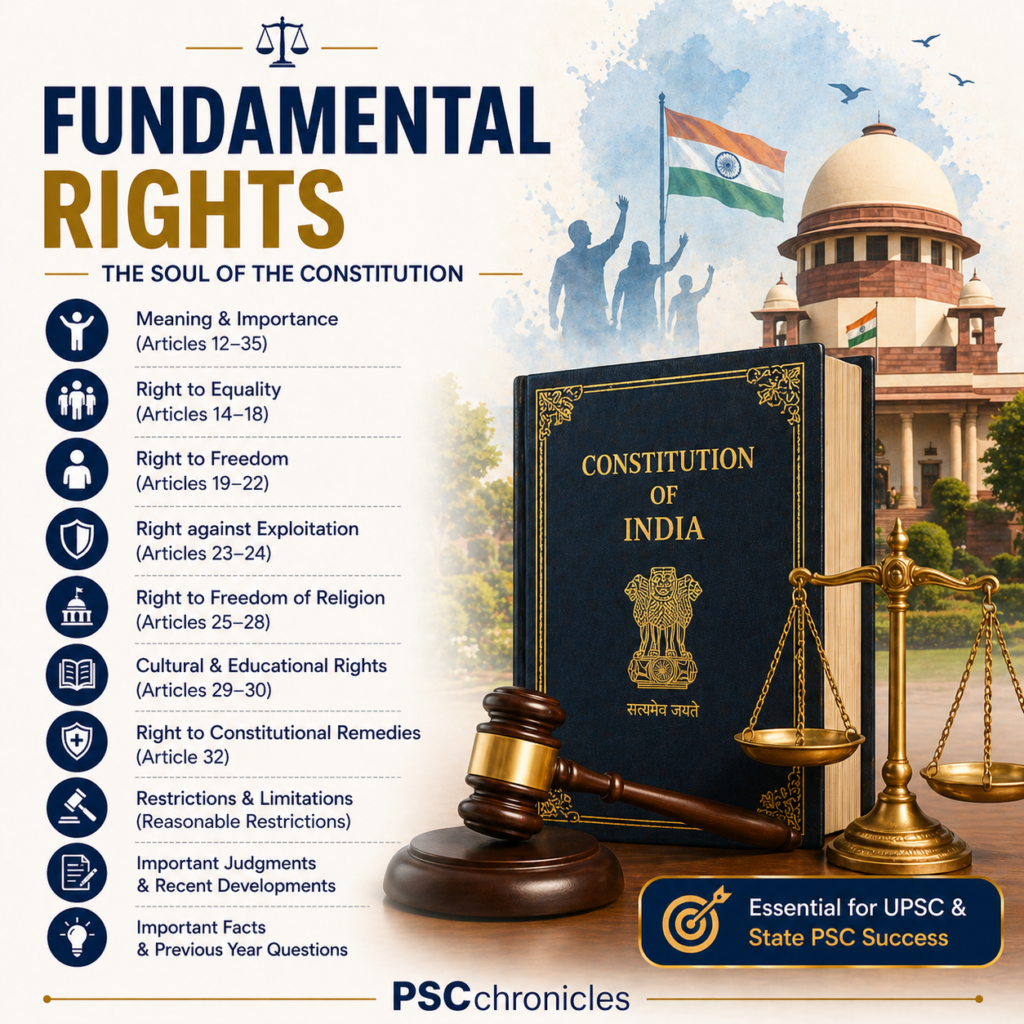
Fundamental Rights Practice Questions for UPSC and State PSC exams Leave a Comment / Practice Questions Indian Polity / By PSC Chronicles Team 1. Fundamental Rights are enshrined in which Part of Constitution? Part II Part III Articles 12-35 Part IV Part VPart III (Articles 12-35) contains Fundamental Rights. They are justiciable, enforceable by Supreme Court under Article 32 and High Courts under Article 226.2. Article 12 defines ‘State’ for Fundamental Rights to include: Government and Parliament of India, State legislatures, local authorities, other authorities Only Union Only Judiciary Private individualsArticle 12 gives expansive definition to ensure FRs enforceable against governmental and quasi-governmental bodies. Supreme Court expanded ‘other authorities’ to include bodies performing public functions (R.D. Shetty).3. Article 13 declares laws inconsistent with FRs as: Valid Void to extent of inconsistency Directory AdvisoryArticle 13(2) prohibits State from making laws abridging FRs; such laws void. Includes constitutional amendments? Initially yes (Golaknath), later limited by basic structure.4. Right to Equality is guaranteed under Articles: 12-13 14-18 19-22 23-24Articles 14-18: equality before law, prohibition of discrimination, equality of opportunity, abolition of untouchability, abolition of titles.5. Article 14 provides: Equality before law and equal protection of laws Only equality before law Only protection ReservationBorrowed from UK and US. Equality before law (negative, no privilege), equal protection (positive, like treatment in like circumstances). Permits reasonable classification.6. Reasonable classification under Article 14 must be based on: Intelligible differentia and rational nexus to objective Arbitrary Political Economic onlyTest laid in Anwar Ali Sarkar case. Classification must not be arbitrary.7. Article 15 prohibits discrimination on grounds of: Religion, race, caste, sex, place of birth Only caste Only religion IncomeArticle 15(1): State shall not discriminate. Clauses 3-6 permit special provisions for women, children, SC/ST, OBC, EWS.8. Article 15(4) enabling reservations for SC/ST/OBC was added by: First Amendment 1951 42nd 44th 86thAfter State of Madras v Champakam Dorairajan struck down caste-based reservations, First Amendment added 15(4).9. Article 15(5) for educational institutions (including private) added by: 93rd Amendment 2005 86th 42nd 44th93rd Amendment enabled reservations for SC/ST/OBC in admissions to private unaided institutions except minority institutions.10. Article 15(6) for EWS reservation added by: 103rd Amendment 2019 102nd 101st 100th103rd Amendment inserted 15(6) and 16(6) providing up to 10% reservation for Economically Weaker Sections, upheld in Janhit Abhiyan 2022.11. Article 16 provides: Equality of opportunity in public employment Right to property Freedom of speech Right to educationArticle 16(1)(2): no discrimination in public employment. Clauses 3-6 permit residence, reservations for backward classes, SC/ST promotions, EWS.12. Article 16(4) allows: Reservation for backward classes inadequately represented Only merit No reservation Only SCEnables state to reserve posts. Indra Sawhney 1992 capped at 50%, excluded creamy layer.13. Article 16(4A) for SC/ST promotions added by: 77th Amendment 1995 76th 85th 81st77th Amendment enabled reservation in promotions for SC/ST. 85th Amendment 2001 provided consequential seniority.14. Article 17 abolishes: Untouchability Titles Begar SlaveryArticle 17 abolishes untouchability, forbids its practice. Enforced by Protection of Civil Rights Act 1955.15. Article 18 abolishes: Titles Untouchability Discrimination SlaveryArticle 18 prohibits state from conferring titles except military/academic. Prevents colonial honors.16. Right to Freedom under Articles 19-22 includes: Six freedoms under Art 19 Only speech Only assembly Only movementArticle 19(1): speech, assembly, association, movement, residence, profession. Reasonable restrictions under 19(2)-(6).17. Freedom of speech and expression under Article 19(1)(a) includes: Press freedom, right to information Only speaking Only writing Only shoutingSC interpreted to include press, commercial speech, silence, RTI (implicit).18. Reasonable restrictions on Article 19 include: Sovereignty, security, public order, decency, contempt, defamation, incitement No restrictions Only security Only public orderArticle 19(2)-(6) enumerate grounds.19. Article 20 provides protection in respect of conviction for offences: Ex post facto, double jeopardy, self-incrimination Only double jeopardy Only self Only ex postArticle 20(1) no ex post facto, (2) no double jeopardy, (3) no self-incrimination. Available to all persons.20. Article 21 provides: Protection of life and personal liberty Only life Only liberty PropertyNo person deprived except procedure established by law. Expanded by Maneka Gandhi 1978 to due process, includes dignity, privacy, livelihood.21. Right to Privacy was held fundamental under Article 21 in: K.S. Puttaswamy 2017 Maneka ADM Jabalpur Golaknath9-judge bench overruled ADM Jabalpur, held privacy intrinsic to life and liberty.22. Article 21A provides Right to Education for children aged: 6-14 years 0-6 14-18 AllInserted by 86th Amendment 2002, made elementary education fundamental right.23. Article 22 provides protection against: Arrest and detention Only arrest Only detention TaxationArticle 22(1)(2): rights of arrested person – informed grounds, lawyer, produced before magistrate within 24 hrs. (4)-(7) preventive detention safeguards.24. Preventive detention maximum period without advisory board is: 3 months 6 months 1 year No limitArticle 22(4): beyond 3 months requires Advisory Board approval.25. Right against Exploitation Articles 23-24 prohibit: Traffic in human beings, begar, child labour under 14 in hazardous Only begar Only traffic Only child labourArticle 23 prohibits trafficking and forced labour; Article 24 prohibits child labour under 14 in factories/mines.26. Right to Freedom of Religion Articles 25-28 provide: Freedom of conscience, profession, practice, propagation Only worship Only belief State religionArticle 25 subject to public order, morality, health. State can regulate secular activities.27. Article 26 gives religious denominations right to: Manage religious affairs Only worship Convert NoneSubject to public order, morality, health.28. Article 27 prohibits: Compulsory taxes for promotion of particular religion All taxes Religious practice ConversionNo person compelled to pay taxes for religious promotion.29. Article 28 prohibits religious instruction in: State-funded educational institutions wholly maintained by state All schools Private schools Minority schoolsNo religious instruction in state institutions; in state-aided, no compulsion.30. Cultural and Educational Rights Articles 29-30 protect: Minorities’ language, script, culture, right to establish institutions Only majority Only SC/ST Only womenArticle 29 protects minorities’ culture; Article 30 right to establish and administer educational institutions.31. Article 30 applies to: Religious and linguistic minorities Only religious Only linguistic AllBoth religious and linguistic minorities can establish institutions, state shall not discriminate in aid.32. Right to Constitutional Remedies under Article 32 is called: Heart and soul of Constitution by Ambedkar Basic Directive DutyArticle 32 allows direct move to SC for FR enforcement. Writs: habeas corpus, mandamus, certiorari, prohibition, quo warranto.33. Article 32 can be suspended during emergency except for Articles 20 and 21 after: 44th Amendment 42nd 38th 1st44th Amendment protected Articles 20 and 21 from suspension under Article 359.34. Writ jurisdiction of High Courts is under: Article 226 Article 32 Article 136 Article 227Article 226 wider than 32 – for FRs and other legal rights.35. Fundamental Rights are available against: State as defined in Article 12 Private individuals generally Only Union Only statesPrimarily vertical against State. Some rights like Article 17,23,24 enforceable horizontally against private individuals.36. Article 15(2) prohibits discrimination in access to: Shops, public restaurants, wells, roads Only jobs Only education Only templesExtends to private individuals for public places.37. Right to property was originally Fundamental Right under Article 31, deleted by: 44th Amendment 1978 42nd 1st 86thMade legal right under Article 300A.38. Present status of Right to Property: Constitutional legal right under Article 300A Fundamental Right Directive DutyCan be regulated by law, not fundamental.39. Article 33 empowers Parliament to: Restrict FRs for armed forces, police Expand FRs Abolish FRs Suspend FRsTo ensure discipline.40. Article 34 provides for: Restriction of FRs during martial law Emergency Preventive detention PropertyParliament can indemnify acts during martial law.41. Article 35 gives power to make laws on FRs to: Parliament only, not state legislatures States Both PresidentEnsures uniformity.42. Doctrine of severability is related to: Article 13 Article 14 Article 19 Article 21If part of law violates FR, only that part void, not whole.43. Doctrine of eclipse applies to: Pre-constitutional laws inconsistent with FRs become dormant Post-constitutional All NoneLaws become eclipsed, not void ab initio, revived by amendment.44. Judicial review of FRs is part of: Basic structure Not basic Directive OrdinaryKesavananda and Minerva Mills held judicial review basic.45. Right to Equality includes: Rule of law Arbitrariness Discrimination PrivilegeArticle 14 embodies rule of law, prohibits arbitrariness (E.P. Royappa).46. Reservation for EWS up to 10% was upheld in: Janhit Abhiyan 2022 Indra Sawhney Mandal NagarajSC upheld 103rd Amendment 3:2.47. Creamy layer concept applies to: OBC reservations, not SC/ST SC/ST EWS AllIndra Sawhney excluded creamy layer from OBC quota.48. Article 19 freedoms are available to: Citizens only All persons Foreigners CompaniesArticle 19(1) explicitly for citizens. Companies get via shareholders.49. Freedom of press is: Implicit in Article 19(1)(a) Explicit Not guaranteed BannedSC read press freedom into speech.50. Right to assemble peaceably under Article 19(1)(b) is subject to: Reasonable restrictions in interest of sovereignty, public order No restriction Only security Only moralityArticle 19(3).51. Right to form associations under 19(1)(c) includes: Trade unions Only political parties Only companies NoneSubject to reasonable restrictions.52. Right to move freely under 19(1)(d) can be restricted for: Public interest, ST protection No restriction Only security Only healthArticle 19(5).53. Right to reside under 19(1)(e) subject to: Protection of ST interests No restriction Only public order Only moralityAllows restrictions for tribal protection.54. Right to profession under 19(1)(g) subject to: Professional qualifications, state monopoly No restriction Only tax Only licenseArticle 19(6).55. Article 21 expanded to include: Right to livelihood, education, health, privacy, clean environment Only life Only liberty Only propertyJudicial interpretation post-Maneka.56. Right to speedy trial is part of: Article 21 Article 19 Article 14 Article 32Hussainara Khatoon case.57. Right to legal aid is part of: Article 21 and 39A Article 19 Article 14 Article 32State to provide free legal aid.58. Article 22(1) rights not available to: Enemy aliens and preventive detention detainees All Citizens ForeignersExceptions provided.59. Preventive detention laws include: NSA, COFEPOSA Only NSA None IPCParliament and states can legislate under Entries.60. Article 23 prohibits begar, enforced by: Bonded Labour Abolition Act No law Only Constitution CustomLegislation gives effect.61. Child labour prohibition under Article 24 strengthened by: Child Labour Prohibition Act No law Only Constitution Factories ActProhibits employment under 14 in hazardous occupations.62. Article 25 freedom subject to: Public order, morality, health, other FRs No restriction Absolute Only moralityReasonable restrictions.63. Shirur Mutt case defined: Essential religious practices test All practices No test Only ritualsSC determines what is essential to religion for protection.64. Article 26 rights subject to: Public order, morality, health No restriction Absolute Only lawDenominational autonomy limited.65. Article 28(3) allows religious instruction in: State-aided minority institutions with consent All state schools No schools Only privateProtects minority rights.66. Article 29(1) protects: Distinct language, script, culture of any section Only minorities Only majority Only SC/STAvailable to any section, not just minorities.67. Article 29(2) prohibits denial of admission to state-aided institutions on grounds of: Religion, race, caste, language Only caste Only religion MeritEnsures non-discrimination.68. Article 30(1) right to establish institutions is: Absolute for minorities, subject to regulation Unlimited No regulation Only for majorityState can regulate for excellence, not to destroy minority character.69. Article 32 writs can be issued by: Supreme Court only High Courts Both DistrictSC for FRs; HC under 226 wider.70. Article 32 is itself a Fundamental Right, hence: Cannot be suspended except under emergency (except 20,21) Can be suspended Abolished AmendedAmbedkar’s heart and soul.71. Public Interest Litigation expanded locus standi for FR enforcement under: Article 32 Article 226 Both NoneRelaxed rules allow public-spirited persons.72. Right to constitutional remedies includes: Five writs Only habeas Only mandamus Only certiorariHabeas corpus, mandamus, prohibition, certiorari, quo warranto.73. Habeas corpus means: Produce the body We command By what authority To certifyProtects personal liberty.74. Mandamus means: We command Produce body Prohibit CertifyCommands public duty.75. Prohibition is issued to: Lower court to prevent excess jurisdiction Release person Command Question officePrevents usurpation.76. Certiorari quashes: Orders of inferior courts/tribunals Legislation Executive policy ConstitutionCorrects jurisdictional errors.77. Quo warranto questions: Authority to hold public office Arrest Tax PropertyPrevents usurpation of office.78. Fundamental Rights can be amended: Yes, but not destroy basic structure No Always NeverKesavananda limits.79. Article 13(4) inserted by 24th Amendment states: Constitutional amendments not law under Article 13 All laws void No amendment Only FROverruled Golaknath.80. Doctrine of basic structure limits: Parliament’s power to amend FRs Executive Judiciary StatesFRs part of basic structure.81. Right to property as legal right can be deprived by: Authority of law under Article 300A Executive order No law PresidentRequires law, not executive fiat.82. Article 15(3) permits special provisions for: Women and children Only men Only SC Only STEnables affirmative action.83. Article 16(3) allows Parliament to prescribe: Residence within state for public employment Caste Religion LanguageException to equality.84. Article 19(1)(a) does not protect: Hate speech inciting violence Peaceful protest Press ArtReasonable restriction under 19(2).85. Article 21 includes right to die? No, but right to die with dignity in passive euthanasia allowed (Common Cause 2018) Yes active euthanasia No rights Only suicideSC allowed passive euthanasia with safeguards.86. Right to education under 21A made enforceable by: RTE Act 2009 No law Only Constitution DirectiveParliament enacted law.87. Article 22 safeguards do not apply to: Enemy aliens Citizens All ForeignersExclusion for enemy aliens.88. Preventive detention must be communicated grounds within: As soon as may be, except public interest Never 1 year 6 monthsArticle 22(5).89. Article 23 exception allows: Compulsory service for public purposes Forced labour Begar SlaveryState can impose compulsory service without discrimination.90. Article 24 prohibits child labour under 14 in: Hazardous employment All employment Only factories Only minesAbsolute ban in hazardous, later expanded by law.91. Freedom of religion does not include: Right to convert by force or fraud Voluntary propagation Belief PracticeSC upheld anti-conversion laws regulating forced conversions.92. Article 25(2) allows state to: Regulate secular activities associated with religion, provide social reform Ban religion Establish religion NoneEnables temple entry laws, etc.93. Article 28 distinguishes between institutions: Wholly state-funded vs aided/recognized All same Only private Only minorityDifferent rules for religious instruction.94. Article 29 protects: Cultural rights of minorities Only majority Only SC Only STPreserves diversity.95. Article 30 protects: Minorities’ right to administer educational institutions Majority All NoneEnsures autonomy.96. State can regulate minority institutions for: Educational standards, not maladministration Destroy Take over CloseRegulation permissible for excellence.97. Article 32 remedies are: Guaranteed, cannot be taken away Can be suspended Optional AdvisoryCore of FR enforcement.98. High Court writ jurisdiction under 226 is: Wider than SC, for FR and other legal rights Narrower Same NoneDiscretionary, territorial.99. Fundamental Rights aim to: Establish political democracy Economic democracy Social only NoneDPSP aim socio-economic.100. FRs are negative obligations on State to: Not encroach on liberties Provide benefits Ignore PromotePrimarily negative, some positive. Loading … Fundamental Rights MCQsTo study current affairs from exam point of Click hereTo study current affairs from exam point of Click here