📰 Today's Current AffairsRead Now →
📷 Follow on Instagram

Practice Questions on Centre state relations for UPSC and State PSC exams

MCQs on Centre state relations

1. Centre-State relations are divided into:


2. Legislative relations are dealt in Articles:


3. Territorial extent of Parliament’s laws under Article 245:


4. Parliament can make extraterritorial laws under Article 245(2) for:


5. Seventh Schedule divides powers into:


6. Union List originally had:


7. State List originally had:


8. Concurrent List originally had:


9. Residuary powers vest in:


10. In case of conflict between Union and State law on Concurrent List:


11. Parliament can legislate on State List during National Emergency under:


12. Rajya Sabha can authorize Parliament to legislate on State List under Article 249 if:


13. Two or more states can request Parliament to legislate on State subject under:


14. Parliament can legislate on State List to implement international treaties under:


15. President’s rule under Article 356 allows Parliament to:


16. Administrative relations Articles:


17. Article 256 obligates states to:


18. Article 257 gives Centre power to:


19. Failure to comply with Union directions under Article 365 may lead to:


20. All-India Services under Article 312 are:


21. Inter-State Council under Article 263 set up to:


22. Inter-State water disputes adjudicated under:


23. Zonal Councils established under:


24. Financial relations Articles:


25. Taxes levied by Centre but collected and appropriated by states under:


26. Taxes levied and collected by Centre but assigned to states under:


27. Taxes levied and distributed between Centre and States under:


28. Surcharge under Article 271:


29. GST introduced by:


30. GST Council composition:


31. Finance Commission under Article 280 constituted every:


32. 15th Finance Commission recommended:


33. Grants-in-aid to states under:


34. Discretionary grants under:


35. Borrowing powers of states under Article 293:


36. Centre can give loans to states under:


37. Financial Emergency under Article 360 allows Centre to:


38. Sarkaria Commission 1983 dealt with:


39. Punchhi Commission 2007 also examined:


40. Governor’s role in Centre-State relations:


41. Article 356 imposition affects:


42. Cooperative federalism promoted via:


43. Competitive federalism encouraged by:


44. Centre-State legislative conflicts resolved by:


45. Doctrine of pith and substance used to:


46. Doctrine of colourable legislation prevents:


47. Doctrine of territorial nexus allows:


48. Residuary powers include:


49. Parliament’s power to form new states under Article 3 affects:


50. Rajya Sabha represents:


51. Inter-State trade freedom under Articles 301-307 ensures:


52. Article 302 allows Parliament to impose restrictions on trade in:


53. Article 304 allows states to impose:


54. Centre can give directions to states for:


55. All-India Services ensure:


56. NITI Aayog replaced:


57. GST Council decisions require:


58. Finance Commission recommends:


59. Vertical devolution is:


60. Horizontal devolution criteria include:


61. Grants under Article 275 are:


62. Article 282 grants used for:


63. Borrowing limits for states set by:


64. Centre’s control over state borrowing ensures:


65. Inter-State Council chaired by:


66. Zonal Councils chaired by:


67. Article 261 provides:


68. Inter-state water disputes tribunals’ awards are:


69. Supreme Court’s original jurisdiction under Article 131 for:


70. Article 131 excludes:


71. Sarkaria recommended:


72. Punchhi recommended:


73. GST reduced:


74. Compensation to states for GST loss provided for:


75. Centre-State financial tensions arise over:


76. Article 279A created:


77. NITI Aayog’s Governing Council includes:


78. Cooperative federalism example:


79. Competitive federalism example:


80. Article 248 residuary powers include:


81. Parliament’s supremacy in Concurrent List ensured by:


82. State law on Concurrent List can prevail if:


83. President’s assent under 254(2) can be overridden by:


84. Centre can deploy central forces in states under:


85. Financial relations aim at:


86. 15th FC used 2011 population for devolution to:


87. States’ share in central taxes is:


88. Grants for local bodies recommended by:


89. Article 266 creates:


90. Article 267 creates:


91. Public Account under Article 266(2) includes:


92. Centre-State disputes over GST resolved by:


93. Article 258 allows Centre to:


94. Article 258A allows states to:


95. Inter-State Council recommendations are:


96. Zonal Councils discuss:


97. Centre-State relations in planning shifted from:


98. Article 293(4) allows Centre to:


99. States cannot raise foreign loans due to:


100. Financial autonomy of states limited by:


To study current affairs from exam point of view Click here

To Practice more Questions from exam point of view, Click here
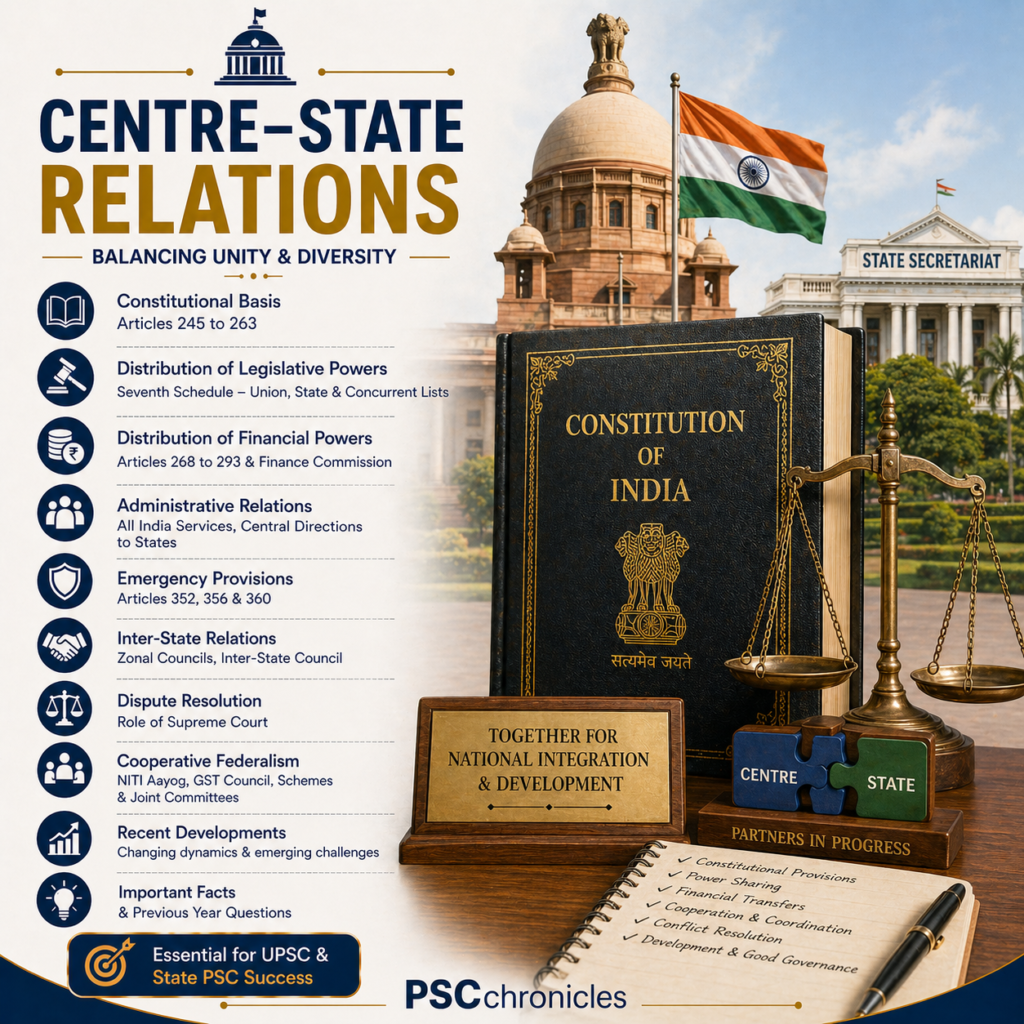
mcqs on centre state relations

Leave a Comment

Your email address will not be published. Required fields are marked *