Why in News?
India’s first indigenously developed manned deep-sea submersible, Matsya 6000, is expected to begin initial ocean operations this year with shallow-water demonstrations up to 500 metres, according to the National Institute of Ocean Technology (NIOT).
- The development is part of the Samudrayaan Project under the Deep Ocean Mission of the Ministry of Earth Sciences.
- The submersible will support marine biodiversity studies and exploration of deep-sea mineral resources.
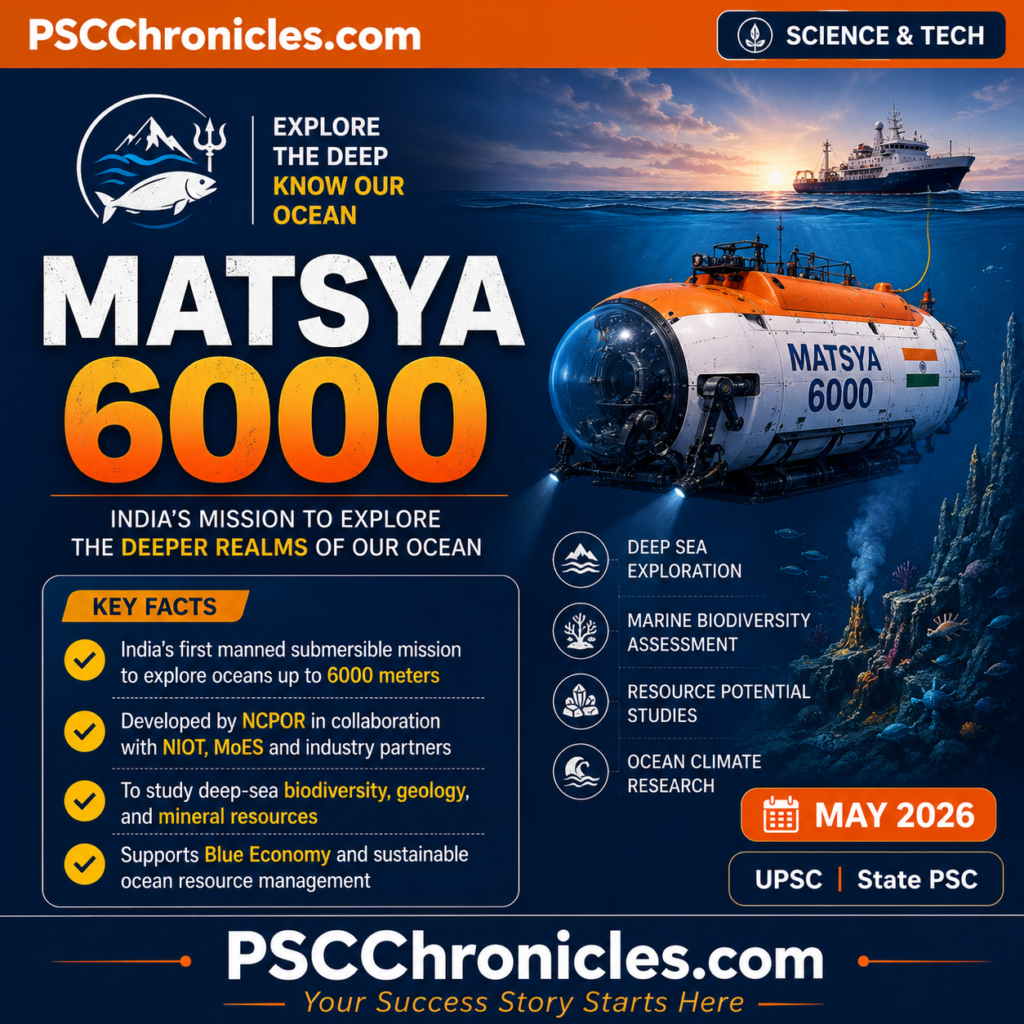
What is Matsya 6000?
Matsya 6000 is India’s first human-carrying deep-sea submersible designed to transport scientists into the deep ocean.
Key features include:
- Diving capability up to 6,000 metres
- Capacity to carry a crew for scientific missions
- 12–16 hours of normal underwater operations
- 96-hour emergency life-support system
- Indigenous technology developed by NIOT, Chennai
The submersible is expected to facilitate exploration of polymetallic nodules and other mineral resources located in the deep ocean.
Background: Deep Ocean Mission
The Deep Ocean Mission was launched in 2021 by the Ministry of Earth Sciences to develop technologies for sustainable exploration and utilization of ocean resources.
Major Components of Deep Ocean Mission
- Development of technologies for deep-sea mining and manned submersibles.
- Ocean climate change advisory services.
- Exploration and conservation of deep-sea biodiversity.
- Deep Ocean Survey and Exploration.
- Energy and freshwater generation from oceans.
- Advanced Marine Station for Ocean Biology.
Samudrayaan Project
The Samudrayaan Project is a flagship initiative under the Deep Ocean Mission focused on manned deep-sea exploration. Matsya 6000 serves as its primary technological platform for carrying scientists to extreme ocean depths.
Significance
The launch of Matsya 6000 Ocean Operations 2026 will strengthen India’s capabilities in deep-sea exploration and resource assessment. It supports strategic access to critical minerals found in the seabed and advances research on marine ecosystems. The project also contributes to India’s long-term blue economy objectives and technological self-reliance in ocean sciences.
Quick Revision Box
| Particular | Details |
|---|---|
| Project | Matsya 6000 Ocean Operations 2026 |
| Developed by | National Institute of Ocean Technology (NIOT), Chennai |
| Ministry | Ministry of Earth Sciences (MoES) |
| Associated Programme | Samudrayaan Project |
| Mission | Deep Ocean Mission |
| Initial Demonstration Depth | 500 metres |
| Maximum Diving Capacity | 6,000 metres |
| Operational Endurance | 12–16 hours |
| Emergency Life Support | 96 hours |
| Key Objectives | Deep-sea mining, biodiversity mapping, blue economy |
Practice MCQs
Q1. Matsya 6000 has been developed by which organisation?
a) ISRO
b) DRDO
c) NIOT
d) CSIR
Answer: (c) NIOT — The National Institute of Ocean Technology developed Matsya 6000.
Q2. Matsya 6000 is associated with which project?
a) Mausam Project
b) Samudrayaan Project
c) Sagarmala Project
d) Project Varuna
Answer: (b) Samudrayaan Project — It is India’s manned deep-sea exploration initiative.
Q3. What is the maximum diving capability of Matsya 6000?
a) 500 m
b) 2,000 m
c) 4,000 m
d) 6,000 m
Answer: (d) 6,000 m — The submersible is designed for deep-ocean exploration up to 6,000 metres.
Q4. The Deep Ocean Mission was launched in which year?
a) 2019
b) 2020
c) 2021
d) 2022
Answer: (c) 2021 — The mission was launched by the Ministry of Earth Sciences.
To study more current affairs from exam point of view, Click here
To know more about matsya 6000, Click here