📰 Today's Current AffairsRead Now →
📷 Follow on Instagram

PSC Chronicles Team

Amaravati Quantum Valley Project 2026: India’s First Integrated Quantum Ecosystem in Andhra Pradesh

Why in News?

Andhra Pradesh has laid the foundation stone for the Amaravati Quantum Valley (AQV) project.
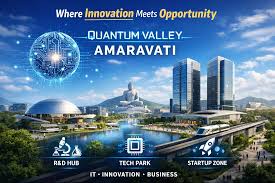
amaravati quantum valley (aqv) project.

Amaravati Quantum Valley (AQV) project:

Location: Uddandarayunipalem village, Amaravati (Andhra Pradesh) AQV is envisioned as India’s first integrated quantum ecosystem. Major Technology Partners:

  • IBM India
  • Tata Consultancy Services (TCS)
  • Larsen & Toubro (L&T)

Key Facilities under AQV:

QChipIN

  • India’s largest open quantum testbed
  • Expected completion within 12 months

Quantum Innovation Centre

  • Joint initiative by IBM & TCS
  • Acts as a research and development hub

Quantum Reference Facility

  • To be established by SRM University
  • Focus on academic research and training

Cryogenic Component Facility

  • Investment: ₹200 crore by Amber Group
  • India’s first facility for quantum cryogenic components
https://www.pib.gov.in/PressReleasePage.aspx?PRID=2225097&reg=3&lang=2: Amaravati Quantum Valley Project 2026: India’s First Integrated Quantum Ecosystem in Andhra Pradesh

Amaravati Quantum Valley Project 2026: India’s First Integrated Quantum Ecosystem in Andhra Pradesh Read More »

Kondaveedu Fort Development: Centre Plans Holistic Revamp of Andhra Pradesh’s Largest Hill Fort

Why in News?

Union Government has announced a comprehensive development plan for Kondaveedu Fort in Andhra Pradesh.

kondaveedu fort

Kondaveedu Fort:

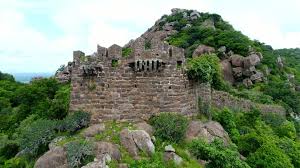
  • Kondaveedu Fort is a 14th-century hill fortress located in Palnadu district, Andhra Pradesh.
  • The fort was established by Prolaya Vema Reddy in the early 14th century.
  • It served as the capital of the Reddy Kingdom (1328–1482).
  • After the decline of the Reddy dynasty, the fort came under various rulers: Gajapatis of Odisha, Vijayanagara Empire (captured by Sri Krishnadevaraya in 1516), Golconda Sultanate, French and British
  • The fort is known for its strategic hilltop location and historical significance.
https://www.deccanchronicle.com/southern-states/andhra-pradesh/union-minister-promises-comprehensive-development-of-kondaveedu-fort-1935755: Kondaveedu Fort Development: Centre Plans Holistic Revamp of Andhra Pradesh’s Largest Hill Fort

Kondaveedu Fort Development: Centre Plans Holistic Revamp of Andhra Pradesh’s Largest Hill Fort Read More »

‘Pashu Aushadhi’ Centres in Andhra Pradesh

Why in News?

The Andhra Pradesh Government has announced the establishment of ‘Pashu Aushadhi Vikraya Kendras’ across all districts.

‘pashu aushadhi vikraya kendras’

Key Highlights:

The initiative aims to provide affordable generic veterinary medicines and strengthen livestock healthcare.

1. Implementation Framework

  • Implemented by:
    • Department of Animal Husbandry & Dairy Development (AP)
  • In coordination with:
    • Central Government under National Animal Disease Control Programme (NADCP)

2. Mode of Establishment

  • Centres will be set up through:
    • Pradhan Mantri Kisan Samriddhi Kendras (PM-KSKs)
    • Cooperative Societies

3. Financial Incentive

  • 20% operating margin incentive provided to centres
https://www.thehindu.com/news/national/andhra-pradesh/andhra-pradesh-to-set-up-pashu-aushadhi-centres-in-all-districts/article70587424.ece: ‘Pashu Aushadhi’ Centres in Andhra Pradesh

‘Pashu Aushadhi’ Centres in Andhra Pradesh Read More »

Union Budget 2026–27: Key Benefits for Andhra Pradesh – Rare Earth Corridor, High-Speed Rail-APPSC Exams

Why in News?

The Union Budget 2026–27 announced several infrastructure, mining, and digital economy initiatives benefiting Andhra Pradesh

union budget 2026

Key announcements for AP

1. Rare Earth Corridor (REC)

  • Andhra Pradesh identified as one of the mineral-rich states under the Rare Earth Corridor initiative

2. High-Speed Rail Corridors (HSRCs)

  • Andhra Pradesh to benefit from:
    • Hyderabad–Bengaluru High-Speed Rail Corridor
    • Hyderabad–Chennai High-Speed Rail Corridor

3. Visakhapatnam Data Centre Boost

  • Hyperscale data centre proposed in Visakhapatnam
    • By Google (via Raiden Infotech)

4. Ecotourism Development

  • Key projects:
    • Bird-watching trails at Pulicat Lake
    • Ecological mountain trail in Araku Valley
https://www.newindianexpress.com/states/andhra-pradesh/2026/Feb/02/execution-key-for-andhra-pradesh-to-leverage-budget-benefits: Union Budget 2026–27: Key Benefits for Andhra Pradesh – Rare Earth Corridor, High-Speed Rail-APPSC Exams

Union Budget 2026–27: Key Benefits for Andhra Pradesh – Rare Earth Corridor, High-Speed Rail-APPSC Exams Read More »

White Revolution 2.0: Government Initiative to Boost Dairy Sector & Women Empowerment (UPSC/PSC Notes)

Why in News?

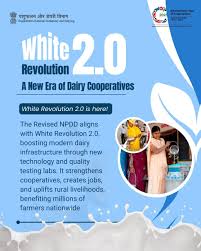
The Government of India has launched “White Revolution 2.0” under the Ministry of Cooperation

“white revolution 2.0

Key Highlights:

1. Objective of White Revolution 2.0

  • Expand cooperative coverage in dairy sector
  • Promote women empowerment
  • Generate rural employment
  • Improve market access for dairy farmers

2. Milk Procurement Target

  • Increase milk procurement by 50% in 5 years
  • Target: 1,007 lakh kg per day by 2028–29

3. Strategy (Two-Pronged Approach)

  • Expansion
    • Establish 75,000 new Dairy Cooperative Societies (DCS) in uncovered areas
  • Strengthening Existing Network
    • Upgrade 46,422 existing DCS
    • Improve:
      • Market access
      • Farmer income
      • Supply chain efficiency

Background-White Revolution (Operation Flood)

  • Known as Operation Flood
  • Objective:
    • Transform India into a self-sufficient milk producer
  • Achievements:
    • India became the world’s largest milk producer by 1998
  • Key Personality
    • Dr. Verghese Kurien
    • Known as the “Father of White Revolution”
    • Founder of NDDB (National Dairy Development Board)
https://ddnews.gov.in/en/centre-launches-white-revolution-2-0-to-boost-womens-role-in-dairy-sector/: White Revolution 2.0: Government Initiative to Boost Dairy Sector & Women Empowerment (UPSC/PSC Notes)

White Revolution 2.0: Government Initiative to Boost Dairy Sector & Women Empowerment (UPSC/PSC Notes) Read More »

No-Confidence Motion Against Lok Sabha Speaker: Removal Process, Articles & Key Facts (UPSC/PSC Notes)

Why in News?

Opposition parties have submitted a no-confidence motion seeking the removal of Lok Sabha Speaker . The notice has met the minimum support requirement, and the motion may be taken up after the mandatory 14-day notice period.

no confidence motion

Procedure for Removal of Speaker

Article 94(c) → Provides for removal of the Lok Sabha Speaker through a resolution passed by the House.

Notice Requirement

  • Minimum 14 days’ written notice must be given

Support for Admission

  • At least 50 Members of Parliament (MPs) must support the motion

Presiding Restriction

  • Speaker cannot preside during the proceedings
  • However, can participate and defend himself (Article 96)

Voting Requirement

  • Requires Effective Majority:
    • Majority of all existing members of Lok Sabha

Outcome

  • If passed → Speaker removed immediately
  • If rejected → Speaker continues in office
  • Even after removal → continues as MP
https://www.ndtv.com/india-news/oppositions-no-confidence-motion-against-speaker-defeated-in-lok-sabha-11200786: No-Confidence Motion Against Lok Sabha Speaker: Removal Process, Articles & Key Facts (UPSC/PSC Notes)

No-Confidence Motion Against Lok Sabha Speaker: Removal Process, Articles & Key Facts (UPSC/PSC Notes) Read More »

16th Finance Commission Recommendations 2026 – Key Highlights, Devolution Formula & Fiscal Reforms (UPSC/PSC Notes)

Why in News?

The 16th Finance Commission (FC) report was tabled in Parliament on February 1, 2026, along with the Union Budget. The Government has accepted key tax devolution and grant recommendations for the period 2026–27 to 2030–31.

16th finance commission recommendations

Key Recommendations:

1. Vertical Devolution (Centre–State Share)

  • 41% of divisible tax pool allocated to States
  • Unchanged from the 15th Finance Commission
  • Ensures continuity and fiscal stability for States

2. Grants-in-Aid (2026–27)

  • Total allocation: ₹1.4 lakh crore
  • Includes:
    • Grants to Rural Local Bodies (Panchayats)
    • Grants to Urban Local Bodies (Municipalities)
    • Disaster management funding

Horizontal Devolution Formula (2026–31)

Criterion 15th FC Weight (2021–26)
16th FC Weight (2026–31)
Income Distance
45.0%
42.5%
Population (2011 Census)15.0%
17.5%
Demographic Performance12.5%10.0%
Area15%10%
Forest & Ecology10%10%
Contribution to GDP (New)10%
Tax and Fiscal Effort2.5%

Background:

The Finance Commission is a constitutional body under Article 280. Constituted every 5 years by the President of India. Functions:

  • Recommend tax sharing (Centre–State)
  • Suggest grants-in-aid
  • Promote fiscal federalism

16th Finance Commission

  • Chairman: Dr. Arvind Panagariya
  • Award Period: 2026–27 to 2030–31
https://www.pib.gov.in/PressReleasePage.aspx?PRID=2221390&reg=3&lang=2: 16th Finance Commission Recommendations 2026 – Key Highlights, Devolution Formula & Fiscal Reforms (UPSC/PSC Notes)

16th Finance Commission Recommendations 2026 – Key Highlights, Devolution Formula & Fiscal Reforms (UPSC/PSC Notes) Read More »

Practice Questions on Pre-Historic cultures for UPSC, APPSC, TGPSC and other state PSC exams

1. The Chalcolithic culture of Kayatha is associated with which region?


2. Which of the following is NOT a characteristic of the Mesolithic Age?


3. The site of Ahar (Chalcolithic culture) is located in which district of Rajasthan?


4. Who is known as the ‘Father of Indian Prehistoric Archaeology’?


5. The Neolithic site of Chirand is located in which state?


6. The term ‘Neolithic Revolution’ was coined by which archaeologist?


7. Hand axes and Cleavers are most associated with which culture of the Lower Palaeolithic Age?


8. Bhimbetka rock shelters (UNESCO World Heritage Site) are located in which state?


9. Which prehistoric site in India has provided the earliest evidence of Palaeolithic culture?


10. Which prehistoric culture is associated with the Copper Hoards found in the Gangetic plains?


11. The practice of burying the dead first appeared prominently in which Indian prehistoric age?


12. Which Chalcolithic culture is associated with the Deccan and is known for ochre-colored pottery?


13. Which of the following Neolithic sites is located in Karnataka?


14. Piklihal and the concept of Ash Mounds were extensively studied by which archaeologist?


15. The Malwa Chalcolithic culture is named after which region?


16. Cave paintings found at Bhimbetka primarily belong to which prehistoric period?


17. Which of the following is the oldest known Chalcolithic culture of India?


18. Which of the following statements about Mesolithic Age is INCORRECT?


19. The Ash Mounds found at South Indian Neolithic sites like Brahmagiri and Piklihal indicate:


20. The use of Microliths is the characteristic feature of which prehistoric age?


21. Which site is considered the largest Neolithic settlement in South Asia?


22. The term ‘Palaeolithic’ is derived from Greek words meaning:


23. The Chalcolithic cultures of India primarily flourished in which time range?


24. The Soanian culture of the Palaeolithic Age is associated with which geographic region?


25. Prehistoric rock paintings in India primarily used which natural pigments?


26. The site of Sarai Nahar Rai, known for Mesolithic burials, is located in which district of UP?


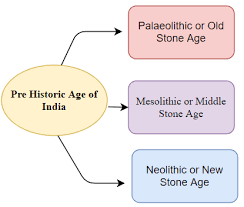
27. Which is the correct chronological order of Stone Age cultures in India?


28. The Neolithic culture of Kashmir (Burzahom) is distinguished by which unique feature?


29. Polished stone tools are the defining feature of which prehistoric age?


30. The Jorwe culture site of Daimabad is known for which remarkable find?


31. The site of Bagor in Rajasthan is associated with which prehistoric culture?


32. The site of Koldihwa in Uttar Pradesh is significant because:


33. The prehistoric site of Adamgarh is located in which state?


34. Which prehistoric site in Telangana is known for Neolithic Ash Mounds?


35. The Palaeolithic Age in India is broadly divided into how many phases?


36. Navdatoli, an important Chalcolithic site, is situated on the banks of which river?


37. Which site gives the most extensive evidence of a Chalcolithic township with irrigation and craft specialization?


38. Terracotta figurines of animals and humans first appear prominently in which prehistoric phase?


39. The Chalcolithic Age is characterized by the use of which combination of materials?


40. Burzahom, an important Neolithic site, is located in which present-day Indian state/UT?


41. Which of the following is a Neolithic site in northeastern India?


42. Hunsgi Valley, an important Palaeolithic site, is located in which state?


43. The concept of ‘food production’ replacing ‘food gathering’ is associated with which transition?


44. The ‘Painted Grey Ware’ (PGW) culture is associated with which broad period?


45. Sanganakallu (Kupgal) is a Neolithic site in Karnataka known for:


46. The Neolithic site of Maski is located in which state?


47. Robert Bruce Foote discovered the first Palaeolithic tool in India in 1863 at which site?


48. The Mesolithic site of Langhnaj is located in which state?


49. Inamgaon, associated with the Chalcolithic culture, is located in which state?


50. Which age is considered the earliest phase of human existence in India?


51. The practice of agriculture first began in the Indian subcontinent during which age?


Practice Questions on Pre-Historic cultures

pre historic cultures

For Practice Questions on Indian Polity

Practice Questions on Pre-Historic cultures for UPSC, APPSC, TGPSC and other state PSC exams Read More »

Motion of Thanks 3

this is just for testing

motion of thanks

The Motion of Thanks is a formal motion moved in both Houses of Parliament (Lok Sabha and Rajya Sabha) after the President’s Address at the beginning of the first session after a general election and at the first session of every year.

  • It is mentioned in Article 87 of the Indian Constitution.
  • The Motion must be passed by a simple majority in the Lok Sabha. Failure to pass it amounts to a defeat for the government and signifies a lack of confidence, which can lead to the government’s resignation.

Motion of Thanks 3 Read More »

Motion of Thanks

Lok Sabha clears Motion of Thanks without PM’s reply:

The Lok Sabha passed the Motion of Thanks on the president’s address without Prime Minister Narendra Modi giving his customary reply as the Opposition continued its protest.

What is Motion of Thanks?

The Motion of Thanks is a formal motion moved in both Houses of Parliament (Lok Sabha and Rajya Sabha) after the President’s Address at the beginning of the first session after a general election and at the first session of every year.

  • It is mentioned in Article 87 of the Indian Constitution.
  • The Motion must be passed by a simple majority in the Lok Sabha. Failure to pass it amounts to a defeat for the government and signifies a lack of confidence, which can lead to the government’s resignation.

Motion of Thanks Read More »