

Kerala Renaming to ‘Keralam’ Approved – Article 3 & State Name Change Procedure Explained for Exams
Why in News?
Union Cabinet has approved a proposal to rename Kerala as “Keralam”, initiating the constitutional process under Article 3 of the Indian Constitution.

Constitutional Basis:
Article 3 – Alteration of State Name
Parliament has the power to:
- Form new states
- Alter boundaries
- Increase or decrease area
- Change the name of a state
Article 4 – Supplemental Provisions
- Any law under Article 3:
- Amends the First Schedule (list of states)
- Amends the Fourth Schedule (Rajya Sabha seats)
- Such changes:
- Are not considered Constitutional Amendments
- Passed by simple majority
Step-by-Step Procedure to Change State Name:
- Presidential Recommendation:
- Bill can be introduced in Parliament only with prior approval of the President.
- Reference to State Legislature:
- President refers the Bill to the concerned State Legislature for its opinion.
- Non-Binding Opinion:
- State’s views are not binding on Parliament.
- Parliamentary Approval:
- Bill passed by simple majority in both Houses.
- Presidential Assent:
- After approval, the President signs the Bill → Name change becomes official.
Rajya Sabha Elections 2026 – 37 Seats Notified | Composition, Tenure & Articles Explained
Why in News?
The Election Commission of India (ECI) has issued notification for elections to 37 Rajya Sabha seats, with polling scheduled in March 2026, as the terms of these members are expiring in April.
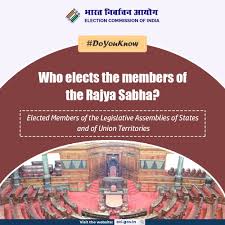
Rajya Sabha – Key Features:
Maximum Strength: 245 members
- 233 elected from States & UTs
- 12 nominated by the President
Nature of House:
- Permanent body (cannot be dissolved)
- Ensures continuity in Parliament
Tenure:
- Each member serves 6 years
- 1/3rd members retire every 2 years (biennial elections)
- Based on Article 83(1)
Composition & Representation:
- Allocation of seats is based on population.
- Governed by the Fourth Schedule of the Constitution.
Nominated Members (Article 80(3)):
- 12 members nominated by the President of India.
- Chosen from fields like:
- Literature
- Science
- Art
- Social Service
- They may join a political party within 6 months of taking their seat
SC/ST Sub-Classification Verdict 2024 – Supreme Court Seeks Centre Report | Article 341 Explained
Why in News?
The Supreme Court has asked the Union Government to submit a report on actions taken following its landmark 2024 Constitution Bench verdict allowing sub-classification within SC/ST categories for reservation.
SC/ST sub-classification:
SC/ST sub-classification is the process of dividing the Scheduled Castes (SC) or Scheduled Tribes (ST) categories into smaller sub-groups to ensure that reservation benefits reach the most disadvantaged communities within them
This concept, often called “quota within a quota,” was validated by a landmark 6:1 majority ruling of a seven-judge Supreme Court bench in August 2024 in the case of State of Punjab v. Davinder Singh
What is the Supreme Court Verdict (2024)?
A 7-judge Constitution Bench upheld the validity of sub-classification within SC/ST categories. It ruled that:
- SC/ST groups are not homogeneous.
- States can provide preferential treatment to the most backward sub-castes.
The judgment overturned the 2004 E.V. Chinnaiah case, which had disallowed such sub-classification.
Constitutional Provisions Involved:
Article 341 – Scheduled Castes
- Empowers the President to notify SCs for each State/UT.
- Done in consultation with the Governor.
- Parliament alone can modify the list (include/exclude groups).
Key Clarification by Supreme Court:
- Article 341 defines who is included in SC list.
- It does not prevent internal classification for reservation benefits.
- Sub-classification does not violate Article 14 (Right to Equality)
Substantive Motion in Lok Sabha – Meaning, Types & Constitutional Significance for Exams
Why in News?
A substantive motion was recently proposed in the Lok Sabha against the Leader of Opposition, seeking cancellation of membership.
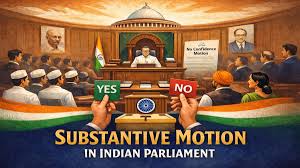
Substantive Motion:
- A substantive motion is an independent proposal placed before the House.
- It seeks a definite and binding decision of the House.
- It is complete in itself and not dependent on any other motion.
- Admission of a substantive motion depends entirely on the Speaker’s discretion.
- Once adopted, it reflects the formal opinion or will of the House.
- It differs from:
- Subsidiary motions (depend on another motion)
- Procedural motions (relate to House functioning)
Examples of Substantive Motions in Lok Sabha:
- Election of Speaker and Deputy Speaker
- Motion of Thanks on the President’s Address
- No-confidence motion / Confidence motion
- Adjournment motion on urgent public issues
- Resolution for removal of Speaker/Deputy Speaker
- Motion declaring a seat vacant
- Motions for general public interest discussions
Substantive Motion in Lok Sabha – Meaning, Types & Constitutional Significance for Exams Read More »