πŸ“° Today's Current AffairsRead Now →
📷 Follow on Instagram

National Current Affairs

UNESCO & Sikkim Partner to Document Ru-Soam: India’s Ancient Cane Bridge Heritage | UPSC Current Affairs 2026

UNESCO has joined hands with the Sikkim state government to document the traditional Ru-Soam bridges β€” indigenous cane suspension footbridges built by the Lepcha community β€” located within the Khangchendzonga Biosphere Reserve (KBR). This initiative aims to preserve and recognize this extraordinary example of indigenous engineering knowledge before it is lost to modernization.

πŸ“Œ UPSC Relevance: GS Paper I – Art & Culture | GS Paper III – Environment & Ecology | Prelims – Static GK & Current Affairs

What are Ru-Soam Bridges?

Ru-Soam are traditional bamboo and cane suspension footbridges crafted by the Lepcha community of Sikkim. These structures are a testimony to centuries of accumulated indigenous knowledge in natural material engineering.

  • Built entirely without nails or metal fasteners
  • Materials used: wild cane, bamboo, and wood
  • Represent centuries-old indigenous engineering knowledge
  • Located within the Khangchendzonga Biosphere Reserve, Sikkim
  • Recognized as a remarkable example of Traditional Ecological Knowledge (TEK)

Why is UNESCO Documenting Ru-Soam?

UNESCO’s documentation effort is part of a broader mission to safeguard intangible cultural heritage worldwide. The specific objectives include:

  1. Preserving intangible cultural heritage and indigenous technical knowledge
  2. Recognizing the Lepcha community’s ecological and engineering contributions
  3. Integrating indigenous knowledge systems into sustainable development frameworks
  4. Safeguarding this knowledge from being lost as modernization advances

About the Lepcha Community

The Lepcha are one of the indigenous communities of Sikkim, classified as a Particularly Vulnerable Tribal Group (PVTG) in India. They have coexisted with the Khangchendzonga ecosystem for centuries, developing unique knowledge systems for construction, agriculture, and ecological management. Their Ru-Soam bridges are not just infrastructure β€” they are a living cultural tradition.

πŸ”οΈ UPSC Connect: Khangchendzonga Biosphere Reserve (KBR)

The Khangchendzonga Biosphere Reserve is a critical interconnected topic for UPSC aspirants. Here are the key facts:

FeatureDetails
LocationSikkim, India
UNESCO World Heritage SiteDesignated in 2016
Heritage TypeIndia’s first and only “mixed” heritage site (natural + cultural)
UNESCO Biosphere ReservePart of UNESCO World Network of Biosphere Reserves since 2018
Key FeatureHome to Mt. Khangchendzonga β€” the world’s 3rd highest peak (8,586 m)
Tribal CommunitiesLepcha, Bhutia, Limbu β€” all with deep cultural ties to the landscape
πŸ’‘ Prelims Tip: KBR is India’s FIRST and ONLY “mixed” UNESCO World Heritage Site β€” recognised for both its outstanding natural values AND cultural heritage. Designated in 2016. Do not confuse this with the Biosphere Reserve status (2018).

Key Facts for Quick Revision

  • Ru-Soam = Traditional cane/bamboo suspension bridges of Sikkim
  • Built by: Lepcha community (indigenous PVTG tribe of Sikkim)
  • Location: Khangchendzonga Biosphere Reserve, Sikkim
  • Initiative: UNESCO + Sikkim Government documentation project
  • No metal used: Built entirely from wild cane, bamboo, and wood
  • KBR UNESCO WHS Year: 2016 (mixed heritage site β€” first in India)
  • KBR Biosphere Reserve Network Year: 2018
  • Mt. Khangchendzonga: World’s 3rd highest peak (8,586 m)

UNESCO & Sikkim Partner to Document Ru-Soam: India’s Ancient Cane Bridge Heritage | UPSC Current Affairs 2026 Read More Β»

Census 2027: World’s First Fully Digital Census Explained

Why in News?

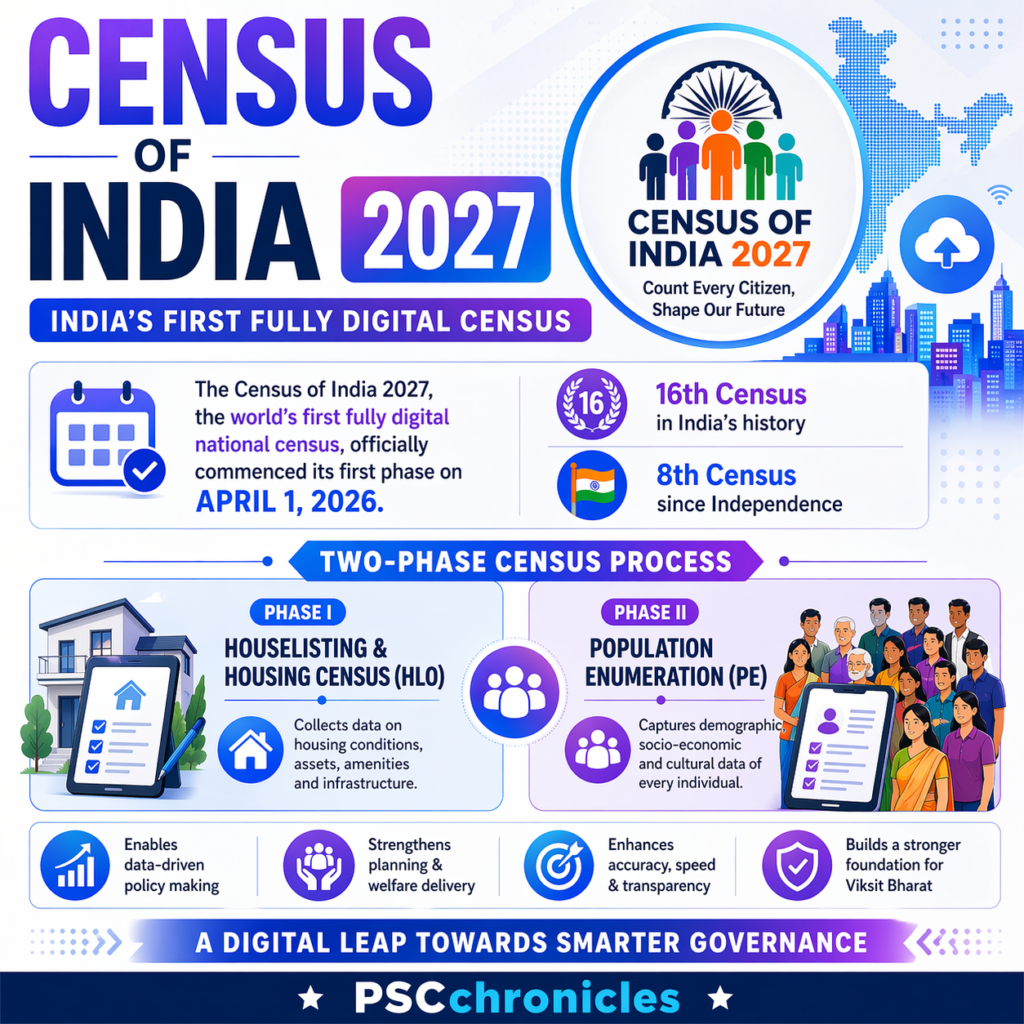
India has launched Census 2027, marking a historic shift as the world’s first fully digital national census. The exercise began on April 1, 2026, and plays a crucial role in policy-making, planning, and governance.

census 2027

Key Highlights of Census 2027

  • First-ever fully digital census in the world
  • Started on April 1, 2026
  • It is the 16th Census of India
  • It is the 8th census after independence
  • Conducted under the authority of the Registrar General and Census Commissioner of India

Two Phases of Census 2027

Phase I: Houselisting & Housing Census (HLO)

  • Timeline: April 1, 2026 – September 30, 2026
  • Purpose:
    • Listing all buildings and households
    • Collecting data on:
      • Housing conditions
      • Basic amenities (water, electricity, sanitation)
      • Household assets

Phase II: Population Enumeration (PE)

  • Timeline: February 2027
  • Reference Date: March 1, 2027
  • Purpose:
    • Collecting individual-level data, such as:
      • Age
      • Gender
      • Education
      • Occupation
      • Socio-economic details

Background: Census in India

  • Conducted every 10 years (Decennial Census)
  • First census in India: 1872 (non-synchronous)
  • First complete census: 1881 (under British rule)
  • Last census: 2011 (2021 census delayed due to COVID-19)

To study more National issues from exam point of view, Click here

Census 2027: World’s First Fully Digital Census Explained Read More Β»

PM RAHAT Scheme Launched: Cashless Treatment for Road Accident Victims

Why in News?

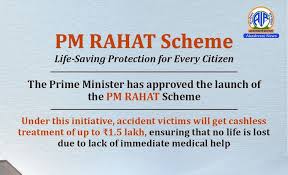
The Government of India has launched the PM RAHAT Scheme to provide cashless treatment for road accident victims.

pm rahat scheme

Key Highlights:

Scheme Name:

  • PM RAHAT (Road Accident Victim Hospitalization and Assured Treatment)

Launched By:

  • Government of India

Coverage:

  • Applicable to all road accident victims
  • Covers all categories of roads (national highways, state roads, etc.)

Financial Assistance:

  • Up to β‚Ή1.5 lakh per victim

Time Limit:

  • Covers treatment for 7 days from the date of accident
https://www.pib.gov.in/PressReleasePage.aspx?PRID=2238637&reg=3&lang=2: PM RAHAT Scheme Launched: Cashless Treatment for Road Accident Victims

PM RAHAT Scheme Launched: Cashless Treatment for Road Accident Victims Read More Β»

SAHI & BODH Initiatives Launched to Promote Safe AI in Healthcare

Why in News?

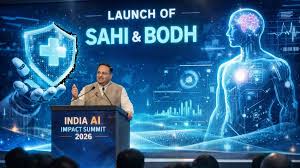
The Union Health Minister launched SAHI and BODH initiatives at the India AI Impact Summit. These initiatives aim to ensure safe, ethical, and reliable use of Artificial Intelligence (AI) in healthcare.

sahi & bodh

Key Highlights:

SAHI (Strategy for AI in Healthcare for India)

  • Acts as a national roadmap and governance framework
  • Ensures AI systems are:
    • Transparent
    • Accountable
    • People-centric
  • Core Objective:
    • AI should assist healthcare workers, not replace them
    • Promote evidence-based clinical decision-making

BODH Platform

  • Developed by:
    • IIT Kanpur
    • In collaboration with National Health Authority
  • Purpose:
    • Benchmark and validate AI tools in healthcare
    • Ensure accuracy and reliability before large-scale use
https://www.pib.gov.in/PressReleasePage.aspx?PRID=2229226&reg=3&lang=1: SAHI & BODH Initiatives Launched to Promote Safe AI in Healthcare

SAHI & BODH Initiatives Launched to Promote Safe AI in Healthcare Read More Β»

India’s First Underwater Road-Cum-Rail Tunnel Approved Under Brahmaputra

Why in News?

The Cabinet Committee on Economic Affairs has approved India’s first underwater road-cum-rail tunnel project under the Brahmaputra River in Assam.

india’s first underwater road cum rail tunnel project

Key Highlights:

Project Type:

  • Underwater twin-tube road-cum-rail tunnel

Location:

  • Under Brahmaputra River, Assam

Significance:

  • First-of-its-kind underwater tunnel in India

Brahmaputra river

Brahmaputra River:

  • Originates from Chemayungdung Glacier near Lake Mansarovar (Tibet)
  • Known as:
    • Yarlung Tsangpo (Tibet)
    • Siang/Dihang (Arunachal Pradesh)
    • Jamuna (Bangladesh)

Key Features:

  • Great Bend near Namcha Barwa
  • Famous river islands:
    • Majuli (largest inhabited)
    • Umananda (smallest inhabited)

Biodiversity Importance:

  • Supports Kaziranga National Park
https://www.pib.gov.in/PressReleasePage.aspx?PRID=2227981&reg=3&lang=1: India’s First Underwater Road-Cum-Rail Tunnel Approved Under Brahmaputra

India’s First Underwater Road-Cum-Rail Tunnel Approved Under Brahmaputra Read More Β»

Shahpur Kandi Dam Near Completion: India to Fully Utilise Ravi Waters

Why in News?

India is set to complete the Shahpur Kandi Dam on the Ravi River . The project is crucial for fully utilising India’s share of water under the Indus Waters Treaty.

shahpur kandi dam

Key Highlights of the project:

Location:

  • On Ravi River in Punjab (Pathankot district)

Project Type:

  • Major national irrigation and hydropower project

    Objective:

    • Ensure maximum utilisation of India’s allocated waters
    • Prevent unused water flowing into Pakistan

    Indus Water Treaty

    • Signed between India and Pakistan
    • Brokered by the World Bank

    River Allocation:

    • Eastern Rivers β†’ Ravi, Beas, Sutlej β†’ Allocated to India
    • Western Rivers β†’ Indus, Jhelum, Chenab β†’ Allocated to Pakistan
    https://timesofindia.indiatimes.com/india/india-moves-to-stop-ravi-waters-to-pak-as-shahpur-kandi-dam-nears-finish/articleshow/128435041.cms: Shahpur Kandi Dam Near Completion: India to Fully Utilise Ravi Waters

    Shahpur Kandi Dam Near Completion: India to Fully Utilise Ravi Waters Read More Β»

    PM POSHAN Scheme: Centre Examines Breakfast Inclusion | Mid-Day Meal Scheme Update for Exams

    Why in News?

    The Centre is considering proposals from several States/UTs to include breakfast under the PM-POSHAN scheme.

    pm poshan

    Key facts related to PM POSHAN scheme:

    • Originally launched as Mid-Day Meal Scheme (1995)
    • Renamed as PM Poshan Shakti Nirman (PM POSHAN) in 2021
    • First school meal initiative started in Madras (1920)
    • Post-independence expansion by K Kamaraj in 1956.
    • Cost-sharing pattern-60:40 β†’ Centre : States, 90:10 β†’ Northeastern & Himalayan States
    https://www.pib.gov.in/PressReleasePage.aspx?PRID=2082323&reg=3&lang=2: PM POSHAN Scheme: Centre Examines Breakfast Inclusion | Mid-Day Meal Scheme Update for Exams

    PM POSHAN Scheme: Centre Examines Breakfast Inclusion | Mid-Day Meal Scheme Update for Exams Read More Β»

    Padma Awards 2026: 131 Awardees Announced | Padma Vibhushan List & Key Facts for Exams

    Why in News?

    The Government of India has announced 131 Padma Awards on the eve of Republic Day 2026. The awards include 5 Padma Vibhushan, 13 Padma Bhushan, and 113 Padma Shri recipients.

    padma awards

    Key Highlights:

    Conferred by the President of India.

    Total Awards (2026)

    • Padma Vibhushan – 5
    • Padma Bhushan – 13
    • Padma Shri – 113
    Padma Vibhushan 2026 Awardees:
    • Dharmendra Singh Deol (Posthumous) – Art – Maharashtra
    • K T Thomas – Public Affairs – Kerala
    • N Rajam – Art – Uttar Pradesh
    • P Narayanan – Literature & Education – Kerala
    • V S Achuthanandan (Posthumous) – Public Affairs – Kerala
    About Padma awards:
    • Instituted in 1954
    • Among the highest civilian awards in India, after the Bharat Ratna.
    • Padma Vibhushan – Exceptional and distinguished service (2nd highest civilian award)
    • Padma Bhushan – Distinguished service of a high order (3rd highest)
    • Padma Shri – Distinguished service in any field (4th highest)
    https://www.pib.gov.in/PressReleasePage.aspx?PRID=2218547&reg=3&lang=1: Padma Awards 2026: 131 Awardees Announced | Padma Vibhushan List & Key Facts for Exams

    Padma Awards 2026: 131 Awardees Announced | Padma Vibhushan List & Key Facts for Exams Read More Β»

    Kaamya Karthikeyan became youngest Indian to reach south pole:

    Why in News?

    Kaamya Karthikeyan, an 18-year-old from Mumbai, has become the youngest Indian to reach the South Pole. She has also achieved the remarkable feat of scaling the Seven Summits (highest peaks on each continent)

    seven summits

    Seven summits:

    The Seven Summits challenge involves climbing the highest mountain on each of the seven continents. The seven summits (Continent-wise Highest Peaks) are:

    • Asia: Mount Everest (8,848 m / 29,029 ft) – Located on the border of Nepal and China, it is the highest point on Earth.
    • South America: Aconcagua – Located in Argentina, it is the highest peak in the Western and Southern Hemispheres.
    • North America: Denali – Formerly known as Mount McKinley, it is located in Alaska, USA.
    • Africa: Mount Kilimanjaro – A dormant volcano in Tanzania, it is the highest free-standing mountain in the world.
    • Europe: Mount Elbrus – An inactive volcano in the Caucasus Mountains of Russia.
    • Antarctica: Vinson Massif – The most remote of the summits, located in the Sentinel Range.

    Kaamya Karthikeyan became youngest Indian to reach south pole: Read More Β»

    Dulhasti Stage-II Hydropower Project Approved: Chenab River & Indus Basin Projects Explained for Exams

    Why in News?

    A panel under the Ministry of Environment has approved the 260 MW Dulhasti Stage-II Hydropower Project in Jammu and Kashmir.

    dulhasti stage ii hydropower project

    Key Highlights:

    • Capacity: 260 MW hydropower project
    • Located in Kishtwar district of Jammu & Kashmir
    • Extension of the existing 390 MW Dulhasti Stage-I project
    • Utilizes water from: Chenab River and Marusudar River (via Pakal Dul project)
    Key facts about Chenab River
    • Chenab River also known as Asikni / Chandrabhaga in ancient texts.
    • Formed by the confluence of Chandra River and Bhaga River.
    • Confluence point: Tandi (Lahaul & Spiti, Himachal Pradesh).
    • Flows through: Himachal Pradesh β†’ Jammu & Kashmir β†’ Pakistan (Punjab province).
    • Major tributary of the Indus River.
    https://www.pib.gov.in/PressReleasePage.aspx?PRID=2236990&reg=3&lang=2: Dulhasti Stage-II Hydropower Project Approved: Chenab River & Indus Basin Projects Explained for Exams

    Dulhasti Stage-II Hydropower Project Approved: Chenab River & Indus Basin Projects Explained for Exams Read More Β»