Montreal Protocol (1987) is a landmark international treaty aimed at protecting the ozone layer by phasing out the production and consumption of Ozone Depleting Substances (ODS) like CFCs and HCFCs
It is a protocol to the Vienna Convention for the Protection of the Ozone Layer.
Key Highlights:
Adoption & Action: Adopted on September 16, 1987; entered into force in 1989.
Goal: To protect the ozone layer from CFCs, halons, and other chemicals used in refrigeration and aerosols.
Kigali Amendment (2016): An important amendment requiring a phase-down of Hydrofluorocarbons (HFCs)—a potent greenhouse gas—to combat climate change. India ratified the Kigali Amendment in 2021.
Multilateral Fund: Established to assist developing countries in transitioning to non-ODS technologies.
To study environment and ecology current affairs from exam point of view, Click here
The United Nations Framework Convention on Climate Change (UNFCCC) is an international environmental treaty aimed at combating climate change by stabilizing greenhouse gas (GHG) concentrations in the atmosphere.
Adopted during the Rio Earth Summit
Came into force in 1994
Secretariat located in Bonn
Nearly 197 Parties (universal membership)
Key Principles of UNFCCC
1. Common But Differentiated Responsibilities (CBDR)
Developed countries bear greater responsibility
Recognizes historical emissions
2. Equity Principle
Fair distribution of responsibilities among nations
3. Precautionary Principle
Lack of full scientific certainty should not delay action
4. Sustainable Development
Climate actions must align with development goals
Conference of Parties (COP)
The Conference of Parties (COP) is the supreme decision-making body of UNFCCC.
Key Features:
Held annually
Reviews implementation of the Convention
Negotiates new agreements
Important COP Outcomes:
COP3 (Kyoto, 1997) → Kyoto Protocol
COP21 (Paris, 2015) → Paris Agreement
Recent COPs focus on climate finance, adaptation, and net-zero targets
Major Agreements under UNFCCC
1. Kyoto Protocol (1997)
Legally binding emission reduction targets
The Kyoto Protocol, adopted in 1997 and in force from 2005 to 2020, was the first legally binding international treaty requiring industrialized countries to reduce greenhouse gas emissions. It operationalized the UNFCCC by setting binding targets for 37 nations to reduce emissions by an average of 5% below 1990 levels during 2008–2012.
2. Paris Agreement (2015)
It is a legally binding international treaty adopted by 195 nations at COP21 in 2015, aiming to limit global temperature increases to well below 2°C—preferably 1.5°C—above pre-industrial levels.
It entered into force on November 4, 2016, requiring countries to submit, update, and fulfill ambitious climate action plans (NDCs) every five years to combat climate change
Financial Mechanisms under UNFCCC
Green Climate Fund (GCF)
Global Environment Facility (GEF)
Developed countries are expected to provide climate finance to developing nations.
To study current affairs related to environment, Click here
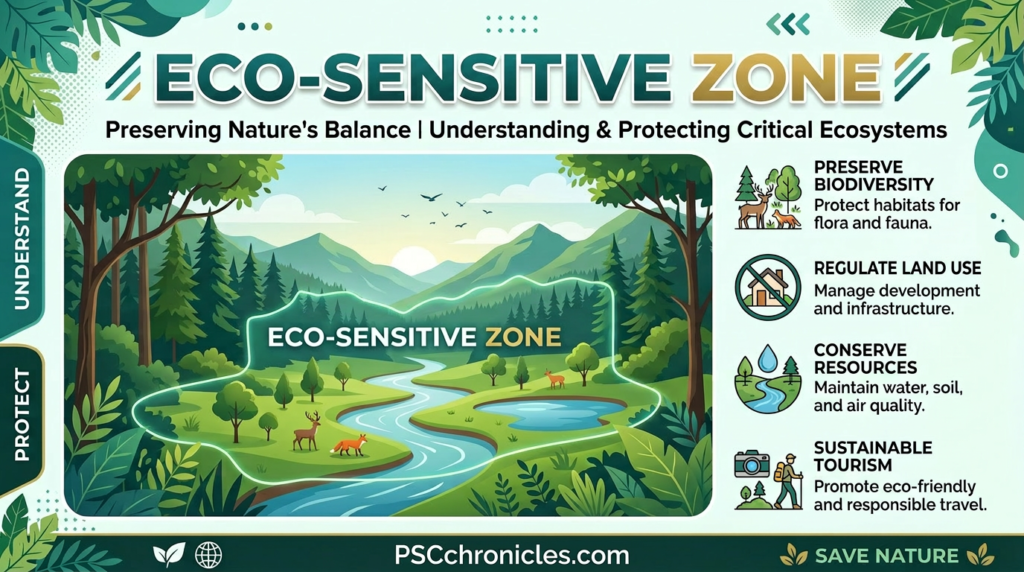
Eco-Sensitive Zones (ESZs) are buffer areas notified around Protected Areas (PAs) such as National Parks and Wildlife Sanctuaries to regulate human activities and protect fragile ecosystems.
They act as a “shock absorber” between:
High-protection zones (core forests)
Human-dominated landscapes (villages, towns)
Legal Basis of ESZ
Declared under Environment (Protection) Act, 1986
Notified by Ministry of Environment, Forest and Climate Change (MoEFCC)
Based on Supreme Court directions (notably in T.N. Godavarman Thirumulpad vs Union of India)
Extent of ESZ
Typically ranges from 0 to 10 km around protected areas
In some cases, can exceed 10 km (based on ecological importance)