πŸ“° Today's Current AffairsRead Now →
📷 Follow on Instagram

Indian Polity Notes

Key facts


Topic 06 of 6 Β· Chapter 09 Β· Indian Polity

President, VP & PM β€” Key Facts & Quick Revision

All important articles, election details, powers comparison, and quick revision for last-minute exam preparation.

πŸ“Š Comparison β€” President, VP, PM

FeaturePresidentVice-PresidentPrime Minister
Article52-6263-7174-75
Minimum age35 years35 years25 years (LS) / 30 years (RS)
ElectionIndirect β€” elected MPs + elected MLAsIndirect β€” all MPs (elected + nominated)Appointed by President
Term5 years5 yearsDuring pleasure of President / Lok Sabha confidence
RemovalImpeachment (Article 61) β€” 2/3 of total membership of both HousesResolution of RS + agreement of LSLoses majority in Lok Sabha
RoleConstitutional head (nominal)Chairman of Rajya SabhaReal executive

πŸ“‹ Important Articles β€” Chapter 09

ArticleSubject
52The President of India
54Election of President
55Manner of election of President (STV)
56Term of office of President (5 years)
61Procedure for impeachment of President
63The Vice-President of India
64VP as ex-officio Chairman of Rajya Sabha
66Election of VP
72Power of President to grant pardons
74Council of Ministers to aid and advise President
75Other provisions as to Ministers (PM appointment, collective responsibility)
123Power of President to promulgate Ordinances
⭐ Quick Facts:
β€’ President’s pardoning power: Article 72 β€” includes death sentences
β€’ Governor’s pardoning power: Article 161 β€” does NOT include death sentences
β€’ Ordinance: Article 123 β€” ceases after 6 weeks of Parliament reassembling
β€’ 91st Amendment: Council of Ministers max 15% of Lok Sabha
β€’ Pocket veto used by: President Zail Singh (Postal Bill 1986)

πŸ”‘ Chapter 09 β€” Complete Must-Remember Facts

  • President: Nominal head; Article 52
  • President election: Elected MPs + Elected MLAs (not nominated)
  • VP election: All MPs (elected + nominated); no MLAs
  • President minimum age: 35 years
  • Impeachment: 2/3 of total membership of both Houses
  • VP: Ex-officio Chairman of Rajya Sabha
  • Article 74: Council of Ministers to aid and advise
  • Article 75(3): Collectively responsible to Lok Sabha
  • 91st Amendment: Max 15% of Lok Sabha in Council of Ministers
  • Article 72: Pardoning power β€” includes death sentences
  • Article 123: Ordinance power β€” ceases after 6 weeks
  • Three vetoes: Absolute, Suspensive, Pocket
Key facts Read More Β»

Rajya Sabha Explained for UPSC & State PSCs 2026: Powers, Members, Functions

What is Rajya Sabha?

The Rajya Sabha (Council of States) is the Upper House of the Indian Parliament. It represents the states and union territories of India and acts as a revising chamber.

  • Mentioned under Article 79 of the Constitution
  • Composition defined in Article 80

Composition of Rajya Sabha

  • Maximum Strength: 250 members
    • 238 β†’ Elected representatives of States & UTs
    • 12 β†’ Nominated by the President
  • Current Strength: 245 members

Nominated Members

The President nominates 12 members from fields like:

  • Literature
  • Science
  • Art
  • Social Service

Election of Members

  • Elected by elected members of State Legislative Assemblies
  • Through Proportional Representation by Single Transferable Vote (STV)

Tenure of Members

  • Term: 6 years
  • One-third members retire every 2 years
  • It is a Permanent House (not subject to dissolution)

Presiding Officer

  • Chairman: Vice-President of India
  • Deputy Chairman: Elected by members of Rajya Sabha

Powers of Rajya Sabha

1. Legislative Powers

  • Can introduce and pass ordinary bills
  • Equal powers with Lok Sabha (except Money Bills)

2. Financial Powers

  • Money Bills can only be introduced in Lok Sabha
  • Rajya Sabha can:
    • Recommend changes within 14 days
    • Cannot reject/amend effectively

3. Judicial Powers

  • Participates in:
    • Impeachment of President
    • Removal of judges of Supreme Court & High Courts

4. Constitutional Powers

  • Equal role in Constitutional Amendments

Special Powers of Rajya Sabha:

Under Article 249

  • Can empower Parliament to legislate on State List subjects
  • Requires 2/3rd majority

Under Article 312

  • Can create All India Services (like IAS, IPS)

Comparison: Rajya Sabha vs Lok Sabha

FeatureRajya SabhaLok Sabha
TypeUpper HouseLower House
DissolutionPermanentCan be dissolved
MembersMax 250Max 552
Money BillLimited powerFull control
RepresentationStatesPeople

Important Articles

ArticleDescription
Article 79Parliament structure
Article 80Composition
Article 84Qualification
Article 89Chairman & Deputy Chairman
Article 249Power over State List
Article 312All India Services

To study Polity current affairs from exam point of view, Click here

design clean simple and professional and creative

Rajya Sabha Explained for UPSC & State PSCs 2026: Powers, Members, Functions Read More Β»

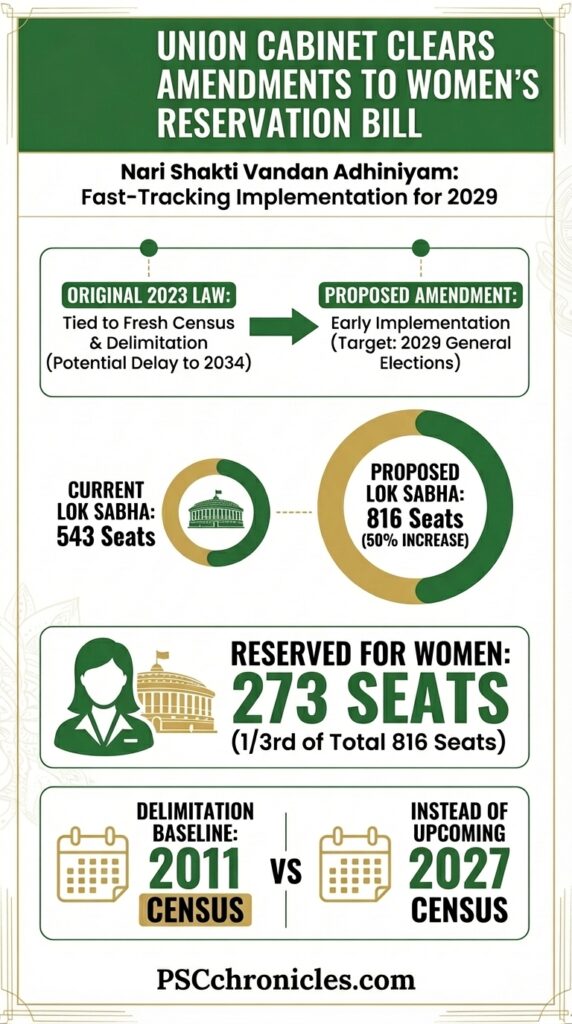
Nari Shakti Vandan Adhiniyam 2023 – Complete Guide for UPSC and state PSC exams 2026

What is Nari Shakti Vandan Adhiniyam 2023?

The Nari Shakti Vandan Adhiniyam, 2023 is a landmark constitutional amendment aimed at enhancing women’s political participation in India. It provides 33% reservation for women in the Lok Sabha and State Legislative Assemblies.

  • It is officially known as the Constitution (106th Amendment) Act, 2023
women reservation psc

Key Features of the Act

1. Reservation for Women

  • 33% reservation in:
    • Lok Sabha
    • State Legislative Assemblies
  • Includes reservation within SC/ST seats

2. Duration of Reservation

  • Reservation will be applicable for 15 years (can be extended by Parliament)

3. Rotation of Seats

  • Reserved constituencies will be rotated after each delimitation exercise

4. Implementation Condition

  • Comes into effect only after delimitation based on the next Census

Constitutional Amendments

The Act introduces changes to the following Articles:

  • Article 330A β†’ Reservation in Lok Sabha
  • Article 332A β†’ Reservation in State Assemblies
  • Article 334A β†’ Duration and implementation

Significance of the Act

1. Political Empowerment
  • Ensures greater participation of women in law-making
2. Gender Equality
  • Promotes substantive equality in governance
3. Better Governance
  • Studies show women leaders focus more on:
    • Health
    • Education
    • Welfare
4. Inclusive Democracy
  • Strengthens democratic values

For recent amendments to women reservation act, Click here

Nari Shakti Vandan Adhiniyam 2023 – Complete Guide for UPSC and state PSC exams 2026 Read More Β»

Election Commission of India (ECI) – Complete Notes for UPSC & State PSC exams

The Election Commission of India (ECI) is an autonomous constitutional authority responsible for administering election processes in India. It ensures free, fair, and transparent elections, which are the backbone of democracy.

add below pscchronicles.com 202604071048

Constitutional Provisions

  • Article 324: Provides for the establishment of the ECI.
  • It vests the superintendence, direction, and control of elections in the Commission.

Elections Conducted by ECI:

  • Lok Sabha
  • Rajya Sabha
  • State Legislative Assemblies & Councils
  • President and Vice-President of India

Composition of ECI

  • Initially: Single-member body (only Chief Election Commissioner)
  • Present: Multi-member body (3 members)
    • Chief Election Commissioner (CEC)
    • Two Election Commissioners (ECs)

Appointment:

  • Appointed by the President of India
Tenure:
  • 6 years or until age of 65 years (whichever earlier)

Removal of Members

  • CEC: Removed like a Supreme Court judge
    (by Parliament through impeachment – Article 324(5))
  • Election Commissioners: Removed by President on recommendation of CEC

This ensures independence of the Commission

Revision:
FeatureDetails
Article324
TypeConstitutional Body
Members3 (CEC + 2 ECs)
AppointmentPresident
Removal of CECLike SC Judge
FunctionsConduct elections, MCC, advisory role

For detailed explanation on Procedure for removal of CEC, Click here

Election Commission of India (ECI) – Complete Notes for UPSC & State PSC exams Read More Β»