๐Ÿ“ฐ Today's Current AffairsRead Now →
📷 Follow on Instagram

Polity Current Affairs

SC Collegium Recommends Chief Justices for 4 High Courts: UPSC Notes

SC Collegium recommends High Court Chief Justices

Why in News?

The Supreme Court Collegium, headed by Chief Justice of India Surya Kant, has recommended Chief Justices for four High Courts.

Key Facts for Prelims

  • SC Collegium for HC appointments: Comprises the CJI + two senior-most SC judges
  • SC Collegium for SC appointments: Comprises the CJI + four senior-most SC judges
  • Constitutional basis for HC judges: Article 217 โ€” appointment by the President after consultation with CJI, Governor of the state, and (for non-CJ appointments) the HC Chief Justice
  • Transfer of HC judges: Article 222 โ€” President can transfer a judge from one HC to another after consulting the CJI
  • Total High Courts in India: 25

Static Exam Link: Collegium System and Judicial Appointments

  • First Judges Case (1981): SC held that “consultation” does not mean “concurrence” โ€” gave primacy to the executive
  • Second Judges Case (1993): Reversed the First Judges Case โ€” gave primacy to the CJI and introduced the collegium concept
  • Third Judges Case (1998): Expanded the collegium to CJI + 4 senior-most judges for SC appointments
  • NJAC (99th Amendment + Act): Parliament tried to replace the collegium with the National Judicial Appointments Commission in 2014, but the SC struck it down in 2015 as unconstitutional
  • Article 217: Appointment of HC judges
  • Article 222: Transfer of HC judges
  • Article 224: Appointment of additional and acting judges in HCs
  • Article 224A: Appointment of retired judges at sitting of HCs

Quick Revision Table

ParameterDetail
SC Collegium (for SC)CJI + 4 senior-most SC judges
SC Collegium (for HC)CJI + 2 senior-most SC judges
HC CollegiumHC Chief Justice + 2 senior-most HC judges
HC Judge AppointmentArticle 217
HC Judge TransferArticle 222
SC Judge AppointmentArticle 124
HC Judge Retirement Age62 years
Total High Courts25
NJAC Struck Down2015 (Fourth Judges Case)

Trap / Confusing Points

ConfusionCorrect Fact
SC Collegium has same composition for SC and HC appointmentsFor SC: CJI + 4 senior judges; For HC: CJI + 2 senior judges
Governor appoints HC judgesPresident appoints HC judges under Article 217; Governor is only consulted
NJAC replaced the Collegium systemNJAC was struck down by the SC in 2015; the Collegium system continues
First Judges Case gave primacy to judiciaryFirst Judges Case (1981) gave primacy to the executive; it was the Second Judges Case (1993) that gave primacy to CJI
HC Chief Justice is appointed by the state governmentHC Chief Justice is appointed by the President on recommendation of the SC Collegium

Practice MCQs

1. The Supreme Court Collegium for High Court appointments consists of:

a. CJI + 4 senior-most SC judges
b. CJI + 2 senior-most SC judges
c. CJI + HC Chief Justice + 2 senior HC judges
d. CJI alone

Ans: B
For HC appointments, the SC Collegium comprises the CJI and two senior-most judges of the Supreme Court.

2. Transfer of a High Court judge is governed by:

a. Article 217
b. Article 222
c. Article 224
d. Article 226

Ans: B
Article 222 empowers the President to transfer a judge from one High Court to another after consulting the CJI.

3. The National Judicial Appointments Commission (NJAC) was struck down by the Supreme Court in:

a. 2013
b. 2014
c. 2015
d. 2016

Ans: C
The SC struck down the NJAC Act and the 99th Constitutional Amendment in 2015 as unconstitutional.

4. Consider the following statements:
1. The Second Judges Case (1993) gave primacy to the executive in judicial appointments.
2. The total number of High Courts in India is 25.
Which of the above is/are correct?

a. 1 only
b. 2 only
c. Both 1 and 2
d. Neither 1 nor 2

Ans: B
The Second Judges Case gave primacy to the CJI (judiciary), not the executive. India has 25 High Courts.

5. Appointment of High Court judges is dealt with under:

a. Article 124
b. Article 214
c. Article 217
d. Article 224A

Ans: C
Article 217 deals with appointment and conditions of office of a High Court judge.

To learn current affairs from exam point of view, Click here.

To know more about SC Collegium recommendations, Click here.

SC Collegium Recommends Chief Justices for 4 High Courts: UPSC Notes Read More ยป

Appropriation Bill 2026: Consolidated Fund of India UPSC Notes

Appropriation Bill 2026 โ€” The Lok Sabha has passed the Appropriation (No-3) Bill, 2026, authorising withdrawal from the Consolidated Fund of India to meet excess expenditure. Here are the key facts, constitutional provisions under Article 114, and practice MCQs for UPSC aspirants.

Appropriation Bill 2026 Consolidated Fund of India

Why in News?

The Lok Sabha has passed the Appropriation (No โ€“ 3) Bill, 2026, authorising the appropriation of money from the Consolidated Fund of India (CFI) to meet excess expenditure on certain services during the financial year ended 31st March 2023.

Key Facts for Prelims: Appropriation Bill 2026

  • Bill: Appropriation (No โ€“ 3) Bill, 2026
  • Purpose: Authorise withdrawal from CFI for excess expenditure already incurred in FY 2022-23
  • Constitutional basis: Article 114 โ€” no money can be withdrawn from CFI except under appropriation made by law
  • Classification: It is a Money Bill under Article 110
  • Introduced in: Lok Sabha only (as with all Money Bills)
  • Rajya Sabha’s role: Can only recommend changes within 14 days; Lok Sabha may accept or reject recommendations

Static Exam Link: Financial Procedure in Parliament

  • Article 112: Annual Financial Statement (Union Budget) to be laid before Parliament
  • Article 113: Procedure for voting of grants by Lok Sabha
  • Article 114: Appropriation Bills โ€” no withdrawal from CFI without an Appropriation Act
  • Article 115: Supplementary, additional or excess grants
  • Article 116: Votes on Account, Vote of Credit, Exceptional Grants
  • Three types of funds: Consolidated Fund of India (Article 266), Contingency Fund of India (Article 267), Public Account of India (Article 266(2))
  • Key difference: Appropriation Bill authorises withdrawal of money; Finance Bill deals with taxation/revenue generation
  • No amendment allowed: Parliament cannot amend an Appropriation Bill to alter the amount or destination of any grant

Quick Revision Table: Appropriation Bill 2026

ParameterDetail
Bill NameAppropriation (No โ€“ 3) Bill, 2026
Constitutional ProvisionArticle 114
Money Bill ClassificationArticle 110
Fund InvolvedConsolidated Fund of India
Rajya Sabha’s PowerRecommend changes within 14 days
Amendment Allowed?No โ€” amount or purpose of grants cannot be altered
Charged Expenditure IncludesSalaries of President, SC/HC Judges, CAG, etc.
Difference from Finance BillAppropriation = withdrawal; Finance = taxation

Trap / Confusing Points on Appropriation Bill 2026

ConfusionCorrect Fact
Appropriation Bill and Finance Bill are the sameAppropriation Bill authorises withdrawal of funds; Finance Bill handles taxation
Rajya Sabha can amend Money BillsRajya Sabha can only recommend changes within 14 days; it cannot amend or reject
Money can be withdrawn from CFI by executive orderNo โ€” Article 114 mandates an Act of Parliament for any withdrawal
Charged expenditure is voted upon by Lok SabhaCharged expenditure is not voted โ€” it is directly charged on the CFI (only discussed, not voted)
Contingency Fund and Consolidated Fund are the sameCFI (Article 266) holds all government revenues; Contingency Fund (Article 267) is for unforeseen expenses, at the disposal of the President

Practice MCQs on Appropriation Bill 2026

1. Under which Article is an Appropriation Bill introduced in Parliament?

a. Article 110
b. Article 112
c. Article 114
d. Article 116

Ans: C
Article 114 mandates that no money shall be withdrawn from the Consolidated Fund of India except under appropriation made by law.

2. Which of the following is NOT a characteristic of an Appropriation Bill?

a. It is a Money Bill
b. Rajya Sabha can reject it
c. It authorises withdrawal from CFI
d. It cannot be amended to alter the grant amount

Ans: B
Rajya Sabha can only recommend changes within 14 days; it cannot reject an Appropriation Bill.

3. The Contingency Fund of India is established under:

a. Article 265
b. Article 266
c. Article 267
d. Article 268

Ans: C
Article 267 establishes the Contingency Fund of India, placed at the disposal of the President.

4. Consider the following statements:
1. Charged expenditure on the Consolidated Fund of India is voted upon by Lok Sabha.
2. The Finance Bill deals with taxation while the Appropriation Bill authorises withdrawal.
Which of the above is/are correct?

a. 1 only
b. 2 only
c. Both 1 and 2
d. Neither 1 nor 2

Ans: B
Charged expenditure is not voted upon โ€” it is only discussed. Statement 2 correctly distinguishes the two bills.

5. Vote on Account under Article 116 allows the government to:

a. Impose new taxes before the budget is passed
b. Withdraw money from the Contingency Fund
c. Obtain advance grants for part of the financial year pending budget approval
d. Amend the Appropriation Act

Ans: C
Vote on Account allows the government to withdraw funds for a limited period until the full budget and Appropriation Bill are passed.

To learn current affairs from exam point of view, Click here.

To know more about India’s financial procedure in Parliament, Click here.

Appropriation Bill 2026: Consolidated Fund of India UPSC Notes Read More ยป

Supreme Court Judges Increased to 38: Amendment Bill 2026 UPSC Notes

Supreme Court Judges 38 โ€” Parliament has passed the Supreme Court (Number of Judges) Amendment Bill, 2026, raising the sanctioned strength of the Supreme Court from 34 to 38 judges including the CJI. Here are the key facts, constitutional provisions, and practice MCQs for UPSC aspirants.

Supreme Court Judges 38 Amendment Bill 2026

Why in News?

Parliament has passed the Supreme Court (Number of Judges) Amendment Bill, 2026, taking the total Supreme Court Judges 38 including the Chief Justice of India, up from 34. Earlier in May 2026, President Droupadi Murmu had promulgated an ordinance for the same purpose.

Key Facts for Prelims: Supreme Court Judges 38

  • Bill: Supreme Court (Number of Judges) Amendment Bill, 2026
  • Amends: Supreme Court (Number of Judges) Act, 1956
  • New strength: 38 judges (including the CJI), up from 34
  • Constitutional basis: Article 124(1) โ€” Parliament may by law prescribe the number of SC judges
  • Type of law needed: Ordinary law โ€” no constitutional amendment required
  • Original strength (1950): 8 (including CJI); increased multiple times since then

Static Exam Link: Supreme Court Under the Constitution

  • Article 124: Establishes the Supreme Court, prescribes appointment of judges, and allows Parliament to fix the number of judges by law
  • Article 125: Deals with salaries, allowances and pensions of SC judges
  • Article 126: Appointment of Acting Chief Justice
  • Article 127: Appointment of Ad hoc judges
  • Collegium System: SC judges are appointed through the collegium (CJI + 4 senior-most judges), not through any Act of Parliament โ€” it evolved from the Second Judges Case (1993) and Third Judges Case (1998)
  • Retirement age: SC judges retire at 65 years; HC judges at 62 years
  • Removal: Only by impeachment under Article 124(4) โ€” proved misbehaviour or incapacity, with special majority in both Houses

Supreme Court Judges 38: Historical Growth of SC Strength

YearSanctioned Strength (including CJI)
1950 (Original)8
1956 (Act passed)11
197718
198626
200831
201934
2026 (Current)38

Quick Revision Table: Supreme Court Judges 38

ParameterDetail
Bill NameSupreme Court (Number of Judges) Amendment Bill, 2026
Parent ActSupreme Court (Number of Judges) Act, 1956
Constitutional ProvisionArticle 124(1)
New Strength38 (including CJI)
Previous Strength34
Amendment Type RequiredOrdinary law (simple majority)
SC Judge Retirement Age65 years
Appointment MechanismCollegium system

Trap / Confusing Points on Supreme Court Judges 38

ConfusionCorrect Fact
Constitutional amendment needed to increase SC judgesNo โ€” an ordinary law by Parliament under Article 124(1) is sufficient
President decides the strength of SCPresident appoints judges but Parliament fixes the number by law
Collegium is established by an Act of ParliamentCollegium evolved through judicial interpretation (Second and Third Judges Cases), not any statute
CJI is not counted in the sanctioned strengthThe strength of 38 includes the CJI
SC and HC judges retire at the same ageSC judges retire at 65; HC judges retire at 62

Practice MCQs on Supreme Court Judges 38

1. Under which Article can Parliament prescribe the number of Supreme Court judges?

a. Article 121
b. Article 124
c. Article 126
d. Article 128

Ans: B
Article 124(1) empowers Parliament to determine the number of SC judges by law.

2. Increasing the number of Supreme Court judges requires:

a. Constitutional amendment with special majority
b. Constitutional amendment ratified by states
c. An ordinary law passed by Parliament
d. A Presidential order under Article 123

Ans: C
Only an ordinary Act of Parliament is needed; no constitutional amendment is required.

3. The Collegium system for appointment of SC judges originated from:

a. Supreme Court (Number of Judges) Act, 1956
b. 42nd Constitutional Amendment
c. Second Judges Case (1993)
d. National Judicial Appointments Commission Act

Ans: C
The collegium system was established through judicial interpretation in the Second Judges Case (1993) and refined in the Third Judges Case (1998).

4. Consider the following statements:
1. The original Constitution fixed the strength of the Supreme Court at 8 judges including the CJI.
2. Supreme Court judges retire at the age of 62 years.
Which of the above is/are correct?

a. 1 only
b. 2 only
c. Both 1 and 2
d. Neither 1 nor 2

Ans: A
The original strength was 8 (including CJI). SC judges retire at 65, not 62 (HC judges retire at 62).

5. The Supreme Court (Number of Judges) Amendment Bill, 2026 increases the total strength to:

a. 34
b. 36
c. 38
d. 40

Ans: C
The bill increases the strength from 34 to 38 including the CJI.

To learn current affairs from exam point of view, Click here.

To know more about the Supreme Court Judges Amendment Bill, Click here.

Supreme Court Judges Increased to 38: Amendment Bill 2026 UPSC Notes Read More ยป

NITI Aayog CEO 2026: Anurag Jain’s Important Appointment by Centre

Why in News?

NITI Aayog CEO Anurag Jain: The Centre has appointed senior IAS officer Anurag Jain as the Chief Executive Officer (CEO) of NITI Aayog. The appointment was cleared by the Appointments Committee of the Cabinet (ACC), filling a leadership vacancy at the apex policy think tank.

Key Facts for Prelims: NITI Aayog and CEO

  • Full form: National Institution for Transforming India
  • Established: Replaced the Planning Commission as India’s apex public policy think tank
  • Nature: A non-statutory, extra-constitutional body (not created by an Act of Parliament or the Constitution)
  • Approach: Follows bottom-up planning and cooperative federalism, unlike the top-down model of the Planning Commission
  • Chairperson: Prime Minister of India (ex-officio)
  • Governing Council: Chief Ministers of all states and Lieutenant Governors of Union Territories
  • Vice-Chairperson: Appointed by the Prime Minister
  • CEO: Appointed by the Prime Minister, holds the rank of Secretary to the Government of India
  • Special Invitees: Experts and up to four ex-officio members from the Union Council of Ministers

Static Exam Link: Planning Bodies in India for the NITI Aayog CEO Role

  • The Planning Commission (1950) was an extra-constitutional, non-statutory body too โ€” NITI Aayog did not change this legal status, only the planning philosophy
  • NITI Aayog does not have the power to allocate funds to ministries/states, unlike the erstwhile Planning Commission which controlled Plan expenditure โ€” this function now largely rests with the Finance Commission and the Finance Ministry
  • The NITI Aayog CEO is the administrative head handling day-to-day functioning, while the Vice-Chairperson functions as the de facto executive head under the PM’s chairpersonship
  • NITI Aayog releases key indices used in governance monitoring, such as the SDG India Index and the Health Index

Quick Revision Table: NITI Aayog

ParameterDetail
Full FormNational Institution for Transforming India
ReplacedPlanning Commission
Legal StatusNon-statutory, extra-constitutional body
ChairpersonPrime Minister (ex-officio)
Vice-ChairpersonAppointed by the Prime Minister
CEO RankSecretary to the Government of India
Governing CouncilCMs of states + LGs of UTs
Planning ApproachBottom-up, cooperative federalism

Trap / Confusing Points

ConfusionCorrect Fact
NITI Aayog is a statutory/constitutional bodyIt is non-statutory and extra-constitutional, created by a Cabinet resolution
Planning Commission still exists alongside NITI AayogNITI Aayog replaced the Planning Commission entirely
NITI Aayog allocates funds to states like the Planning Commission didNITI Aayog has no fund allocation power; it is a think tank/advisory body
CEO is the top-most functionary of NITI AayogThe Prime Minister (Chairperson) is the top functionary; CEO is the administrative head
Vice-Chairperson and CEO are the same postThese are two distinct posts โ€” both appointed by the PM, but with different roles

Practice MCQs

1. NITI Aayog replaced which of the following bodies?

a. Finance Commission
b. Planning Commission
c. National Development Council
d. Union Public Service Commission

Ans: B
NITI Aayog replaced the Planning Commission as India’s apex public policy think tank.

2. Consider the following statements about NITI Aayog:
1. It is a statutory body created by an Act of Parliament.
2. Its Governing Council includes Chief Ministers of all states.
Which of the above is/are correct?

a. 1 only
b. 2 only
c. Both 1 and 2
d. Neither 1 nor 2

Ans: B
NITI Aayog is a non-statutory, extra-constitutional body. Its Governing Council does include CMs of all states and LGs of UTs.

3. Who is the ex-officio Chairperson of NITI Aayog?

a. Finance Minister
b. Vice-Chairperson
c. Prime Minister
d. Cabinet Secretary

Ans: C
The Prime Minister of India serves as the ex-officio Chairperson of NITI Aayog.

4. The Chief Executive Officer (CEO) of NITI Aayog holds a rank equivalent to:

a. Cabinet Minister
b. Secretary to the Government of India
c. Chief Secretary of a state
d. Attorney General

Ans: B
The CEO of NITI Aayog is appointed by the Prime Minister and holds the rank of Secretary to the Government of India.

5. Which of the following best distinguishes NITI Aayog’s planning approach from that of the Planning Commission?

a. Top-down planning
b. Bottom-up planning and cooperative federalism
c. Five-Year Plans
d. Centralised fund allocation

Ans: B
Unlike the Planning Commission’s top-down model, NITI Aayog follows a bottom-up, cooperative federalism approach and has no fund allocation powers.

To learn current affairs from exam point of view, Click here.

To know more about the appointment of Anurag Jain as NITI Aayog CEO, Click here.

NITI Aayog CEO 2026: Anurag Jain’s Important Appointment by Centre Read More ยป

Harjit Singh Grewal: New Chairperson of National Commission for Minorities 2026 Explained

Why in News

The Central Government appointed Harjit Singh Grewal as Chairperson of the National Commission for Minorities (NCM), filling a post that had remained vacant since the tenure of the previous chairperson ended.

Key Facts for Prelims

  • Harjit Singh Grewal succeeds former NCM Chairperson Iqbal Singh Lalpura.
  • He is the second Sikh leader in succession to head the statutory body.
  • The appointments were notified under Sections 3 and 4 of the National Commission for Minorities Act, 1992.
  • He hold office for a term of three years.

Interconnected Concept: National Commission for Minorities

  • The National Commission for Minorities is a statutory body (not constitutional), established under the National Commission for Minorities Act, 1992.
  • It functions under the Ministry of Minority Affairs.
  • Composition: one Chairperson, one Vice-Chairperson, and five Members, nominated by the Central Government from persons of eminence, ability and integrity.
  • Notified minorities under Section 2(c) of the NCM Act: Muslims, Christians, Sikhs, Buddhists, Parsis, and Jains (Jains were notified in 2014).

Quick Revision Table

AspectDetail
Governing ActNational Commission for Minorities Act, 1992
Nature of bodyStatutory (not constitutional)
Nodal MinistryMinistry of Minority Affairs
Composition1 Chairperson + 1 Vice-Chairperson + 5 Members
Tenure3 years
Notified minority communitiesMuslims, Christians, Sikhs, Buddhists, Parsis, Jains
Relevant Section (notified minorities)Section 2(c)

Trap / Confusing Points

Confusing PointClarification
NCM vs NCSC/NCSTNational Commission for Minorities is a statutory body (Act of Parliament); NCSC (Article 338) and NCST (Article 338A) are constitutional bodies โ€” don’t mix the categories.
NCM vs NHRCNational Commission for Minorities protects rights of notified minorities; NHRC (under the Protection of Human Rights Act, 1993) has a broader human rights mandate covering all citizens.
Number of notified minoritiesSix communities are notified โ€” Jains were added later, in 2014, and are often missed.
Tenure of NCM members3 years โ€” not to be confused with the 5-year tenure of Finance Commission members or other bodies.

Practice MCQs

  1. The NCM is constituted under which legislation?
    a. Constitution of India, Article 338
    b. National Commission for Minorities Act, 1992
    c. Protection of Human Rights Act, 1993
    d. Minorities Welfare Act, 2004
    Ans: b. National Commission for Minorities is a statutory body set up under the National Commission for Minorities Act, 1992.
  2. Which Ministry administers the National Commission for Minorities?
    a. Ministry of Home Affairs
    b. Ministry of Social Justice and Empowerment
    c. Ministry of Minority Affairs
    d. Ministry of Law and Justice
    Ans: c. National Commission for Minorities functions under the Ministry of Minority Affairs.
  3. How many communities are currently notified as minorities under the National Commission for Minorities Act, 1992?
    a. 4
    b. 5
    c. 6
    d. 7
    Ans: c. Muslims, Christians, Sikhs, Buddhists, Parsis and Jains are the six notified minority communities.
  4. What is the tenure of the Chairperson of the National Commission for Minorities?
    a. 3 years
    b. 5 years
    c. 6 years
    d. Till the age of 65 years
    Ans: a. Members of the National Commission for Minorities, including the Chairperson, hold office for a term of three years.
  5. Which community was notified as a minority in India relatively later, in 2014?
    a. Bahais
    b. Jains
    c. Jews
    d. Anglo-Indians
    Ans: b. Jains were notified as a minority community under the National Commission for Minorities Act in 2014.

To know more about the discussed issue, click here.

To learn current affairs from an exam point of view, Click here.

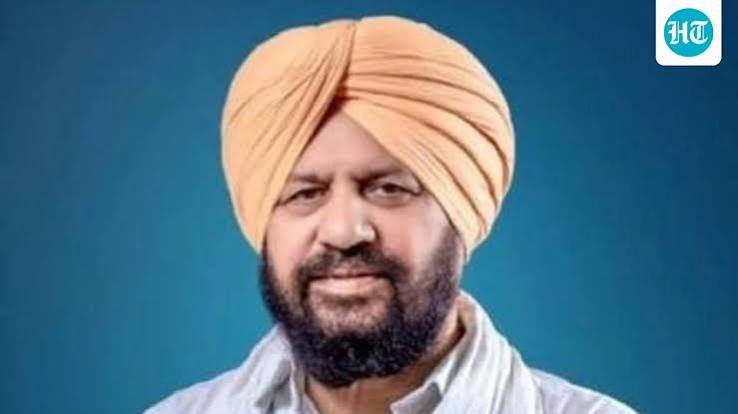
Harjit Singh Grewal, new Chairperson of the National Commission for Minorities

Harjit Singh Grewal: New Chairperson of National Commission for Minorities 2026 Explained Read More ยป

16th Finance Commission: โ‚น4.35 Lakh Crore Panchayat Grants โ€“ UPSC/PSC Notes

Why in News

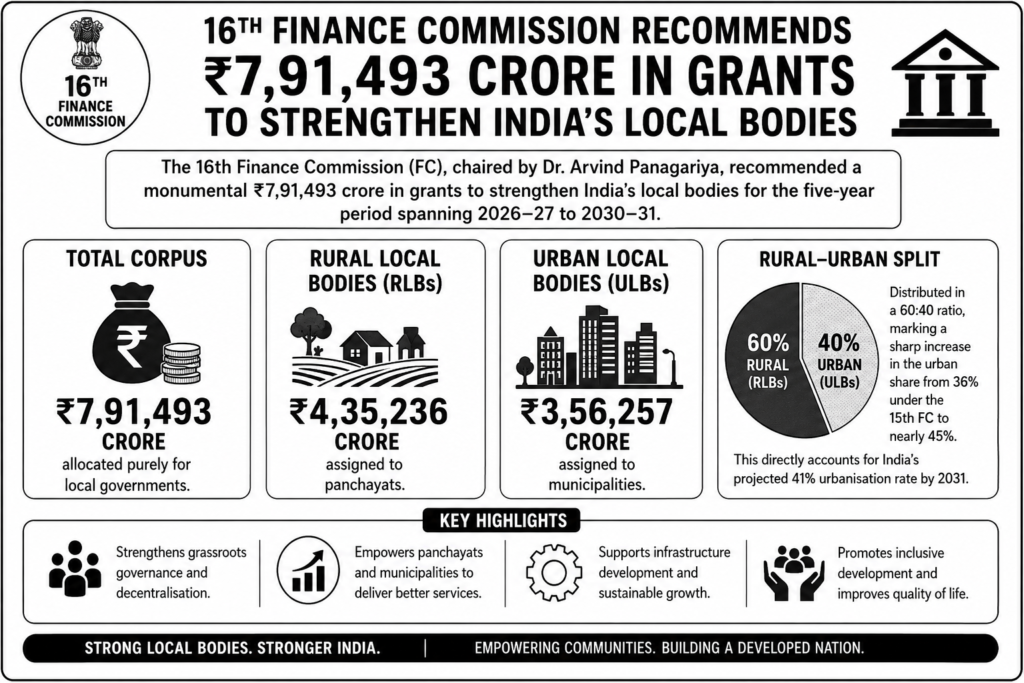
The Ministry of Panchayati Raj organised a National Workshop of State Panchayati Raj Ministers to deliberate on effective implementation of the recommendations of the Sixteenth Finance Commission (16th FC) for local bodies.

Key Facts for Prelims

  • The 16th Finance Commission is chaired by Dr. Arvind Panagariya.
  • It has recommended a total of โ‚น7,91,493 crore in grants for local bodies for the award period 2026-27 to 2030-31.
  • Rural Local Bodies (RLBs) have been allocated โ‚น4,35,236 crore โ€” an increase of about 84% over the comparable 15th FC allocation.
  • Urban Local Bodies (ULBs) have been allocated โ‚น3,56,257 crore.
  • The rural-urban split of local body grants is now 60:40, with the urban share rising from about 36% (under the 15th FC) to nearly 45%, reflecting India’s projected urbanisation of 41% by 2031.

Interconnected Concept: The Finance Commission

  • The Finance Commission is a constitutional body constituted by the President under Article 280, generally every five years.
  • It recommends the distribution of net proceeds of taxes between the Union and the States, and the principles governing grants-in-aid, including grants to local bodies.
  • The 73rd and 74th Constitutional Amendment Acts, 1992 gave constitutional status to Panchayats and Municipalities and require State Finance Commissions to further devolve resources to them.
  • Local body grants are generally split into a basic (untied) component and a tied/performance-linked component.

Quick Revision Table

AspectDetail
Chairperson, 16th FCDr. Arvind Panagariya
Total local body grantsโ‚น7,91,493 crore
Rural Local Bodies (RLB) shareโ‚น4,35,236 crore
Urban Local Bodies (ULB) shareโ‚น3,56,257 crore
Rural : Urban ratio60 : 40
Rise in RLB grant over 15th FC~84%
Constitutional basisArticle 280
Nodal Ministry for RLB grantsMinistry of Panchayati Raj

Trap / Confusing Points

Confusing PointClarification
15th FC vs 16th FC urban shareUrban share was ~36% under the 15th FC; it has increased to nearly 45% under the 16th FC โ€” don’t reverse the trend.
Finance Commission vs GST CouncilFinance Commission (Article 280) recommends tax devolution and grants; GST Council (Article 279A) decides GST rates and related matters โ€” different bodies, different articles.
RLB vs ULB grant shareRural Local Bodies get 60%, Urban Local Bodies get 40% of local body grants โ€” not an equal split.
Basic grant vs Tied grantBasic grants are untied and flexible; tied grants are linked to specific sectors/performance conditions.

Practice MCQs

  1. The Finance Commission of India is constituted by the President under which Article of the Constitution?
    a. Article 275
    b. Article 280
    c. Article 282
    d. Article 293
    Ans: b. Article 280 provides for the constitution of a Finance Commission by the President, generally every five years.
  2. Who chairs the 16th Finance Commission?
    a. N. K. Singh
    b. Arvind Panagariya
    c. Vijay Kelkar
    d. Y. V. Reddy
    Ans: b. Dr. Arvind Panagariya, former Vice-Chairman of NITI Aayog, chairs the 16th Finance Commission.
  3. As recommended by the 16th Finance Commission, what is the approximate rural-urban split of local body grants?
    a. 50:50
    b. 60:40
    c. 70:30
    d. 80:20
    Ans: b. The grants are split roughly 60% to Rural Local Bodies and 40% to Urban Local Bodies, reflecting rising urbanisation.
  4. Which Constitutional Amendment Acts institutionalised financial devolution to Panchayats and Municipalities?
    a. 42nd and 44th
    b. 73rd and 74th
    c. 61st and 65th
    d. 86th and 93rd
    Ans: b. The 73rd Amendment (Panchayats) and 74th Amendment (Municipalities), 1992, gave constitutional status to local self-government.
  5. Grants recommended by the Finance Commission for local bodies are released based on operational guidelines issued by which authority?
    a. NITI Aayog
    b. Department of Expenditure, Ministry of Finance
    c. Ministry of Panchayati Raj alone
    d. Reserve Bank of India
    Ans: b. The Department of Expenditure, Ministry of Finance, issues the operational guidelines for release of Finance Commission grants to local bodies.

To know more about the discussed issue, click here.

To learn current affairs from an exam point of view, Click here.

16th Finance Commission grants infographic for Rural Local Bodies

16th Finance Commission: โ‚น4.35 Lakh Crore Panchayat Grants โ€“ UPSC/PSC Notes Read More ยป

e-Shram Portal: 31.78 Crore Workers, Best UPSC Notes

e-Shram portal registrations of unorganised workers
The e-Shram portal has registered over 31.78 crore unorganised workers

Why in News?

The Ministry of Labour and Employment announced that more than 31.78 crore unorganised workers have been registered on the e-Shram portal, strengthening efforts to extend social security to the unorganised sector.

Key Facts for Prelims: e-Shram Portal

  • Nodal Ministry: Ministry of Labour and Employment
  • Objective: Create the first-ever National Database of Unorganised Workers (NDUW)
  • Identifier issued: A 12-digit Universal Account Number (UAN), seeded with Aadhaar
  • Target beneficiaries: Migrant workers, construction workers, street vendors, gig and platform workers, domestic workers, agricultural labourers
  • Function: Single platform to access central and state social security and welfare schemes
  • Linked schemes: PMSBY, PMJJBY, Ayushman Bharat PM-JAY
  • Registration: Free, self-registration or through CSCs, with Aadhaar-based authentication

Static Exam Link: Unorganised Sector and Social Security

  • Unorganised Workers Social Security Act, 2008: Provides for the National Social Security Board and welfare schemes for unorganised workers
  • Code on Social Security, 2020: First law to define gig worker, platform worker and aggregator; provides for a social security fund
  • Constitutional basis: Article 41 and Article 43 under the Directive Principles of State Policy; Labour is in the Concurrent List
  • Related schemes: PMSBY โ€” accident insurance; PMJJBY โ€” life insurance; PM-JAY โ€” health cover of Rs 5 lakh per family per year

Why the e-Shram Portal Matters for Governance

The core problem the e-Shram portal addresses is identification. Welfare schemes for unorganised workers existed long before the portal, but there was no single verified list of who those workers were, where they lived or what work they did. Without such a list, benefits could not be targeted, portability across states was impossible, and migrant workers routinely fell out of the system when they moved. Aadhaar-seeded registration creates a de-duplicated database that makes direct benefit transfer feasible for this group.

The design also reflects a shift in how India thinks about labour welfare. Instead of tying benefits to a formal employer, which most unorganised workers do not have, entitlements attach to the worker. This is the same principle behind the social security fund envisaged in the Code on Social Security, 2020 for gig and platform workers, financed partly through aggregator contributions.

Limitations are equally examinable. Registration is self-declared, so occupational data can be inaccurate. Digital access and Aadhaar authentication failures exclude some of the poorest workers. Registration alone does not create a legal entitlement, since benefits still depend on the eligibility rules of individual schemes. And states run parallel welfare boards, particularly for construction workers, whose databases do not always align with the national one. For prelims, focus on the nodal ministry, the database name, the identifier, and which schemes are linked.

Quick Revision Table: e-Shram Portal

ParameterDetail
Nodal MinistryMinistry of Labour and Employment
Database CreatedNational Database of Unorganised Workers (NDUW)
Identifier12-digit UAN, Aadhaar-seeded
RegistrationsOver 31.78 crore
CoverageUnorganised, migrant, gig and platform workers
Linked SchemesPMSBY, PMJJBY, Ayushman Bharat PM-JAY
Law Defining Gig WorkersCode on Social Security, 2020

Trap / Confusing Points

ConfusionCorrect Fact
The e-Shram portal is run by the Ministry of Rural DevelopmentIt is an initiative of the Ministry of Labour and Employment
Its UAN is the same as the EPFO UANBoth are 12-digit UANs but different: EPFO UAN is for organised-sector PF members; the e-Shram UAN is for unorganised workers
Registration itself provides a pensionIt is a database and access platform; benefits flow through linked schemes
Organised-sector employees can registerEPFO/ESIC members and income-tax payers are generally not eligible
Gig workers were first defined in the 2008 ActThey were first defined in the Code on Social Security, 2020

Practice MCQs

1. The e-Shram portal is an initiative of which ministry?

a. Ministry of Rural Development
b. Ministry of Labour and Employment
c. Ministry of Social Justice and Empowerment
d. Ministry of Skill Development and Entrepreneurship

Ans: B
It is a flagship initiative of the Ministry of Labour and Employment.

2. The portal creates which of the following databases?

a. National Register of Migrant Labour
b. National Database of Unorganised Workers
c. National Employment Register
d. National Skill Registry

Ans: B
It is the first-ever National Database of Unorganised Workers.

3. Registered workers are issued a:

a. 10-digit registration number
b. 12-digit Universal Account Number seeded with Aadhaar
c. 16-digit Aadhaar-linked identity
d. 8-digit labour card number

Ans: B
Each registered worker receives a 12-digit UAN seeded with Aadhaar.

4. Which of the following are linked for benefit delivery?
1. PMSBY 2. PMJJBY 3. Ayushman Bharat PM-JAY

a. 1 and 2 only
b. 2 and 3 only
c. 1 and 3 only
d. 1, 2 and 3

Ans: D
It acts as a single window to central and state welfare schemes including all three.

5. Gig workers and platform workers were first defined in Indian law under:

a. Unorganised Workers Social Security Act, 2008
b. Industrial Relations Code, 2020
c. Code on Social Security, 2020
d. Occupational Safety, Health and Working Conditions Code, 2020

Ans: C
The Code on Social Security, 2020 first defined gig worker, platform worker and aggregator.

To learn current affairs from exam point of view, Click here.

To know more about the e-Shram portal, Click here.

e-Shram Portal: 31.78 Crore Workers, Best UPSC Notes Read More ยป

Ladakh to Get Article 371-Like Constitutional Safeguards | UPSC Notes

Why in News?

Leaders of Ladakh and the Ministry of Home Affairs (MHA) reached an in-principle agreement on providing constitutional safeguards on the lines of Articles 371A, 371F, and 371G to the Union Territory of Ladakh โ€” similar to protections for Nagaland, Sikkim, and Mizoram.

Key Facts for Prelims

  • Articles 371 to 371J are in Part XXI of the Indian Constitution
  • Part XXI is titled: “Temporary, Transitional, and Special Provisions”
  • These provisions apply to 12 specific states
  • Ladakh seeks safeguards on lines of: 371A (Nagaland), 371F (Sikkim), 371G (Mizoram)

Quick Revision Table: Articles 371 to 371J

ArticleStateKey Provision
371Maharashtra & GujaratDevelopment boards for backward regions (Vidarbha, Marathwada, Saurashtra, Kutch)
371ANagalandParliament cannot legislate on Naga customary laws, land rights without State Assembly approval
371BAssamSpecial committee for Tribal Area members in State Assembly
371CManipurHill Areas Committee; Governor’s special responsibility for hill areas
371DAndhra Pradesh & TelanganaEquitable public employment and education; local cadre reservations
371EAndhra PradeshCentral University establishment
371FSikkimProtection of existing laws and rights after integration with India
371GMizoramParliament cannot legislate on Mizo customary laws/land without State Assembly approval
371HArunachal PradeshGovernor’s special responsibility for law and order
371IGoaLegislature not less than 30 members
371JKarnatakaSpecial provisions for Kalyana Karnataka (Hyderabad-Karnataka) region

Trap / Confusing Points

ConfusionCorrect Fact
Article 371A applies to Mizoram371A โ†’ Nagaland; 371G โ†’ Mizoram
Part XXI is permanent provisionsPart XXI = “Temporary, Transitional, and Special Provisions”
371J is for Assam371J is for Karnataka (Kalyana Karnataka)
371B is for Manipur371B โ†’ Assam; 371C โ†’ Manipur
371D applies to AP only371D covers both Andhra Pradesh and Telangana

Practice MCQs

1. Articles 371 to 371J are in which Part of the Constitution?

a. Part XVIII
b. Part XIX
c. Part XX
d. Part XXI

Ans: D
Articles 371โ€“371J are in Part XXI: “Temporary, Transitional, and Special Provisions.”

2. Under which article is Parliament restricted from legislating on Naga customary laws?

a. Article 371
b. Article 371A
c. Article 371G
d. Article 371H

Ans: B
Article 371A provides special protections to Nagaland regarding customary law and land rights.

3. Ladakh seeks safeguards like Articles 371A, 371F, and 371G applicable to which states respectively?

a. Assam, Mizoram, Nagaland
b. Nagaland, Sikkim, Mizoram
c. Manipur, Goa, Arunachal Pradesh
d. Nagaland, Arunachal Pradesh, Mizoram

Ans: B
371A โ†’ Nagaland, 371F โ†’ Sikkim, 371G โ†’ Mizoram.

4. Article 371J provides special provisions for which region of Karnataka?

a. Kodagu region
b. Coastal Karnataka
c. Kalyana Karnataka (Hyderabad-Karnataka)
d. Malnad region

Ans: C
Article 371J covers the Kalyana Karnataka (formerly Hyderabad-Karnataka) region.

5. Which article provides for a special committee of the Assam Legislative Assembly for tribal area members?

a. Article 371A
b. Article 371B
c. Article 371C
d. Article 371D

Ans: B
Article 371B provides a special committee in the Assam Legislative Assembly for tribal area members.

To learn current affairs from exam point of view, Click here.

To know more about Ladakh’s constitutional status, Click here.

Ladakh to Get Article 371-Like Constitutional Safeguards | UPSC Notes Read More ยป

Tushar Mehta Reappointed Solicitor General of India for 3 Years | UPSC Notes

Why in News?

The Appointments Committee of the Cabinet (ACC) approved the reappointment of Tushar Mehta as Solicitor General of India (SGI) for a further term of three years from July 1.

Key Facts for Prelims: Solicitor General of India

  • Position: Second-highest law officer of India (after Attorney General)
  • Constitutional Status: NOT mentioned in the Constitution (unlike AG under Article 76)
  • Governed by: Law Officers (Conditions of Service) Rules, 1987
  • Appointed by: Appointments Committee of the Cabinet (ACC)
  • Tenure: Fixed three years, renewable
  • Parliamentary Rights: SGI does NOT have the right to participate in parliamentary proceedings

Attorney General vs Solicitor General

FeatureAttorney General (AGI)Solicitor General (SGI)
Constitutional StatusCreated under Article 76Not in Constitution โ€” statutory post
Parliamentary RightsCan speak in both Houses (Article 88), no voteNo parliamentary rights
TenureAt President’s pleasure โ€” no fixed termFixed 3-year term
RemovalBy President at any timeUnder statutory executive rules
RankHighest law officerSecond-highest law officer

Trap / Confusing Points

ConfusionCorrect Fact
SGI is a constitutional postSGI is statutory โ€” NOT in the Constitution
SGI can address ParliamentOnly Attorney General has parliamentary rights (Article 88)
AGI has a fixed 3-year termAGI serves at President’s pleasure; SGI has fixed 3-year term
ACC is chaired by Home MinisterACC is chaired by the Prime Minister

Practice MCQs

1. The Solicitor General of India is the _____ highest law officer.

a. First
b. Second
c. Third
d. Fourth

Ans: B
SGI is the second-highest law officer, directly subordinate to the Attorney General.

2. The SGI post is governed by which rules?

a. Article 76
b. Article 88
c. Law Officers (Conditions of Service) Rules, 1987
d. Supreme Court Rules, 2013

Ans: C
SGI is governed by Law Officers (Conditions of Service) Rules, 1987.

3. Which body approved Tushar Mehta’s reappointment?

a. Cabinet Committee on Economic Affairs
b. Appointments Committee of the Cabinet
c. Supreme Court Collegium
d. UPSC

Ans: B
ACC approved the reappointment for a further three-year term.

4. AG’s right to participate in Parliament is under which article?

a. Article 76
b. Article 79
c. Article 88
d. Article 124

Ans: C
Article 88 grants the AG right to speak in both Houses (without voting rights).

5. Standard tenure of the Solicitor General?

a. At President’s pleasure
b. Five years
c. Three years
d. Two years

Ans: C
SGI is appointed for a fixed 3-year term by ACC.

To learn current affairs from exam point of view, Click here.

To know more about law officers of India, Click here.

Tushar Mehta Reappointed Solicitor General of India for 3 Years | UPSC Notes Read More ยป

North Eastern Council (NEC): 73rd Plenary Session

Why in News

The North Eastern Council (NEC) held its 73rd Plenary Session in Shillong, Meghalaya, chaired by Union Home Minister Amit Shah. The session brought together Governors, Chief Ministers, and senior officials from all eight North Eastern states. It deliberated on the North East Vision Plan 2047 โ€” a long-term roadmap to transform the North Eastern Region into a hub of economic growth, connectivity, and cultural prosperity.

About the North Eastern Council (NEC) โ€” Key Facts for Prelims

What is NEC?

The North Eastern Council is the apex statutory regional planning body for the socio-economic and balanced development of India’s eight North Eastern states.

Eight Member States

Arunachal Pradesh, Assam, Manipur, Meghalaya, Mizoram, Nagaland, Sikkim, and Tripura.

Establishment

  • Constituted in 1971 under The North Eastern Council Act, 1971 โ€” an Act of Parliament.
  • Sikkim was added in 2002 through an amendment to the NEC Act.

Composition

  • Governors and Chief Ministers of all eight member states.
  • Three members nominated by the President of India.

Key Positions

  • Chairperson: Union Home Minister (ex-officio)
  • Vice-Chairperson: Minister of DoNER (Ministry of Development of North Eastern Region)

Nature of Body

  • Statutory body โ€” created by an Act of Parliament.
  • NOT a constitutional body.

Secretariat

Located in Shillong, Meghalaya.

Key Functions

  • Regional planning and inter-state coordination for North Eastern states.
  • Reviews and recommends projects in transport, education, power, and flood control.
  • Promotes cooperative federalism across the eight states.

Interconnected Concept: NEC vs. Zonal Councils

ParameterNorth Eastern CouncilZonal Councils
Created byNEC Act, 1971 (Parliament)States Reorganisation Act, 1956
NatureStatutory bodyStatutory body
Coverage8 North Eastern States onlyRest of India (5 zones)
ChairpersonUnion Home MinisterUnion Home Minister
FocusPlanning & developmentAdvisory โ€” inter-state cooperation
SecretariatShillong, MeghalayaMinistry of Home Affairs, Delhi

โš ๏ธ Key Fact: Both NEC and Zonal Councils are statutory, NOT constitutional bodies.

Quick Revision Table

FactDetail
NEC established1971, by NEC Act of Parliament
Sikkim added2002 amendment
ChairpersonUnion Home Minister
Vice-ChairpersonMinister of DoNER
Member states8 (includes Sikkim)
SecretariatShillong, Meghalaya
Body typeStatutory (NOT constitutional)
73rd Session themeNorth East Vision Plan 2047

Trap / Confusing Points

Common ConfusionCorrect Fact
NEC is a constitutional bodyโŒ It is a statutory body under NEC Act, 1971
NEC has 7 member statesโŒ It has 8 states (Sikkim added in 2002)
Home Minister is Vice-ChairmanโŒ Home Minister is Chairman; DoNER Minister is Vice-Chairman
NEC covers all of IndiaโŒ Covers only the 8 North Eastern states
NEC established in 2002โŒ Established in 1971; 2002 only added Sikkim
NEC and Zonal Councils are sameโŒ Different scope and purpose โ€” NEC is for planning; Zonal Councils are advisory

Practice MCQs

1. The North Eastern Council (NEC) was established under which of the following?
a. 73rd Constitutional Amendment Act
b. NEC Act, 1971
c. States Reorganisation Act, 1956
d. North Eastern Areas Reorganisation Act, 1971

Ans: B
The NEC is a statutory body created by the North Eastern Council Act, 1971 โ€” an Act of Parliament. It is not a constitutional body.

2. Which state was added to the North Eastern Council through an amendment in 2002?
a. Tripura
b. Arunachal Pradesh
c. Sikkim
d. Manipur

Ans: C
Sikkim was included in NEC through the NEC (Amendment) Act, 2002. Before that, NEC had only 7 states.

3. Who serves as the Vice-Chairperson of the North Eastern Council?
a. Chief Minister of Assam
b. Union Home Minister
c. Minister of DoNER
d. Governor of Meghalaya

Ans: C
The Minister of Development of North Eastern Region (DoNER) is the Vice-Chairman. The Union Home Minister is the Chairman โ€” a common trap question.

4. Which of the following statements about NEC is CORRECT?
a. It is a constitutional body under Article 263
b. Its secretariat is in Guwahati
c. It was created by the States Reorganisation Act, 1956
d. It is a statutory apex body for planning in 8 North Eastern states

Ans: D
NEC is a statutory apex body for planning. Its secretariat is in Shillong (not Guwahati). Article 263 deals with the Inter-State Council โ€” a different body.

5. The 73rd Plenary Session of the NEC deliberated on which document/plan?
a. Act East Policy 2047
b. NER Industrial Vision 2030
c. North East Vision Plan 2047
d. DONER Development Plan 2035

Ans: C
The 73rd session focused on the North East Vision Plan 2047 โ€” a long-term roadmap for transforming the North Eastern Region by 2047.


To learn current affairs from exam point of view, Click here.

To know more about the discussed issues, Click here.

North Eastern Council (NEC): 73rd Plenary Session Read More ยป