The Convention on Biological Diversity (CBD) is an international legally binding treaty aimed at conserving biological diversity and ensuring its sustainable use.
- Adopted: 1992
- Place: Rio Earth Summit
- Entered into force: 1993
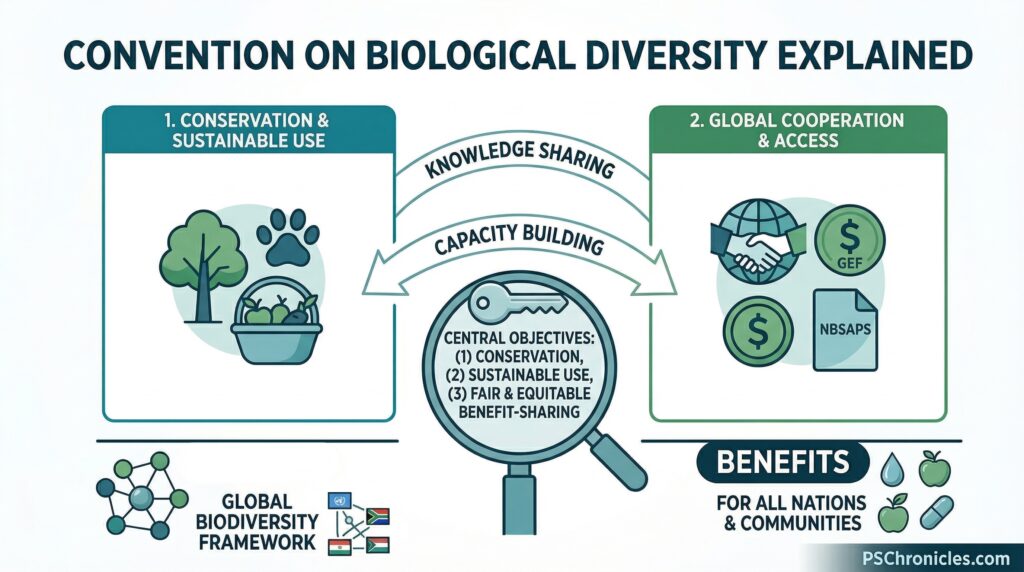
Objectives of CBD:
The CBD has three main objectives:
- Conservation of Biological Diversity
- Sustainable Use of its Components
- Fair and Equitable Sharing of Benefits arising from genetic resources
These are commonly called the “3 Pillars of CBD”
Protocols under CBD
1. Cartagena Protocol (2000)
- Full name: Cartagena Protocol on Biosafety
- Focus: Safe handling and transfer of Living Modified Organisms (LMOs)
- Related to biotechnology & GMOs
2. Nagoya Protocol (2010)
- Full name: Nagoya Protocol
- Focus: Access and Benefit Sharing (ABS) of genetic resources
- Ensures fair compensation to countries/communities
Institutional Structure
1. Conference of Parties (COP)
- Supreme decision-making body
- Meets every 2 years
2. Secretariat
- Located in Montreal
- Administers CBD implementation
Kunming-Montreal Global Biodiversity Framework (2022)
Adopted at COP15 of CBD. Key Targets (30×30 Target)
- Protect 30% of land and oceans by 2030
- Restore degraded ecosystems
- Reduce pollution and biodiversity loss
India and CBD
- India is a party to CBD
Legal Framework in India
1. Biological Diversity Act, 2002
- Implements CBD provisions
2. National Biodiversity Authority (NBA)
- Established in Chennai
For current affairs related to Environment and ecology click here