Why in News?
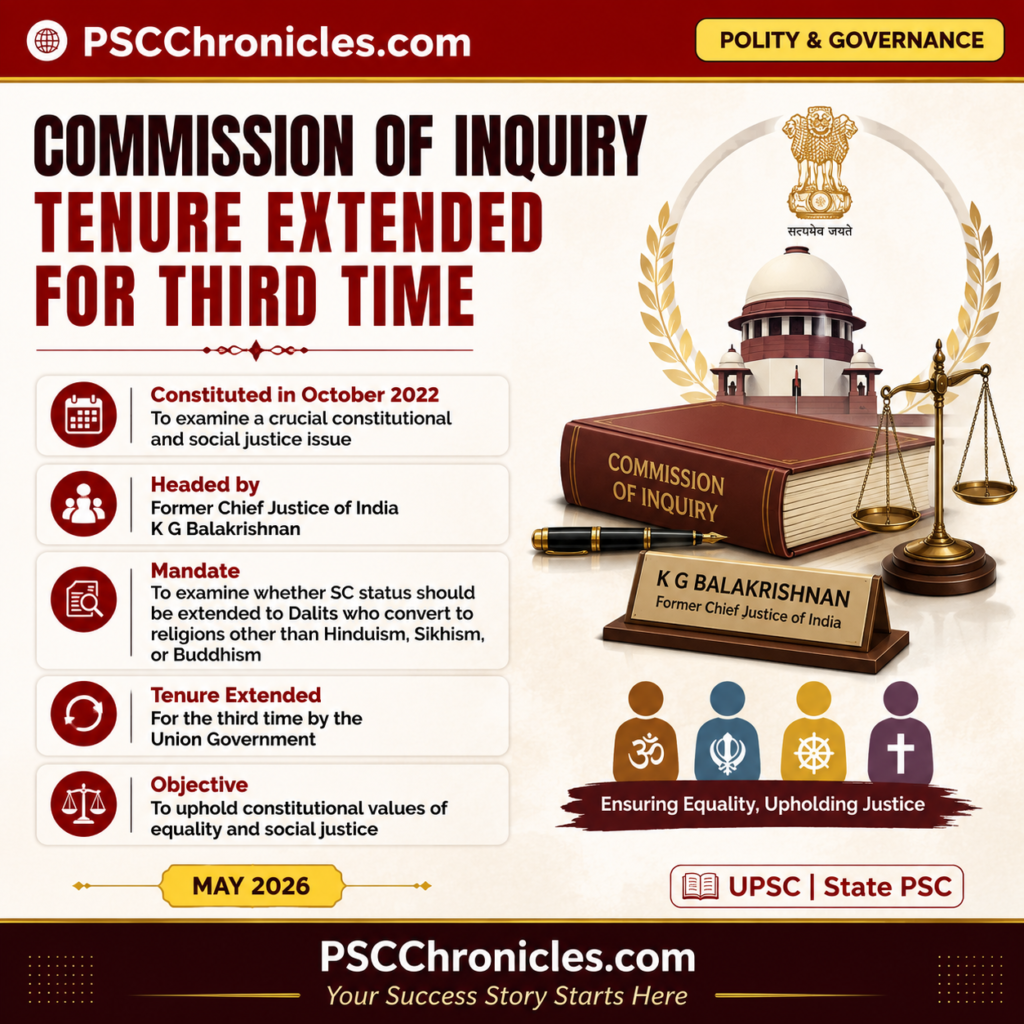
The Union Government has extended the tenure of the Commission of Inquiry headed by former Chief Justice of India K G Balakrishnan for the third time. The commission was constituted in October 2022 to examine whether Scheduled Caste status should be extended to Dalits who convert to religions other than Hinduism, Sikhism, or Buddhism.
Key Facts About the Commission
| Aspect | Details |
|---|---|
| Commission Head | Justice K G Balakrishnan, former Chief Justice of India |
| Constituted | October 2022 |
| Purpose | Examine extension of SC status to converted Dalits |
| Current Extension | Third extension granted by Centre |
| Concerned Communities | Dalits converted to Christianity or Islam |
| Legal Basis Under Review | Constitution (Scheduled Castes) Order, 1950 |
| Ministry Involved | Ministry of Social Justice and Empowerment |
Constitutional and Statutory Background
Constitution (Scheduled Castes) Order, 1950
The Constitution (Scheduled Castes) Order, 1950 was issued under Article 341 of the Constitution. Paragraph 3 of the Order restricts Scheduled Caste recognition to persons professing Hinduism, Sikhism, or Buddhism.
| Amendment | Change Introduced |
|---|---|
| 1950 Order | SC status limited to Hindus |
| 1956 Amendment | Sikhs included in SC category |
| 1990 Amendment | Buddhists included in SC category |
Under the present legal framework, Dalits converting to Christianity or Islam lose eligibility for SC reservation benefits. The Balakrishnan Commission is examining whether this restriction violates constitutional principles of equality and social justice.
Difference Between SC and ST Status
| Feature | Scheduled Castes (SC) | Scheduled Tribes (ST) |
|---|---|---|
| Linked to Religion | Yes | Generally No |
| Constitutional Provision | Article 341 | Article 342 |
| Effect of Religious Conversion | SC status may cease | ST status usually continues |
| Basis of Recognition | Historical untouchability | Tribal identity and customs |
Unlike SC status, Scheduled Tribe recognition is generally not tied to religion. An ST individual may continue to retain tribal status after conversion unless community recognition and tribal customs are completely abandoned.
Quick Revision Points
- Justice K G Balakrishnan heads the commission.
- Commission constituted in October 2022.
- SC status governed under Article 341.
- Constitution (Scheduled Castes) Order, 1950 restricts SC status by religion.
- Sikhs added to SC list in 1956.
- Buddhists included in 1990.
- ST status governed under Article 342.
- SC Status for Dalit Converts 2026 concerns Dalits converted to Christianity and Islam.
Previous Year Questions (PYQs)
- (UPSC Prelims 2012): With reference to the Constitution of India, consider the following:
- The Constitution empowers the President to specify Scheduled Castes.
- Parliament can modify the list of Scheduled Castes.
- (UPSC Mains 2016): Discuss the role of affirmative action in addressing social discrimination in India.
- (For Practice): Examine the constitutional issues involved in the debate on SC Status for Dalit Converts 2026.
Practice MCQs
Q1. Under which Article are Scheduled Castes specified in India?
a) Article 340
b) Article 341
c) Article 342
d) Article 343
Answer: (b) — Article 341 empowers the President to specify Scheduled Castes.
Q2. The Constitution (Scheduled Castes) Order originally restricted SC status to which religion?
a) Hinduism
b) Sikhism
c) Buddhism
d) Christianity
Answer: (a) — The 1950 Order initially limited SC status to Hindus only.
Q3. In which year were Buddhists included in the Scheduled Caste category?
a) 1956
b) 1976
c) 1990
d) 2001
Answer: (c) — Buddhists were included through the 1990 amendment.
Q4. Which former Chief Justice of India heads the present commission on Dalit converts?
a) N V Ramana
b) U U Lalit
c) K G Balakrishnan
d) R M Lodha
Answer: (c) — The commission is chaired by Justice K G Balakrishnan.
To study current affairs from exam point of view Click here
To study more about this news Click here