πŸ“° Today's Current AffairsRead Now →
📷 Follow on Instagram

April 2026 current affairs

UNESCO & Sikkim Partner to Document Ru-Soam: India’s Ancient Cane Bridge Heritage | UPSC Current Affairs 2026

UNESCO has joined hands with the Sikkim state government to document the traditional Ru-Soam bridges β€” indigenous cane suspension footbridges built by the Lepcha community β€” located within the Khangchendzonga Biosphere Reserve (KBR). This initiative aims to preserve and recognize this extraordinary example of indigenous engineering knowledge before it is lost to modernization.

πŸ“Œ UPSC Relevance: GS Paper I – Art & Culture | GS Paper III – Environment & Ecology | Prelims – Static GK & Current Affairs

What are Ru-Soam Bridges?

Ru-Soam are traditional bamboo and cane suspension footbridges crafted by the Lepcha community of Sikkim. These structures are a testimony to centuries of accumulated indigenous knowledge in natural material engineering.

  • Built entirely without nails or metal fasteners
  • Materials used: wild cane, bamboo, and wood
  • Represent centuries-old indigenous engineering knowledge
  • Located within the Khangchendzonga Biosphere Reserve, Sikkim
  • Recognized as a remarkable example of Traditional Ecological Knowledge (TEK)

Why is UNESCO Documenting Ru-Soam?

UNESCO’s documentation effort is part of a broader mission to safeguard intangible cultural heritage worldwide. The specific objectives include:

  1. Preserving intangible cultural heritage and indigenous technical knowledge
  2. Recognizing the Lepcha community’s ecological and engineering contributions
  3. Integrating indigenous knowledge systems into sustainable development frameworks
  4. Safeguarding this knowledge from being lost as modernization advances

About the Lepcha Community

The Lepcha are one of the indigenous communities of Sikkim, classified as a Particularly Vulnerable Tribal Group (PVTG) in India. They have coexisted with the Khangchendzonga ecosystem for centuries, developing unique knowledge systems for construction, agriculture, and ecological management. Their Ru-Soam bridges are not just infrastructure β€” they are a living cultural tradition.

πŸ”οΈ UPSC Connect: Khangchendzonga Biosphere Reserve (KBR)

The Khangchendzonga Biosphere Reserve is a critical interconnected topic for UPSC aspirants. Here are the key facts:

FeatureDetails
LocationSikkim, India
UNESCO World Heritage SiteDesignated in 2016
Heritage TypeIndia’s first and only “mixed” heritage site (natural + cultural)
UNESCO Biosphere ReservePart of UNESCO World Network of Biosphere Reserves since 2018
Key FeatureHome to Mt. Khangchendzonga β€” the world’s 3rd highest peak (8,586 m)
Tribal CommunitiesLepcha, Bhutia, Limbu β€” all with deep cultural ties to the landscape
πŸ’‘ Prelims Tip: KBR is India’s FIRST and ONLY “mixed” UNESCO World Heritage Site β€” recognised for both its outstanding natural values AND cultural heritage. Designated in 2016. Do not confuse this with the Biosphere Reserve status (2018).

Key Facts for Quick Revision

  • Ru-Soam = Traditional cane/bamboo suspension bridges of Sikkim
  • Built by: Lepcha community (indigenous PVTG tribe of Sikkim)
  • Location: Khangchendzonga Biosphere Reserve, Sikkim
  • Initiative: UNESCO + Sikkim Government documentation project
  • No metal used: Built entirely from wild cane, bamboo, and wood
  • KBR UNESCO WHS Year: 2016 (mixed heritage site β€” first in India)
  • KBR Biosphere Reserve Network Year: 2018
  • Mt. Khangchendzonga: World’s 3rd highest peak (8,586 m)
UNESCO & Sikkim Partner to Document Ru-Soam: India’s Ancient Cane Bridge Heritage | UPSC Current Affairs 2026 Read More Β»

Andhra University Gets β‚Ή500 Crore Boost

Why in News?

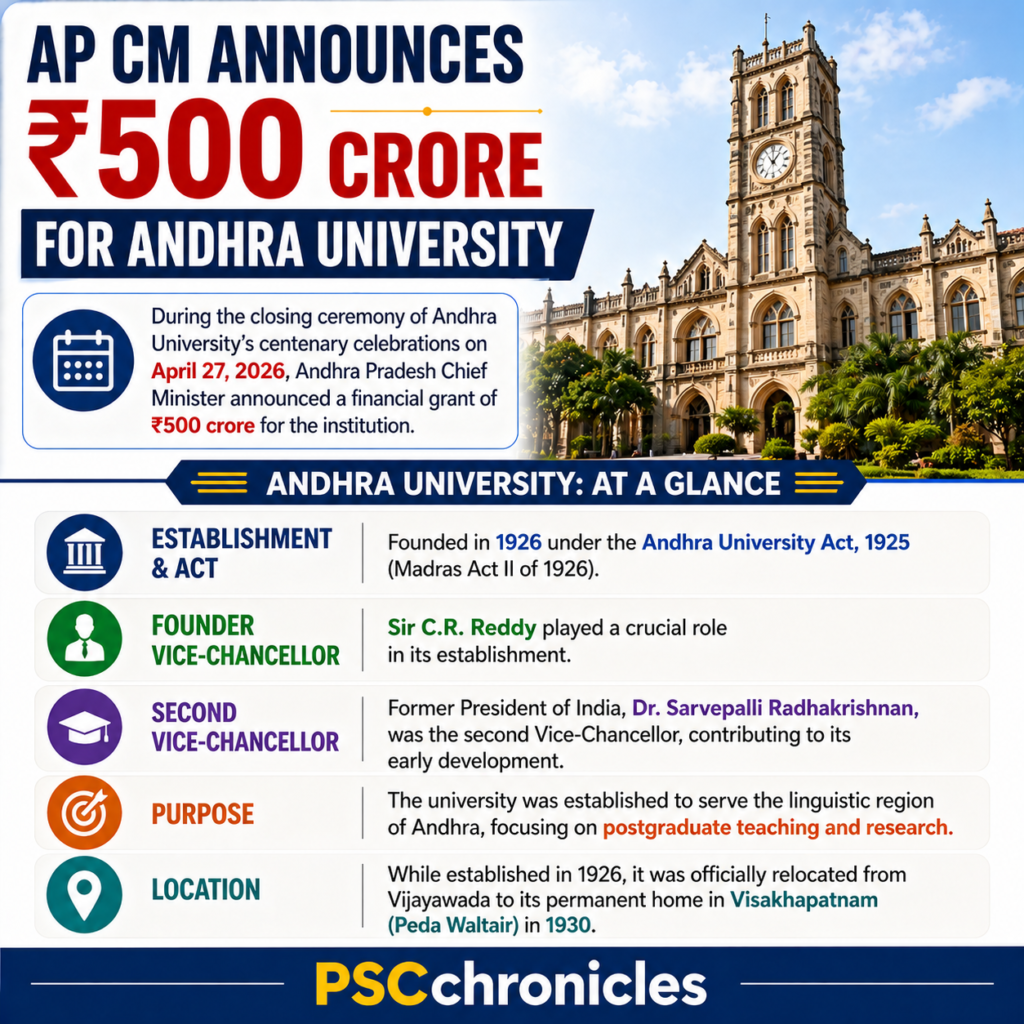
Andhra Pradesh Chief Minister announced a major financial grant of β‚Ή500 crore to Andhra University during its centenary celebrations.

andhra university

About Andhra University

Establishment & Background

  • Established in 1926 under the Andhra University Act, 1925 (Madras Act II of 1926).
  • Created to serve the educational needs of the Andhra-speaking regions (Northern Circars & Ceded districts).

Key Personalities

  • Founder Vice-Chancellor:
    • Sir C. R. Reddy
    • Played a crucial role in establishing the university.
  • Second Vice-Chancellor:
    • Sarvepalli Radhakrishnan
    • Later became the President of India.
    • Contributed significantly to academic development.

Location & Development

  • Initially started in Vijayawada (1926).
  • Shifted to its permanent campus at Visakhapatnam (Peda Waltair) in 1930.

To study AP related current affairs from exam point of view, Click here

Andhra University Gets β‚Ή500 Crore Boost Read More Β»

Governor Clears MLC Nominations in Telangana

Why in News?

The Governor of Telangana has approved the nomination of two prominent personalities to the State Legislative Council under the Governor’s quota. The nominated members are:

  • M. Kodandaram – Academic and social activist
  • Mohammad Azharuddin – Former cricketer
mlc nomination

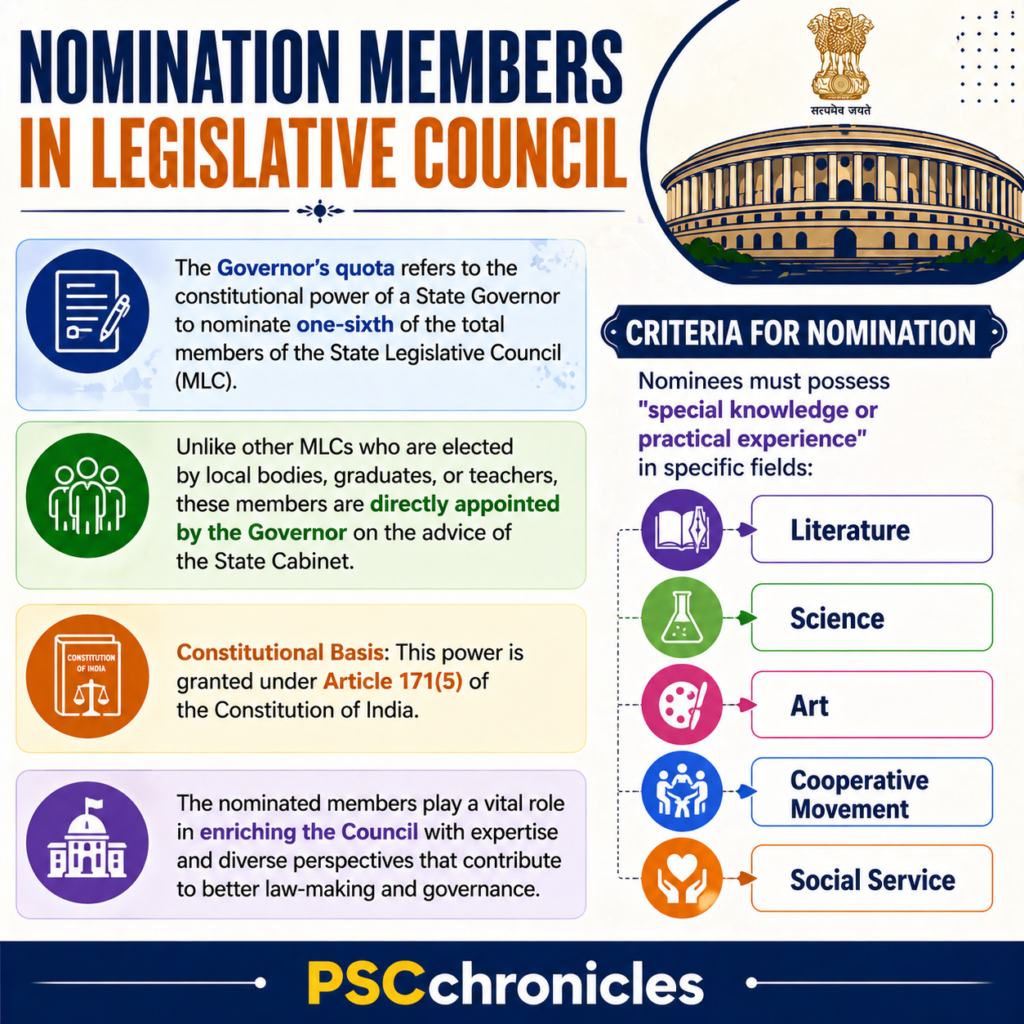
Governor’s Quota in Legislative Council

Constitutional Basis

  • Governed by Article 171(5) of the Indian Constitution.
  • It empowers the Governor to nominate members to the State Legislative Council (MLC).

Key Features of Governor’s Quota

  • The Governor can nominate 1/6th of the total members of the Legislative Council.
  • These members are:
    • Not elected
    • Directly appointed by the Governor
    • Based on the advice of the State Cabinet

Eligibility Criteria for Nomination

Nominees must have special knowledge or practical experience in the following fields:

  • Literature
  • Science
  • Art
  • Cooperative Movement
  • Social Service

About Legislative Council (Quick Facts)

  • It is the Upper House of the State Legislature.
  • Not all states have a Legislative Council.
  • Members are elected through:
    • Local bodies
    • Graduates
    • Teachers
    • MLAs
  • Plus nominated members (Governor’s quota)

To study more Telangana related current affairs, Click here

Governor Clears MLC Nominations in Telangana Read More Β»

Google’s $15 Billion AI Data Centre in Vizag

Why in News?

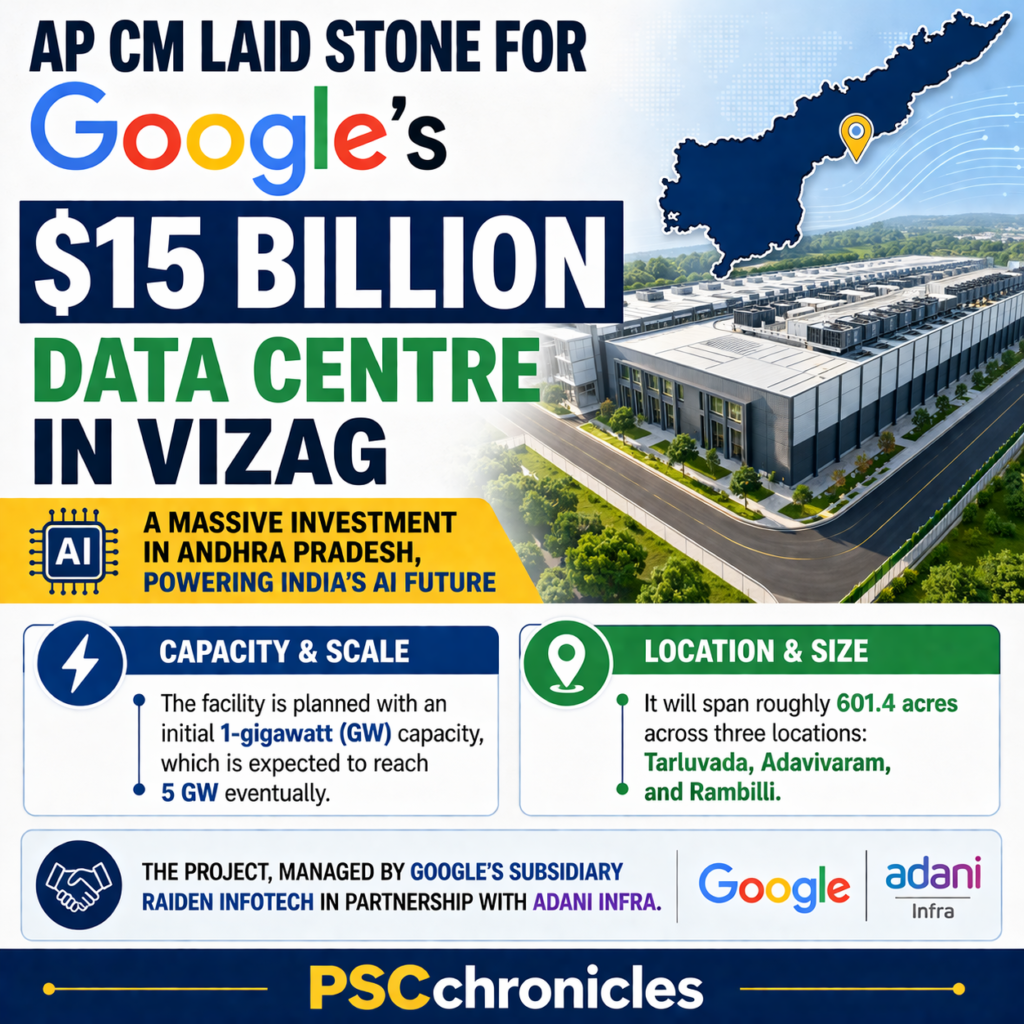
Andhra Pradesh government has launched a major digital infrastructure project with Google’s $15 billion AI data centre hub in Visakhapatnam (Vizag). This project is expected to strengthen India’s position in artificial intelligence and global data services.

ai data center vizag

Project Location: Tarluvada near Visakhapatnam (Vizag). Additional sites include:

  • Adavivaram
  • Rambilli

Total Investment: $15 billion (approx. β‚Ή1.35 lakh crore). Land Area: Around 601.4 acres across three locations.

Capacity & Scale

  • Initial Capacity: 1 Gigawatt (GW).
  • Future Expansion: Up to 5 GW.
  • This makes it one of the largest data centre hubs in India

Companies Involved

  • Developed by Google.
  • Project handled through its subsidiary Raiden Infotech.
  • Partnership with Adani Infra

To study more AP related current affairs from exam point of view, Click here

Google’s $15 Billion AI Data Centre in Vizag Read More Β»

AP Space City Project 2026

Why in News?

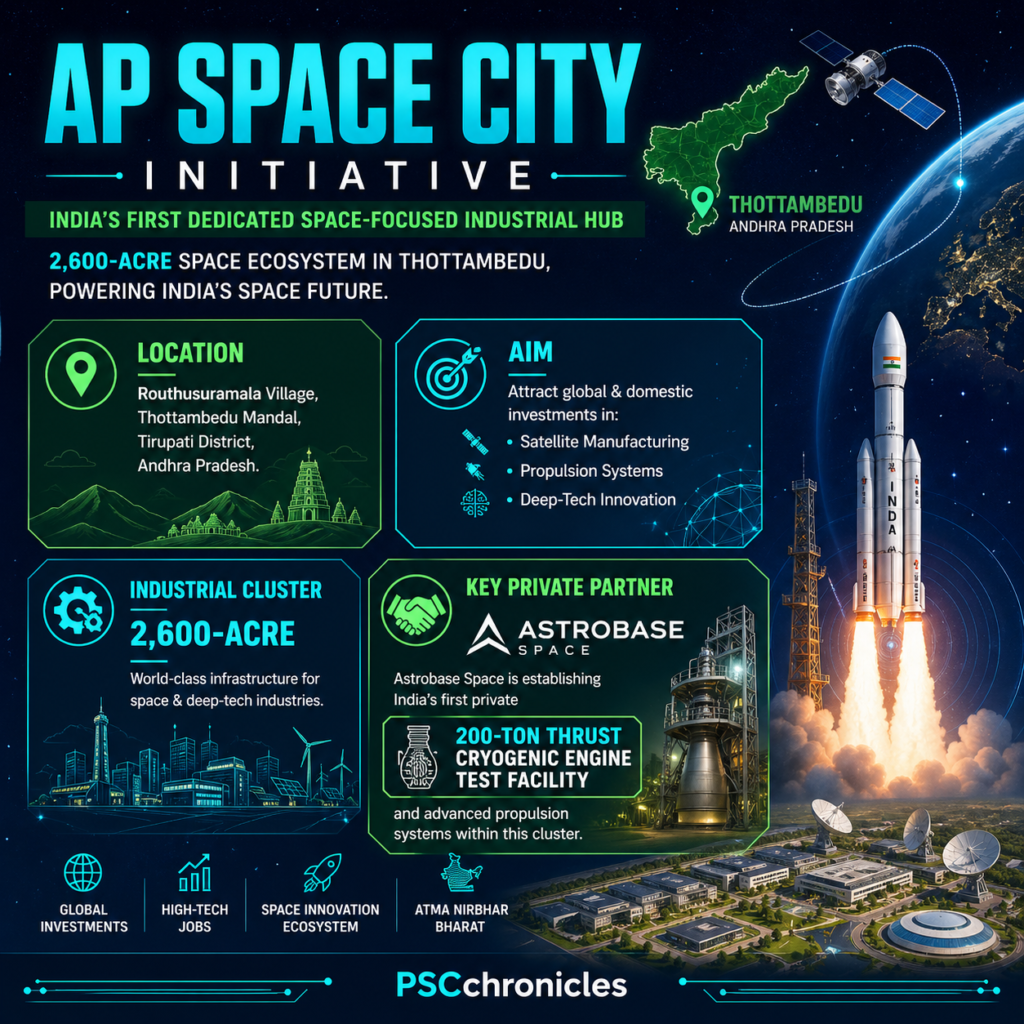
Andhra Pradesh government is developing India’s first dedicated Space City in Tirupati district. Spread across 2,600 acres, this project aims to transform the state into a major hub for space technology and innovation.

ap space city

Location & Overview

  • The Space City is being developed in Routhusuramala village
  • Located in Thottambedu Mandal, Andhra Pradesh
  • Covers an area of 2,600 acres industrial cluster
  • Positioned near Tirupati, a growing industrial and educational hub

Objectives of AP Space City

  • Attract global and domestic investments in the space sector
  • Promote private sector participation in space technology
  • Develop a self-reliant space ecosystem in line with India’s space reforms
  • Encourage deep-tech innovation, including AI and data analytics

To study more AP current affairs from exam point of view, Click here

AP Space City Project 2026 Read More Β»

Census 2027: World’s First Fully Digital Census Explained

Why in News?

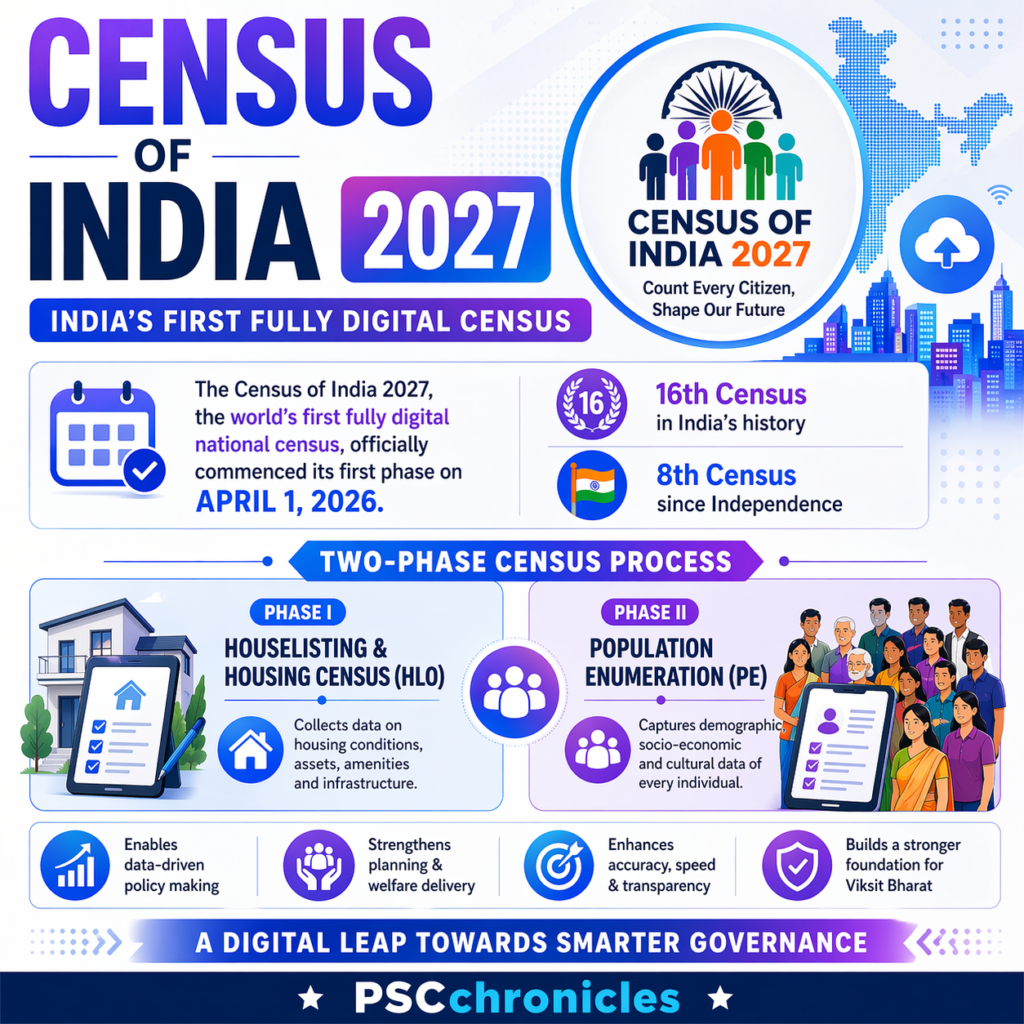
India has launched Census 2027, marking a historic shift as the world’s first fully digital national census. The exercise began on April 1, 2026, and plays a crucial role in policy-making, planning, and governance.

census 2027

Key Highlights of Census 2027

  • First-ever fully digital census in the world
  • Started on April 1, 2026
  • It is the 16th Census of India
  • It is the 8th census after independence
  • Conducted under the authority of the Registrar General and Census Commissioner of India

Two Phases of Census 2027

Phase I: Houselisting & Housing Census (HLO)

  • Timeline: April 1, 2026 – September 30, 2026
  • Purpose:
    • Listing all buildings and households
    • Collecting data on:
      • Housing conditions
      • Basic amenities (water, electricity, sanitation)
      • Household assets

Phase II: Population Enumeration (PE)

  • Timeline: February 2027
  • Reference Date: March 1, 2027
  • Purpose:
    • Collecting individual-level data, such as:
      • Age
      • Gender
      • Education
      • Occupation
      • Socio-economic details

Background: Census in India

  • Conducted every 10 years (Decennial Census)
  • First census in India: 1872 (non-synchronous)
  • First complete census: 1881 (under British rule)
  • Last census: 2011 (2021 census delayed due to COVID-19)

To study more National issues from exam point of view, Click here

Census 2027: World’s First Fully Digital Census Explained Read More Β»

3rd India-Nordic Summit 2026 to be held in Norway

Why in News?

The 3rd India-Nordic Summit will be held in Oslo, Norway, on 15–16 May 2026. It aims to strengthen cooperation between India and Nordic nations in emerging global sectors such as sustainability, climate change, and Arctic governance

3rd india nordic summit

What is the India-Nordic Summit?

  • A high-level diplomatic platform between India and Nordic countries
  • Focuses on economic, technological, and environmental cooperation
  • Previous summits:
    • 1st Summit – 2018 (Stockholm)
    • 2nd Summit – 2022 (Virtual)

Nordic Countries

  • Nordic countries refer toΒ a region in Northern Europe and the North Atlantic, comprising five sovereign statesβ€”Denmark, Finland, Iceland, Norway, and Swedenβ€”along with the autonomous territories of Greenland, the Faroe Islands, and Γ…land.
  • They share common history, cultural values, close political cooperation, and a strong, tax-funded welfare model.

To study International issues from exam point of view, Click here

3rd India-Nordic Summit 2026 to be held in Norway Read More Β»

2 Key Biodiversity Repositories Notified under Biological Diversity Act, 2002

Why in News?

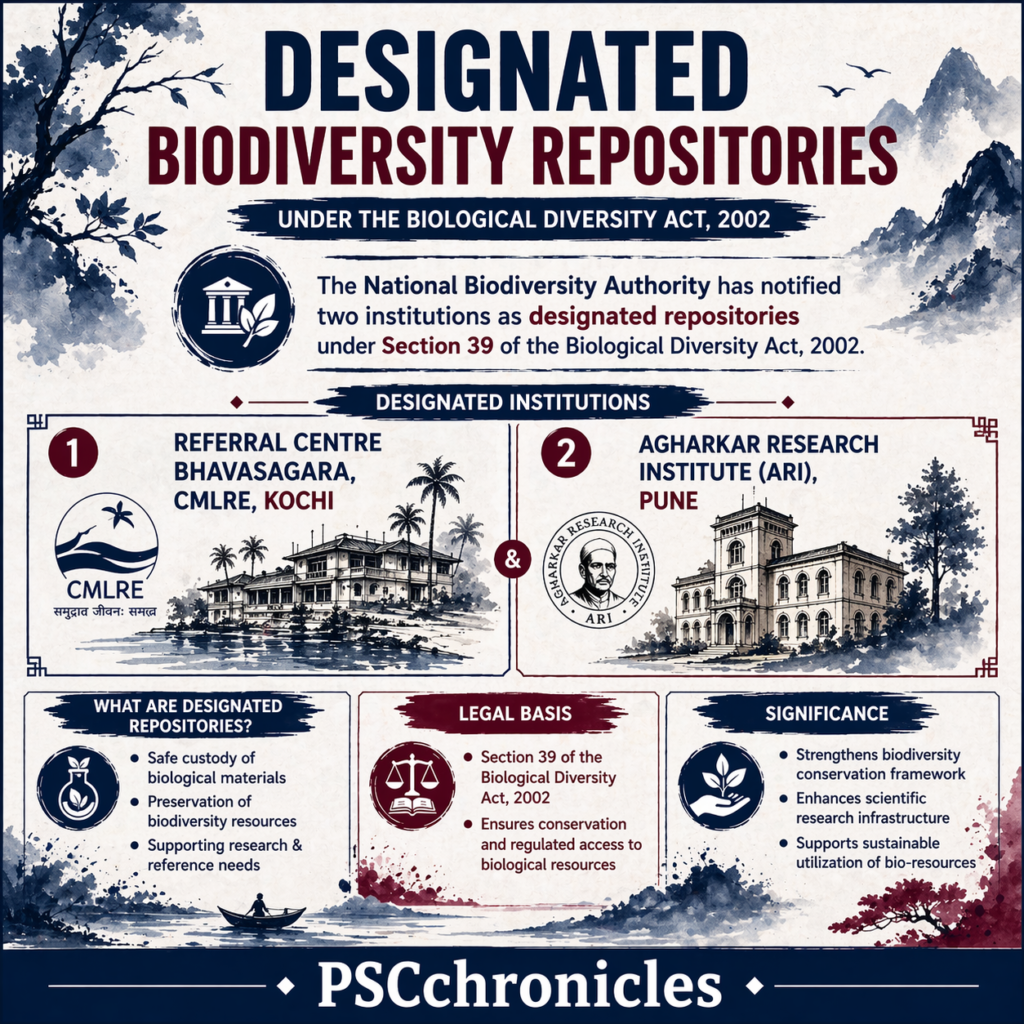
In a significant step to strengthen biodiversity conservation and research, the National Biodiversity Authority (NBA) has notified two institutions as designated repositories under the Biological Diversity Act, 2002. These repositories will ensure safe storage and proper documentation of biological resources in India

government notified two key institutions as repositories under the biological diversity act, 2002

What are Designated Repositories?

  • Declared under Section 39 of the Biological Diversity Act, 2002
  • Serve as official centers for storing biological materials
  • Include:
    • Voucher specimens (reference samples)
    • Microbial cultures
    • Marine organisms
  • Support:
    • Scientific research
    • Commercial use of biological resources
    • Identification of new species

The two notified institutes are:

  1. Referral Centre BhavasagaraΒ at the Centre for Marine Living Resources and Ecology (CMLRE), Kochi:Β Specializing in deep-sea biodiversity, maintaining marine voucher specimens.
  2. Agharkar Research Institute (ARI)Β in Pune:Β Specifically for its MACS Collection of Microorganisms and National Fungal Culture Collection

To study more current affairs related to environment and ecology, click here

2 Key Biodiversity Repositories Notified under Biological Diversity Act, 2002 Read More Β»

ISRO to launch G20 Satellite in 2027

India is set to strengthen global climate monitoring efforts with the proposed G20 satellite mission, expected to launch in 2027. This satellite will support environmental monitoring, weather forecasting, and disaster management for G20 nations.

g20 satellite

About the G20 Satellite Mission

  • Proposed by Indian Space Research Organisation
  • Expected Launch Year: 2027
  • Designed for global cooperation among G20 countries
  • Focus on climate, environment, and disaster management

To know more about G20, Click here

ISRO to launch G20 Satellite in 2027 Read More Β»

500 years for First Battle of Panipat (1526)

Why in News?

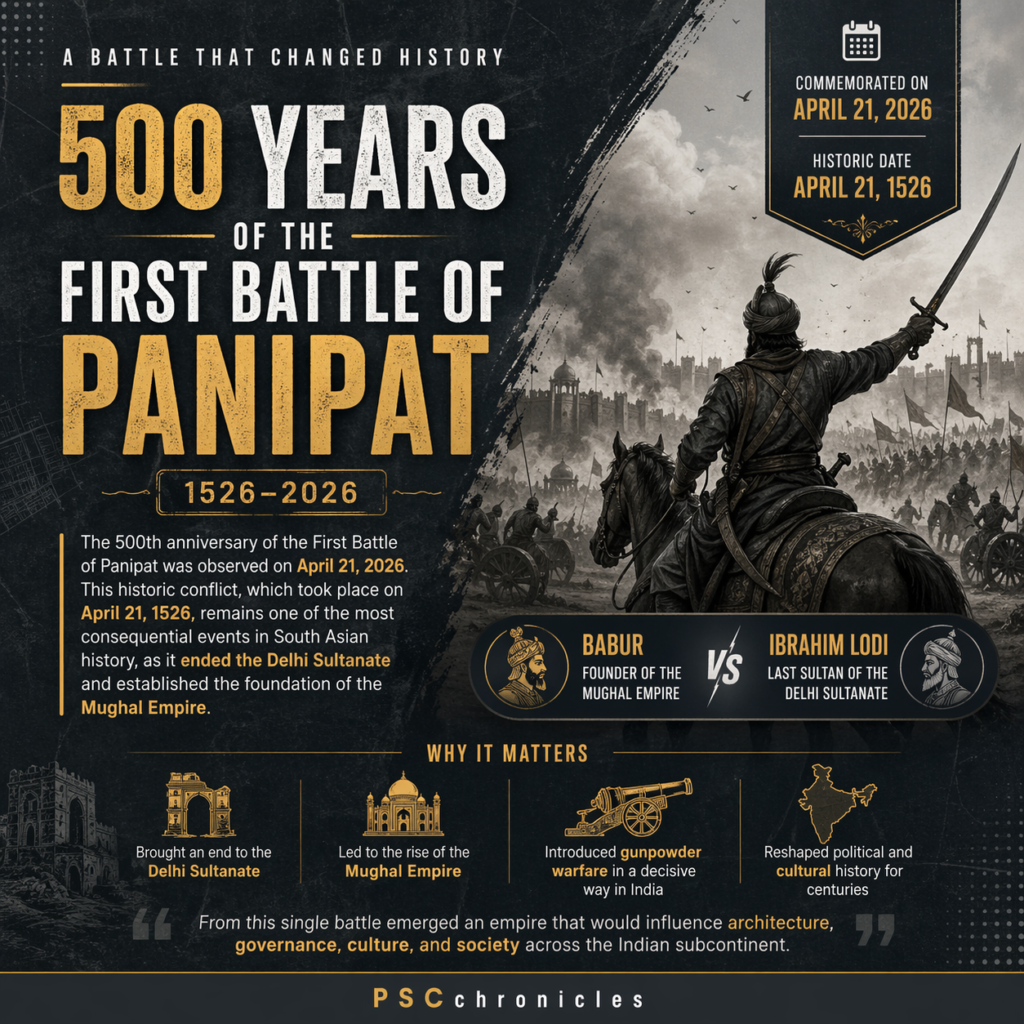
India marked the 500th anniversary of the First Battle of Panipat on April 21, 2026. Fought in 1526, this battle reshaped Indian history by ending the Delhi Sultanate and laying the foundation of Mughal rule.

first battle of panipat

Background of the Battle

The First Battle of Panipat was fought on April 21, 1526, between:

  • Babur (invader from Central Asia)
  • Ibrahim Lodi (ruler of Delhi Sultanate)

Immediate Cause

  • Internal conflicts weakened the Delhi Sultanate
  • Afghan nobles, including:
    • Daulat Khan Lodi
    • Alam Khan
  • They invited Babur to invade India and overthrow Ibrahim Lodi

Results of the Battle

  • Ibrahim Lodi was defeated and killed
  • Babur captured Delhi and Agra
  • End of the Delhi Sultanate (1206–1526)

Impact and Significance

1. Foundation of the Mughal Empire
  • Established the rule of the Mughal dynasty
  • Continued for nearly 300 years
2. Military Transformation
  • Introduction of gunpowder warfare in India
  • Decline of traditional warfare methods like war elephants
3. End of Delhi Sultanate
  • Marked the collapse of a 320-year-old regime

To study more History and culture related current affairs from exam point of view, Click here

500 years for First Battle of Panipat (1526) Read More Β»