Biology human body practice questions are important for UPSC, APPSC, TGPSC and other competitive exams. These questions cover the digestive system, respiratory system, nervous system, circulatory system and human organs for quick revision.
To study current affairs from exam point of view Click here
To Practice more Questions from exam point of view, Click here
To study latest issues related to S & T click here
Chemistry Basic Concepts practice questions are important for UPSC, APPSC, TGPSC and other competitive exams. These questions cover atoms, molecules, acids, bases, chemical reactions, elements and compounds for quick revision.
Physics Basic Concepts practice questions are important for UPSC, APPSC, TGPSC and other competitive exams. These questions cover force, motion, energy, laws of motion, electricity, magnetism and basic physics principles for quick revision.
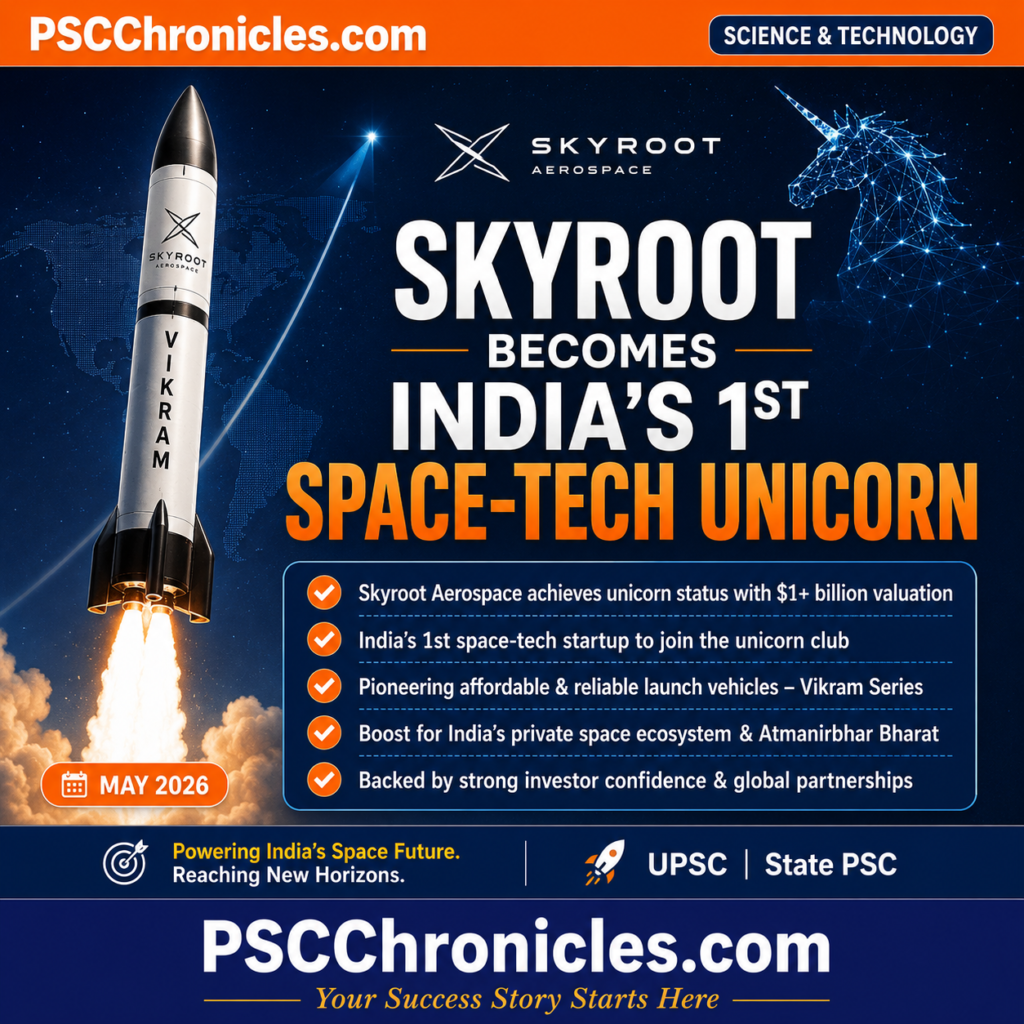
Skyroot Aerospace Unicorn 2026 gained attention after the Hyderabad-based startup achieved a valuation of $1.1 billion following a fresh funding round of nearly $60 million. The milestone comes weeks before the expected launch of Vikram-1, India’s first privately developed orbital rocket.
Key Facts About Skyroot Aerospace Unicorn 2026
Aspect
Details
Company
Skyroot Aerospace
Headquarters
Hyderabad
Valuation
$1.1 billion
Fresh Funding Raised
Nearly $60 million
Status Achieved
India’s first space-tech unicorn
Upcoming Mission
Vikram-1 orbital rocket launch
Launch Site
Satish Dhawan Space Centre (SHAR)
Rocket Series Named After
Dr. Vikram Sarabhai
Vikram Series of Launch Vehicles
Vehicle
Type
Key Details
Vikram-S
Sub-orbital rocket
First privately developed Indian rocket to reach space in November 2022
Vikram-1
Orbital launch vehicle
Maiden flight expected in mid-2026
Vikram-2
Heavy-lift launch vehicle
Designed for 1-tonne payload to Low Earth Orbit by 2027
Significance of Skyroot Aerospace Unicorn 2026
The emergence of Skyroot as India’s first space-tech startup unicorn demonstrates the success of India’s space sector liberalisation. It reflects growing investor confidence in indigenous launch technology and commercial space missions.
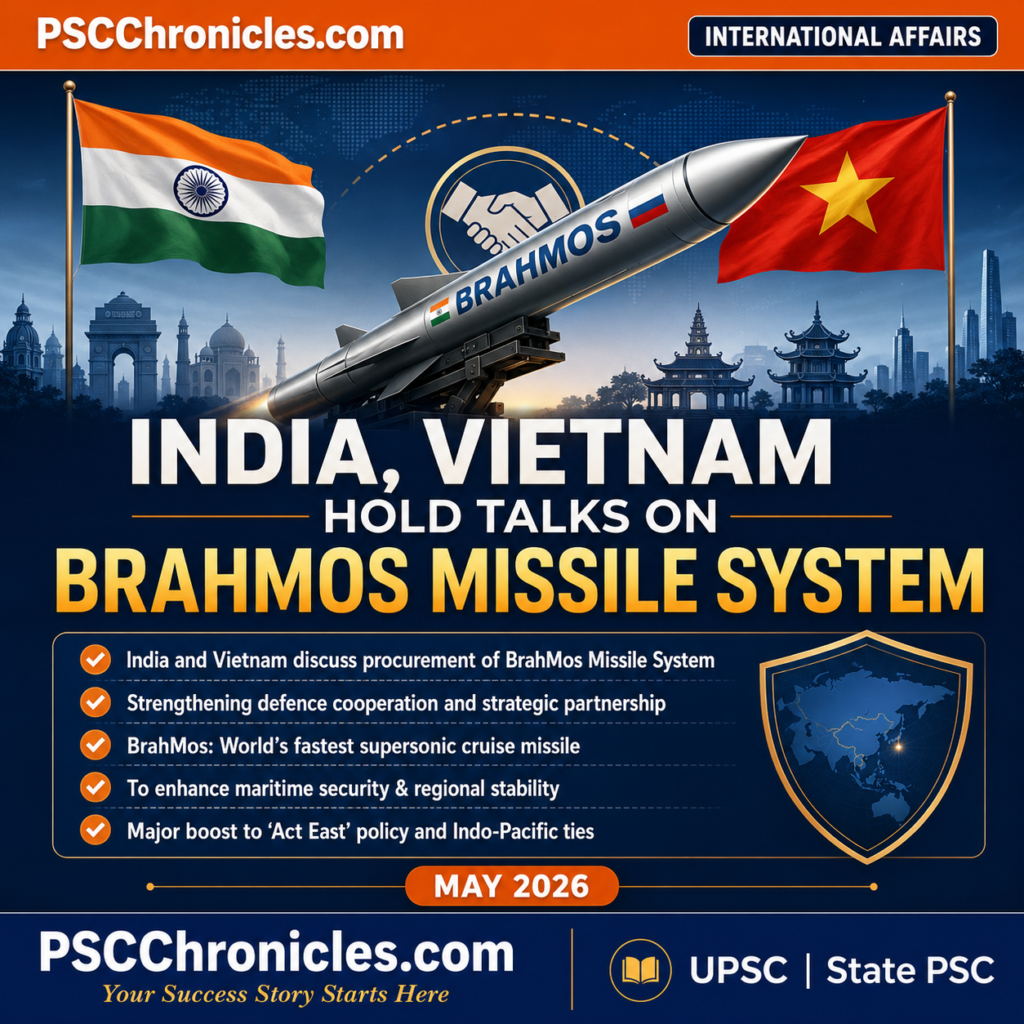
BrahMos Missile Talks 2026 came into focus during the state visit of Vietnamese President To Lam to India. The Indian government officially confirmed that discussions are underway regarding the possible sale of the BrahMos supersonic cruise missile system to Vietnam.
Key Facts About BrahMos Missile Talks 2026
Aspect
Details
Missile Name
BrahMos Supersonic Cruise Missile
Developed By
DRDO (India) and NPO Mashinostroyenia (Russia)
Missile Type
Medium-range supersonic cruise missile
Speed
Mach 2.8–3.0
Current Talks
India and Vietnam discussing possible export deal
First Foreign Buyer
Philippines in 2024
Launch Platforms
Land, sea, submarine, and air
Name Origin
Brahmaputra River + Moskva River
Key Features of BrahMos Missile
Feature
Description
Propulsion
Two-stage propulsion system
First Stage
Solid propellant booster
Second Stage
Liquid-fuel ramjet engine
Original Range
290 km
Extended Range Versions
450 km, 500 km, and 800+ km
Guidance
Precision-guided strike capability
Significance of BrahMos Missile Talks 2026
The proposed BrahMos deal would strengthen Vietnam’s maritime deterrence capability in the South China Sea region. It also enhances India’s image as a reliable supplier of advanced military technology.
Quick Revision Points
BrahMos Missile Talks 2026 involve India and Vietnam.
BrahMos developed jointly by DRDO and NPO Mashinostroyenia.
Missile speed: Mach 2.8–3.0.
Original BrahMos range limited to 290 km.
Extended-range variants exceed 800 km.
Philippines became first foreign buyer in 2024.
BrahMos named after Brahmaputra and Moskva rivers.
BrahMos is a supersonic cruise missile system.
Practice MCQs
Q1. BrahMos missile is jointly developed by India and which country? a) France b) Russia c) Israel d) USA
Answer: (b) Russia — BrahMos is a joint venture between DRDO and Russia’s NPO Mashinostroyenia.
Q2. What is the approximate speed of the BrahMos missile? a) Mach 0.8 b) Mach 1.2 c) Mach 2.8–3.0 d) Mach 5.0
Answer: (c) Mach 2.8–3.0 — BrahMos is among the fastest operational supersonic cruise missiles.
Q3. Which country became the first foreign customer of BrahMos in 2024? a) Vietnam b) Indonesia c) Philippines d) Japan
Answer: (c) Philippines — The Philippines purchased the shore-based BrahMos variant.
Q4. The name BrahMos is derived from which rivers? a) Ganga and Volga b) Brahmaputra and Moskva c) Indus and Danube d) Yamuna and Neva
Answer: (b) Brahmaputra and Moskva — The missile’s name combines rivers from India and Russia.
To know more about India Vietnam Brahmos talks Click here
To study current affairs from exam point of view Click here
To Practice more Questions from exam point of view, Click here
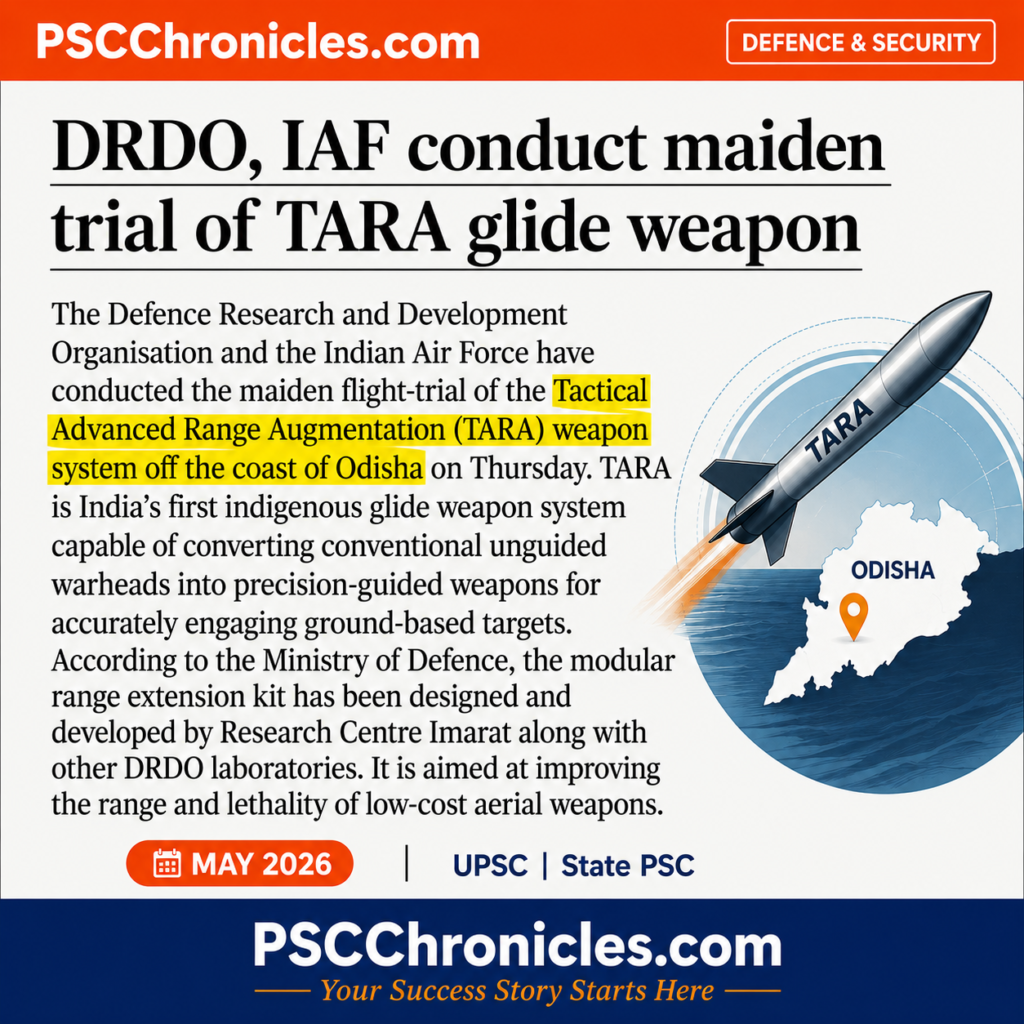
DRDO and the Indian Air Force (IAF) successfully conducted the maiden flight trial of the TARA Glide Weapon 2026.
The system is India’s first indigenous glide weapon capable of converting conventional unguided warheads into precision-guided weapons. The trial marks a major advancement in India’s indigenous defence technology and tactical strike capability.
Key Facts about TARA
Aspect
Details
Full Form
Tactical Advanced Range Augmentation (TARA)
Developed By
DRDO
User Agency
Indian Air Force (IAF)
Type
Indigenous glide weapon system
Purpose
Converts unguided warheads into precision-guided weapons
Maximum Range
80 km
Launch Altitude
10 to 45,000 feet
Weight Variants
250 kg, 450 kg, 500 kg
Target Type
Ground-based targets
Significance of TARA Glide Weapon
The TARA Glide Weapon 2026 strengthens India’s indigenous defence manufacturing capabilities under the Atmanirbhar Bharat initiative. The system enhances stand-off strike capability by enabling aircraft to hit targets from safer distances. It also reduces dependence on imported precision-guided munitions.
Quick Revision Points-TARA
TARA stands for Tactical Advanced Range Augmentation
Developed by DRDO
Tested jointly with the Indian Air Force
India’s first indigenous glide weapon system
Maximum operational range of 80 km
Launch altitude between 10 and 45,000 feet
Available in 250 kg, 450 kg, and 500 kg variants
Converts unguided warheads into precision-guided weapons
Practice MCQs
Q1. TARA glide weapon system was developed by: a) ISRO b) HAL c) DRDO d) BEL
Answer: (c) — DRDO developed the TARA glide weapon system.
Q2. The primary purpose of TARA is to: a) Intercept ballistic missiles b) Convert unguided warheads into precision-guided weapons c) Launch satellites d) Detect submarines
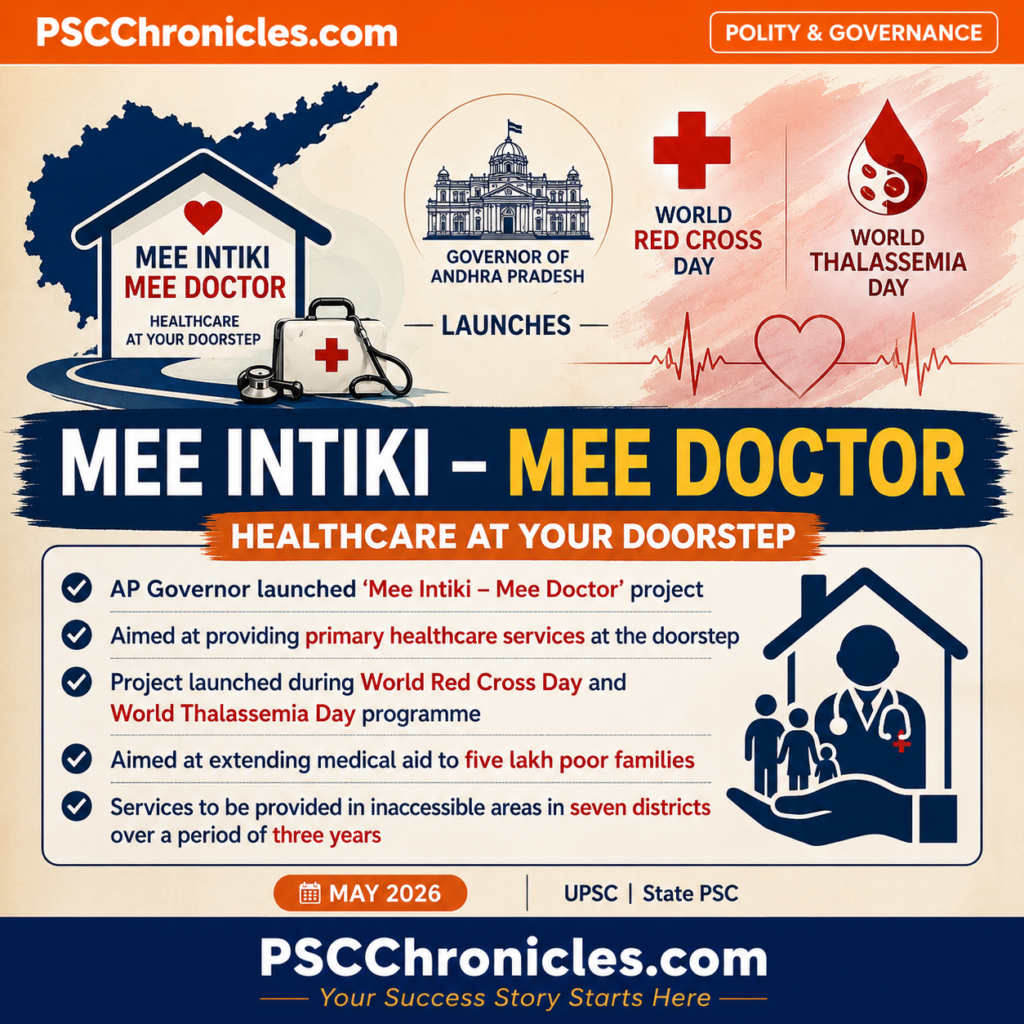
Andhra Pradesh Governor launched the Mee Intiki – Mee Doctor 2026 initiative on May 8, 2026 during the observance of World Red Cross Day and World Thalassemia Day.
The programme aims to provide doorstep healthcare services to poor families living in inaccessible regions of the State.
The project targets vulnerable groups including pregnant women, children aged 0–6 years, and bedridden persons unable to visit health centres
Key Details of the Programme
Aspect
Details
Programme
Mee Intiki – Mee Doctor
Launch Occasion
World Red Cross Day & World Thalassemia Day
Launch Date
May 8, 2026
Objective
Provide primary healthcare at doorstep
Target Beneficiaries
Poor families in remote and inaccessible areas
Coverage Target
5 lakh families
Duration
3 years
District Coverage
7 districts
Focus Groups
Pregnant women, children (0–6 years), bedridden persons
Constitutional and Health Background
Public Health in India
Constitutional Provision
Details
State List – Entry 6 (Seventh Schedule)
Public health and sanitation fall under the jurisdiction of States
Article 47
Directs the State to improve public health and nutrition levels
Related Health Mission
National Health Mission (NHM) supports accessible healthcare delivery
What is Thalassemia?
Thalassemia is an inherited blood disorder in which the body produces insufficient or abnormal hemoglobin. This reduces oxygen transport in blood and leads to anemia, fatigue, and weakness.
Feature
Details
Type
Genetic blood disorder
Main Cause
Abnormal hemoglobin production
Major Impact
Anemia and reduced oxygen supply
Observance Day
World Thalassemia Day – May 8
About World Red Cross Day
World Red Cross and Red Crescent Day is observed every year on May 8 to commemorate the birth anniversary of Henry Dunant, founder of the International Committee of the Red Cross (ICRC) and recipient of the first Nobel Peace Prize.
Quick Revision Points
Mee Intiki – Mee Doctor launched in Andhra Pradesh
Programme launched on May 8, 2026
Linked with World Red Cross Day
Linked with World Thalassemia Day
Targets 5 lakh poor families
Covers 7 districts over 3 years
Focus on pregnant women and children aged 0–6 years
Article 47 relates to improvement of public health
Practice MCQs
Q1. Mee Intiki – Mee Doctor initiative was launched in which state? a) Telangana b) Karnataka c) Andhra Pradesh d) Tamil Nadu
Answer: (c) — The programme was launched by the Andhra Pradesh Governor.
Q2. World Red Cross Day is observed annually on: a) April 7 b) May 8 c) June 5 d) July 11
Answer: (b) — It commemorates the birth anniversary of Henry Dunant.
Q3. Thalassemia mainly affects which component of the body? a) Liver enzymes b) Hemoglobin production c) Bone density d) Blood sugar
Answer: (b) — Thalassemia is an inherited disorder affecting hemoglobin production.
Q4. Which Article of the Constitution directs the State to improve public health? a) Article 32 b) Article 21 c) Article 47 d) Article 51A
Answer: (c) — Article 47 is part of the Directive Principles of State Policy.
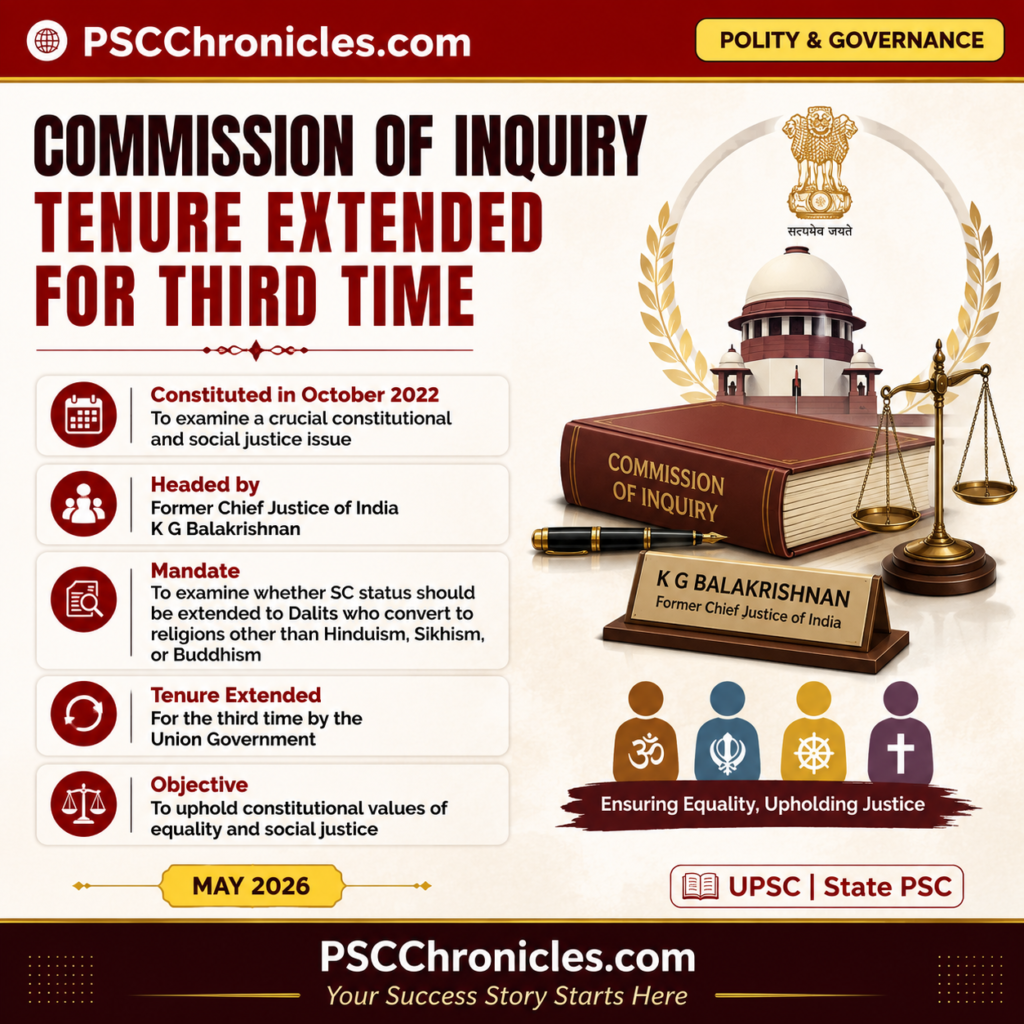
The Union Government has extended the tenure of the Commission of Inquiry headed by former Chief Justice of India K G Balakrishnan for the third time. The commission was constituted in October 2022 to examine whether Scheduled Caste status should be extended to Dalits who convert to religions other than Hinduism, Sikhism, or Buddhism.
Key Facts About the Commission
Aspect
Details
Commission Head
Justice K G Balakrishnan, former Chief Justice of India
Constituted
October 2022
Purpose
Examine extension of SC status to converted Dalits
Current Extension
Third extension granted by Centre
Concerned Communities
Dalits converted to Christianity or Islam
Legal Basis Under Review
Constitution (Scheduled Castes) Order, 1950
Ministry Involved
Ministry of Social Justice and Empowerment
Constitutional and Statutory Background
Constitution (Scheduled Castes) Order, 1950
The Constitution (Scheduled Castes) Order, 1950 was issued under Article 341 of the Constitution. Paragraph 3 of the Order restricts Scheduled Caste recognition to persons professing Hinduism, Sikhism, or Buddhism.
Amendment
Change Introduced
1950 Order
SC status limited to Hindus
1956 Amendment
Sikhs included in SC category
1990 Amendment
Buddhists included in SC category
Under the present legal framework, Dalits converting to Christianity or Islam lose eligibility for SC reservation benefits. The Balakrishnan Commission is examining whether this restriction violates constitutional principles of equality and social justice.
Difference Between SC and ST Status
Feature
Scheduled Castes (SC)
Scheduled Tribes (ST)
Linked to Religion
Yes
Generally No
Constitutional Provision
Article 341
Article 342
Effect of Religious Conversion
SC status may cease
ST status usually continues
Basis of Recognition
Historical untouchability
Tribal identity and customs
Unlike SC status, Scheduled Tribe recognition is generally not tied to religion. An ST individual may continue to retain tribal status after conversion unless community recognition and tribal customs are completely abandoned.
Quick Revision Points
Justice K G Balakrishnan heads the commission.
Commission constituted in October 2022.
SC status governed under Article 341.
Constitution (Scheduled Castes) Order, 1950 restricts SC status by religion.
Sikhs added to SC list in 1956.
Buddhists included in 1990.
ST status governed under Article 342.
SC Status for Dalit Converts 2026 concerns Dalits converted to Christianity and Islam.
Previous Year Questions (PYQs)
(UPSC Prelims 2012): With reference to the Constitution of India, consider the following:
The Constitution empowers the President to specify Scheduled Castes.
Parliament can modify the list of Scheduled Castes.
Which of the statements given above is/are correct?
(UPSC Mains 2016): Discuss the role of affirmative action in addressing social discrimination in India.
(For Practice): Examine the constitutional issues involved in the debate on SC Status for Dalit Converts 2026.
Practice MCQs
Q1. Under which Article are Scheduled Castes specified in India? a) Article 340 b) Article 341 c) Article 342 d) Article 343
Answer: (b) — Article 341 empowers the President to specify Scheduled Castes.
Q2. The Constitution (Scheduled Castes) Order originally restricted SC status to which religion? a) Hinduism b) Sikhism c) Buddhism d) Christianity
Answer: (a) — The 1950 Order initially limited SC status to Hindus only.
Q3. In which year were Buddhists included in the Scheduled Caste category? a) 1956 b) 1976 c) 1990 d) 2001
Answer: (c) — Buddhists were included through the 1990 amendment.
Q4. Which former Chief Justice of India heads the present commission on Dalit converts? a) N V Ramana b) U U Lalit c) K G Balakrishnan d) R M Lodha
Answer: (c) — The commission is chaired by Justice K G Balakrishnan.
To study current affairs from exam point of view Click here
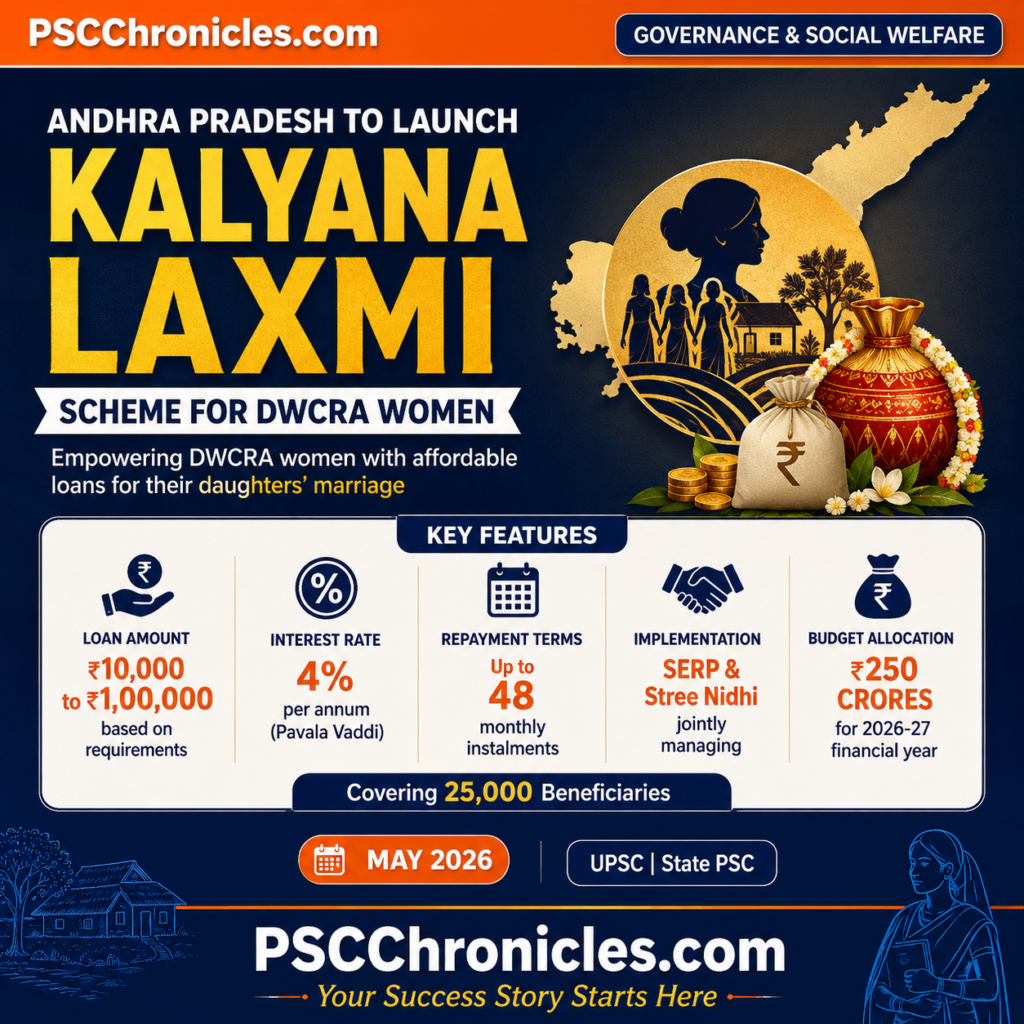
Andhra Pradesh government has announced the launch of the Kalyana Laxmi Scheme 2026 for DWCRA women.
The scheme aims to provide low-interest financial assistance for daughters’ marriage expenses.
It will be implemented through SERP and Stree Nidhi with budgetary support from the State government.
Key Facts:
Feature
Details
Scheme Name
Kalyana Laxmi Scheme 2026
State
Andhra Pradesh
Beneficiaries
DWCRA women
Purpose
Financial support for daughters’ marriage expenses
Loan Amount
₹10,000 to ₹1,00,000
Interest Rate
4% annual interest (Pavala Vaddi)
Repayment Period
Up to 48 monthly installments
Implementing Agencies
Society for Elimination of Rural Poverty (SERP) and Stree Nidhi
Budget Allocation
₹250 crore
Financial Year
2026–27
Expected Beneficiaries
25,000 women
Significance of the Scheme
The scheme is aimed at improving financial access for DWCRA women by providing affordable credit support. The Pavala Vaddi loans under the Kalyana Laxmi Scheme 2026 may reduce dependence on informal borrowing for marriage-related expenses.
Quick Revision Points
Andhra Pradesh announced the Kalyana Laxmi Scheme 2026
Scheme targets DWCRA women
Loan amount ranges from ₹10,000 to ₹1,00,000
Interest rate fixed at 4% annually
Repayment allowed in 48 monthly installments
Implemented through SERP Andhra Pradesh and Stree Nidhi
Budget allocation for 2026–27 is ₹250 crore
Scheme aims to benefit 25,000 beneficiaries
Practice MCQs
The Kalyana Laxmi Scheme 2026 in Andhra Pradesh is primarily intended for: A. Farmers B. Students C. DWCRA women D. Senior citizens
What is the annual interest rate under the Kalyana Laxmi Scheme 2026? A. 2% B. 4% C. 6% D. 8%
Which agencies will implement the Kalyana Laxmi Scheme 2026? A. NABARD and RBI B. DRDO and ISRO C. SERP and Stree Nidhi D. SIDBI and SEBI
What is the maximum repayment period under the scheme? A. 24 months B. 36 months C. 48 months D. 60 months
To study more current affairs from exam point of view Click here
India will host the inaugural International Big Cat Alliance (IBCA) Summit from June 1–3, 2026 in New Delhi. Around 95 countries are expected to participate in the event.
The International Big Cat Alliance Summit is likely to adopt the first-ever global declaration on big cat conservation, called the Delhi Declaration.
The declaration aims to strengthen international cooperation, encourage landscape-based conservation, and improve protection of big cat habitats across borders.
What is the International Big Cat Alliance Summit?
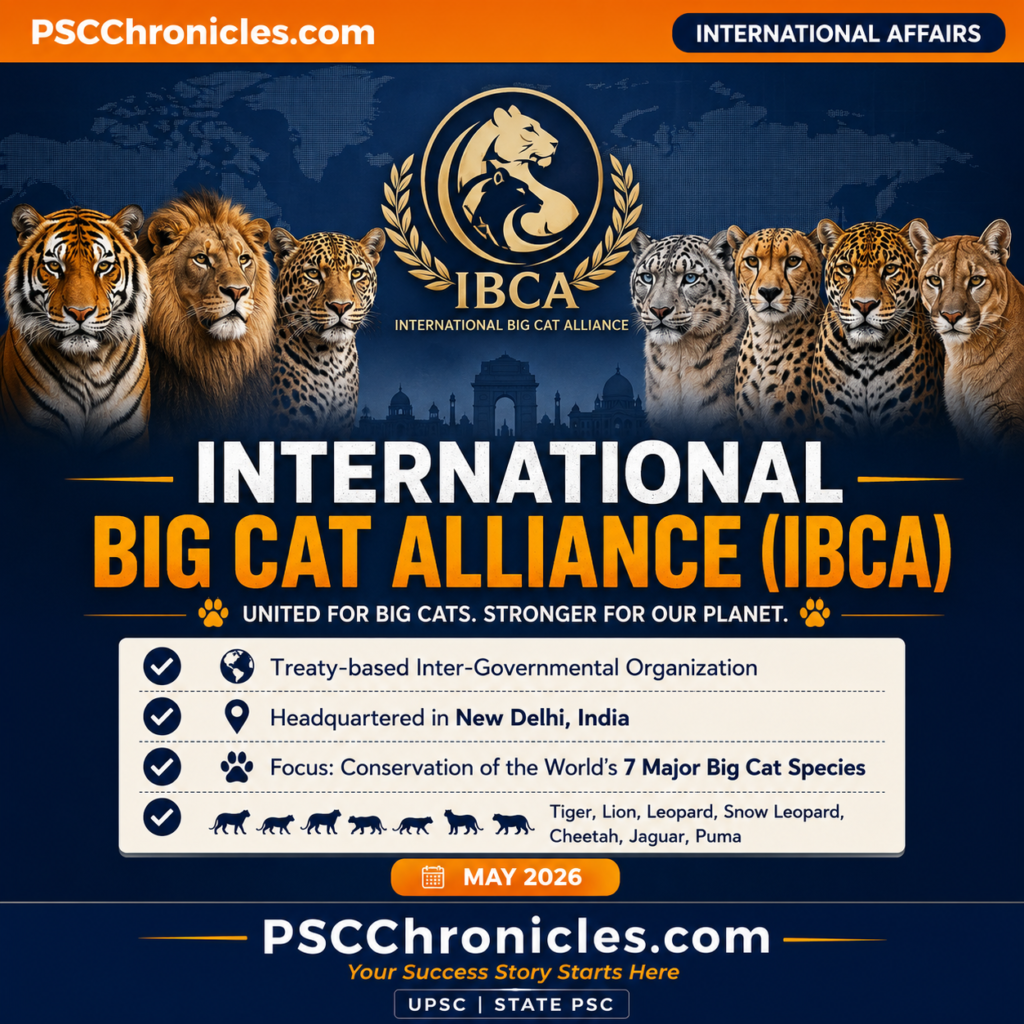
The International Big Cat Alliance (IBCA) is a treaty-based intergovernmental organisation headquartered in New Delhi. It was established to promote global cooperation for the conservation of seven major big cat species.
Big Cat Species Covered Under IBCA
Big Cat Species
Scientific/Regional Importance
Tiger
India hosts the world’s largest tiger population
Lion
Asiatic lions found mainly in Gujarat
Leopard
Widely distributed across Asia and Africa
Snow Leopard
Found in Himalayan regions
Cheetah
Reintroduced in India under Project Cheetah
Jaguar
Native to the Americas
Puma
Also known as cougar or mountain lion
Frequently Asked Questions (FAQ)
What is the International Big Cat Alliance (IBCA)?
The IBCA is a treaty-based intergovernmental organisation headquartered in New Delhi that focuses on global conservation of seven major big cat species.
Which animals are covered under IBCA?
Tiger, Lion, Leopard, Snow Leopard, Cheetah, Jaguar, and Puma are covered under the alliance.
What is the Delhi Declaration?
The Delhi Declaration is a proposed global declaration on big cat conservation expected to be adopted during the 2026 IBCA Summit.
Where is the IBCA headquartered?
The headquarters of the IBCA is located in New Delhi, India.
Why are big cats important for biodiversity conservation?
Big cats are apex predators and umbrella species. Their conservation helps protect forests, ecosystems, and other wildlife species.
Practice Questions
Which of the following species is NOT covered under the International Big Cat Alliance? a) Jaguar b) Puma c) Wolf d) Snow Leopard
The headquarters of the International Big Cat Alliance is located in: a) Nairobi b) Geneva c) New Delhi d) Kathmandu
What is the proposed declaration expected from the inaugural IBCA Summit? a) Rio Declaration b) Delhi Declaration c) Kyoto Declaration d) Nairobi Protocol
Which ministry-related theme is most associated with the International Big Cat Alliance? a) Renewable Energy b) Wildlife Conservation c) Maritime Security d) Space Research
To study more about International Big cat alliance click here
To study more about current affairs from exam point of view, Click here