Parakram Diwas is observed every year on January 23 to mark the birth anniversary of Subhas Chandra Bose.
Subhash Chandra Bose Aapda Prabandhan Puraskar:
Subhash Chandra Bose Aapda Prabandhan Puraskar award established to recognize individuals and institutions for their outstanding service in the field of disaster management.
Instituted in 2019, the award is announced annually on January 23rd, the birth anniversary of Netaji Subhash Chandra Bose (celebrated as Parakram Diwas).
Recent awardees are:
Institutional Category: Sikkim State Disaster Management Authority
Individual Category: Lt. Col. Seeta Ashok Shelke
Key facts related to Subash Chandra Bose:
Political mentor: Chittaranjan Das
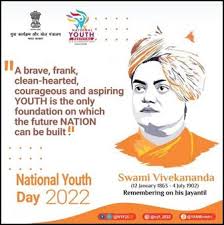
Spiritual influence: Swami Vivekananda
1938 (Haripura Session): Elected President of the Indian National Congress; set up the National Planning Committee
1939 (Tripuri Session): Re-elected after defeating Pattabhi Sitaramayya, leading to ideological differences with Mahatma Gandhi.
Founded the All India Forward Bloc in 1939.
Took command of the INA (Azad Hind Fauj) in Singapore (originally formed by Mohan Singh)
Formed the Rani of Jhansi Regiment, an all-women combat unit led by Captain Lakshmi Sahgal
The Pradhan Mantri Gram Sadak Yojana (PMGSY) recently reached a historic milestone, celebrating 25 yearsof connecting rural India. With over 7.87 lakh kilometers of roads completed out of 8.25 lakh kilometers sanctioned, it remains the backbone of rural economic transformation and accessibility.
Pradhan Mantri Gram Sadak Yojana (PMGSY):
Pradhan Mantri Gram Sadak Yojana (PMGSY) is a flagship nationwide program launched by the Government of India on December 25, 2000. Its primary goal is to provide all-weather road connectivity to unconnected rural habitations to facilitate poverty reduction and socio-economic development
Its objective is to linking unconnected habitations with:
a population of 500 or more in plain areas
250 or more in hill states, tribal areas, and desert areas.
Nodal Ministry: Ministry of Rural Development, Government of India.
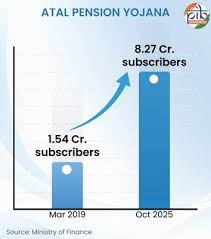
Union Cabinet extended the Atal Pension Yojana (APY) until the fiscal year 2030–31. This move aims to ensure long-term social security for India’s unorganized workforce.
About Scheme:
Atal Pension Yojana (APY) is a government-backed pension scheme in India primarily targeted at workers in the unorganised sector. Launched in 2015, it provides a guaranteed minimum monthly pension of ₹1,000 to ₹5,000 after the age of 60, depending on the subscriber’s contribution and age of joining
Age: Must be between 18 and 40 years.
Citizenship: Must be an Indian citizen.
Regulatory Body: The scheme is administered and regulated by the Pension Fund Regulatory and Development Authority (PFRDA).
The Government of India has officially issued the notification for the 16th National Census, originally delayed from 2021 due to the pandemic. This exercise is critical as it marks a historic shift in India’s demographic data collection, introducing digital-first methodology and the first nationwide caste count since 1931.
Key Highlights of Census 2027:
The Census will be executed in two distinct phases to ensure comprehensive data accuracy
Phase I: House-listing & Housing Census (April – September 2026): Each State and Union Territory will designate a 30-day window within this period to identify and list residential structures across the country.
Phase II: Population Enumeration (February 2027): The actual counting of individuals and collection of socio-economic data will occur during this month.
Major Policy Shifts:
Digital Transformation: This is India’s first “Paperless Census.” Data will be collected via mobile applications.
Caste-Based Enumeration: In a landmark decision, the 2027 Census will include a specific count of castes. While the 1931 Census was the last to do this nationwide, this is the first time in Independent India that such data will be collected during the general census
Static General Knowledge Link: Key Facts
Nodal Ministry: Ministry of Home Affairs (MHA).
Conducted by the Office of the Registrar General and Census Commissioner of India.
Governed by the Census Act, 1948
1872: The first non-synchronous census was conducted under Lord Mayo.
1881: The first synchronous (complete and simultaneous) census was held under Lord Ripon.
2027 Edition: This will be the 16th Census of India overall and the 8th Census since Independence.
Seventh Schedule: The Census is a Union Subject listed under Entry 69 of List I.
The Global Environment Facility (GEF) has approved $372 million funding for 36 environmental projects in developing countries. The move supports global efforts to achieve biodiversity targets under the Kunming-Montreal Global Biodiversity Framework (2022)
Global Environment Facility:
Established in 1991, the Global Environment Facility (GEF) is the world’s largest multilateral fund dedicated to the environment. It serves as an independent financial mechanism for several major international conventions, helping developing countries and transition economies address urgent environmental challenges.
GEF Supports 5 Major International Conventions:
Convention on Biological Diversity (CBD)
UN Framework Convention on Climate Change (UNFCCC)
UN Convention to Combat Desertification (UNCCD)
Stockholm Convention on Persistent Organic Pollutants (POPs)
Minamata Convention on Mercury
Kunming-Montreal Global Biodiversity Framework (KMGBF):
Kunming-Montreal Global Biodiversity Framework (KMGBF), also known as The Biodiversity Plan, is a landmark international agreement adopted on 19 December 2022 during the 15th Conference of the Parties (COP15) to the UN Convention on Biological Diversity (CBD). It is often described as the “Paris Agreement for Nature,” serving as the global roadmap to halt and reverse biodiversity loss by 2030
It has four global goals:
Restore and protect ecosystems & species
Ensure sustainable use of biodiversity
Fair and equitable sharing of genetic resource benefits
Mobilize finance, technology, and capacity-building
The High Seas Treaty, officially called the Biodiversity Beyond National Jurisdiction (BBNJ) Agreement, came into force on 17 January 2026. It is the first legally binding global agreement aimed at protecting marine biodiversity in areas beyond national jurisdiction
Biodiversity Beyond National Jurisdiction (BBNJ) Agreement:
Biodiversity Beyond National Jurisdiction (BBNJ) Agreement, also known as the High Seas Treaty, is a legally binding international treaty under the United Nations Convention on the Law of the Sea (UNCLOS) designed to ensure the conservation and sustainable use of marine life in international waters
The agreement has four main pillars:
Marine Genetic Resources (MGRs): Ensures fair sharing of benefits (monetary and non-monetary) from marine resources in international waters.
Area-Based Management Tools (ABMTs): Enables creation of Marine Protected Areas (MPAs) to help achieve the 30% ocean protection target by 2030.
Environmental Impact Assessments (EIAs): Establishes global norms to assess environmental impacts of activities in the high seas.
Capacity Building & Technology Transfer: Supports developing countries in marine research and sustainable use of ocean resources.
United States of America has withdrawn from the International Solar Alliance (ISA), an India-backed global initiative. This move is part of a broader decision by the US to exit multiple international organizations
Key Highlights:
The International Solar Alliance (ISA) is a treaty-based intergovernmental organization.
It was launched in 2015 by India and France during the COP21 Paris Climate Summit.
The ISA headquarters is located in Gurugram, Haryana — making it the first international organization headquartered in India.
The alliance focuses on promoting solar energy adoption globally, especially in tropical countries.