πŸ“° Today's Current AffairsRead Now →
📷 Follow on Instagram

PSC Chronicles Team

UNFCCC Explained 2026: Complete Guide for UPSC and State PSC exams

What is UNFCCC?

The United Nations Framework Convention on Climate Change (UNFCCC) is an international environmental treaty aimed at combating climate change by stabilizing greenhouse gas (GHG) concentrations in the atmosphere.

  • Adopted during the Rio Earth Summit
  • Came into force in 1994
  • Secretariat located in Bonn
  • Nearly 197 Parties (universal membership)
unfccc psc

Key Principles of UNFCCC

1. Common But Differentiated Responsibilities (CBDR)

  • Developed countries bear greater responsibility
  • Recognizes historical emissions

2. Equity Principle

  • Fair distribution of responsibilities among nations

3. Precautionary Principle

  • Lack of full scientific certainty should not delay action

4. Sustainable Development

  • Climate actions must align with development goals

Conference of Parties (COP)

The Conference of Parties (COP) is the supreme decision-making body of UNFCCC.

Key Features:
  • Held annually
  • Reviews implementation of the Convention
  • Negotiates new agreements
Important COP Outcomes:
  • COP3 (Kyoto, 1997) β†’ Kyoto Protocol
  • COP21 (Paris, 2015) β†’ Paris Agreement
  • Recent COPs focus on climate finance, adaptation, and net-zero targets

Major Agreements under UNFCCC

1. Kyoto Protocol (1997)
  • Legally binding emission reduction targets
  • The Kyoto Protocol, adopted in 1997 and in force from 2005 to 2020, was the first legally binding international treaty requiring industrialized countries to reduce greenhouse gas emissions. It operationalized the UNFCCC by setting binding targets for 37 nations to reduce emissions by an average of 5% below 1990 levels during 2008–2012.
2. Paris Agreement (2015)
  •  It is a legally binding international treaty adopted by 195 nations at COP21 in 2015, aiming to limit global temperature increases to well below 2Β°Cβ€”preferably 1.5Β°Cβ€”above pre-industrial levels.
  • It entered into force on November 4, 2016, requiring countries to submit, update, and fulfill ambitious climate action plans (NDCs) every five years to combat climate change

Financial Mechanisms under UNFCCC

  • Green Climate Fund (GCF)
  • Global Environment Facility (GEF)

Developed countries are expected to provide climate finance to developing nations.

To study current affairs related to environment, Click here

UNFCCC Explained 2026: Complete Guide for UPSC and State PSC exams Read More Β»

India Withdraws Bid for COP 33 (2028)

India has withdrawn its bid to host the 33rd Conference of Parties (COP 33) scheduled for 2028.

  • COP is the annual global climate summit held under the United Nations climate framework, where countries discuss actions to tackle climate change
unfccc psc

What is UNFCCC?

The United Nations Framework Convention on Climate Change (UNFCCC) is the main international agreement guiding global efforts to combat climate change.

Key Facts:

  • Adopted: 1992
  • Event: Earth Summit (Rio de Janeiro)
  • Objective: Stabilize greenhouse gas emissions to prevent dangerous climate change
  • Nature: Framework treaty (not legally binding emission targets)

Important Agreements under UNFCCC:

  • Kyoto Protocol
    • Legally binding emission reduction targets for developed countries
  • Paris Agreement
    • Aim: Limit global warming to well below 2Β°C, preferably 1.5Β°C

To study more about UNFCCC, Click here

India Withdraws Bid for COP 33 (2028) Read More Β»

Nari Shakti Vandan Adhiniyam 2023 – Complete Guide for UPSC and state PSC exams 2026

What is Nari Shakti Vandan Adhiniyam 2023?

The Nari Shakti Vandan Adhiniyam, 2023 is a landmark constitutional amendment aimed at enhancing women’s political participation in India. It provides 33% reservation for women in the Lok Sabha and State Legislative Assemblies.

  • It is officially known as the Constitution (106th Amendment) Act, 2023
women reservation psc

Key Features of the Act

1. Reservation for Women

  • 33% reservation in:
    • Lok Sabha
    • State Legislative Assemblies
  • Includes reservation within SC/ST seats

2. Duration of Reservation

  • Reservation will be applicable for 15 years (can be extended by Parliament)

3. Rotation of Seats

  • Reserved constituencies will be rotated after each delimitation exercise

4. Implementation Condition

  • Comes into effect only after delimitation based on the next Census

Constitutional Amendments

The Act introduces changes to the following Articles:

  • Article 330A β†’ Reservation in Lok Sabha
  • Article 332A β†’ Reservation in State Assemblies
  • Article 334A β†’ Duration and implementation

Significance of the Act

1. Political Empowerment
  • Ensures greater participation of women in law-making
2. Gender Equality
  • Promotes substantive equality in governance
3. Better Governance
  • Studies show women leaders focus more on:
    • Health
    • Education
    • Welfare
4. Inclusive Democracy
  • Strengthens democratic values

For recent amendments to women reservation act, Click here

Nari Shakti Vandan Adhiniyam 2023 – Complete Guide for UPSC and state PSC exams 2026 Read More Β»

Women Reservation Bill Amendments 2026: Key Highlights

Why in News?

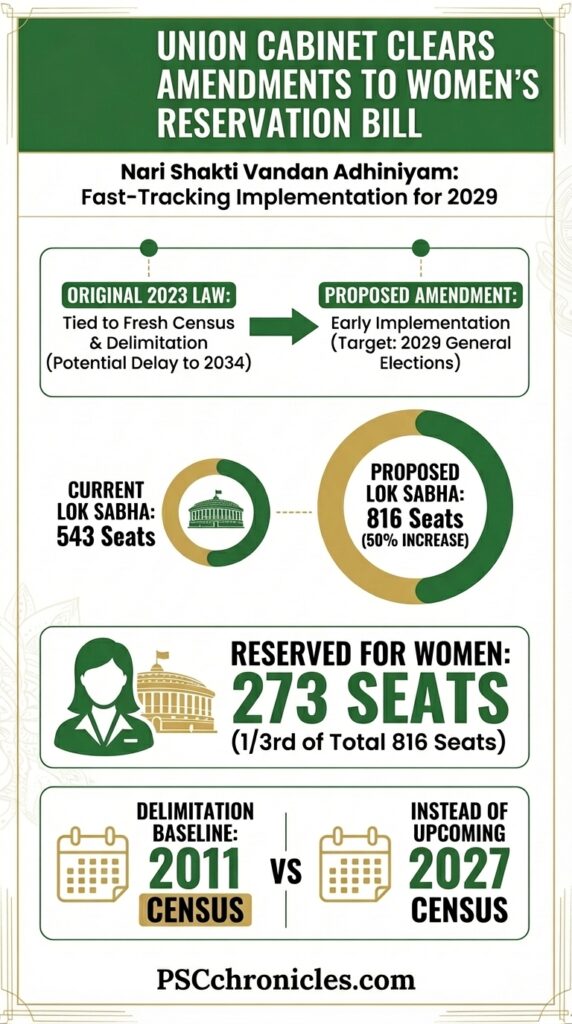
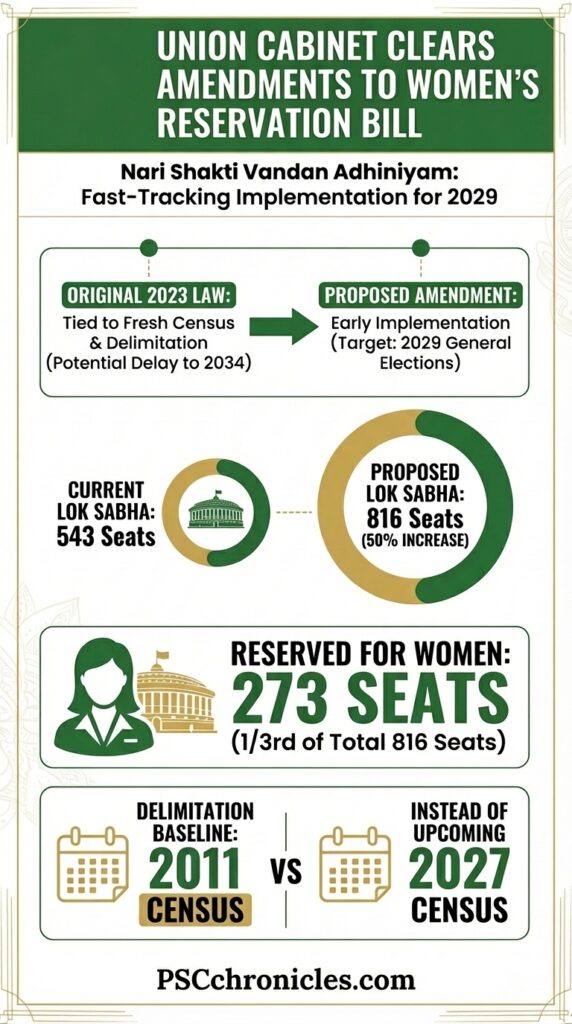
Union Cabinet has approved amendments to fast-track the implementation of the Women’s Reservation Act (Nari Shakti Vandan Adhiniyam).

  • This move aims to ensure 33% reservation for women in Lok Sabha and State Assemblies by the 2029 General Elections, instead of delaying it further.
women reservation psc

Key Amendments Approved by Cabinet

Early Implementation:

  • Reservation will now be implemented in 2029 General Elections. Based on 2011 Census data
  • Earlier provision:
    • Required new Census + delimitation
    • Likely delay till 2034

Expansion of Lok Sabha Seats

  • Current strength: 543 seats
  • Proposed increase: 816 seats (β‰ˆ50% rise)
  • Expansion linked to population changes & representation balance

Reservation for Women

  • Out of 816 seats:
    • 273 seats reserved for women (33%)

Delimitation Based on 2011 Census

  • Constituencies will be redrawn using: 2011 Census of India

To know more about Women Reservation act, Click here

Women Reservation Bill Amendments 2026: Key Highlights Read More Β»

Consumer Price Index (CPI)-Explained for UPSC and State PSC exams

What is Consumer Price Index (CPI)?

The Consumer Price Index (CPI) measures the average change in prices of a basket of goods and services consumed by households over time.

  • It tracks the average change over time in the prices paid by consumers for a fixed basket of goods and services.Β 
cpi inflation

Who Releases CPI in India?

  • Released by: National Statistical Office (NSO)
  • Under: Ministry of Statistics and Programme Implementation (MoSPI)

Types of CPI in India

Type of CPI Releasing AuthorityPurpose/Use Case
CPI-Combined (Rural + Urban)NSO (MoSPI)Headline inflation indicator for RBI’s monetary policy.
CPI for Industrial Workers (IW)Labour BureauUsed for Dearness Allowance (DA) revision for govt employees.
CPI for Agricultural Labourers (AL)Labour BureauUsed for wage fixation under MGNREGA and state minimum wages.
CPI for Rural Labourers (RL)Labour BureauMeasures price changes faced by rural labour households.

Recent changes in CPI

  • Ministry of Statistics and Programme Implementation (MoSPI) has revised the base year for the CPI series from 2012 toΒ 2024
  • Weight Source: Based on theΒ Household Consumption Expenditure Survey (HCES) 2023-24.
  • Expanded Basket: The number of weighted items increased from 299 toΒ 358Β (308 goods and 50 services).
  • New Items: Included modern services likeΒ OTT streaming, e-commerce, andΒ rural house rentΒ for the first time.
  • Weightage Shift: The weight ofΒ Food and BeveragesΒ has been reduced from approximately 45.86% toΒ 36.75%, reflecting its decreasing share in modern household budgets

Other facts related to CPI:

  • Headline Inflation: Measured byΒ CPI-Combined (Rural + Urban), it is the primary indicator used by theΒ Reserve Bank of India (RBI)Β for monetary policy and inflation targeting (target:Β 4% Β± 2%).
  • Core Inflation: Headline inflation minus the volatile components (Food and Fuel).
  • Calculation Method: Uses theΒ Laspeyres Index Formula

CPI vs. WPI

  • Scope: CPI covers bothΒ goods and services, while WPI (Wholesale Price Index) coversΒ only goods.
  • Price Level: CPI measures retail prices (consumer perspective); WPI measures wholesale prices (producer/bulk perspective).
  • Weights: Food has a significantlyΒ higher weightageΒ in CPI (over 36%) compared to WPI (~24%)

To study current affairs of Indian economy from exam point of view, Click here

Consumer Price Index (CPI)-Explained for UPSC and State PSC exams Read More Β»

New CPI Series 2024 Explained:

Why in News?

The Ministry of Statistics and Programme Implementation (MoSPI) has introduced a new Consumer Price Index (CPI) series with base year 2024=100. According to the latest data, India’s retail inflation stood at 2.75% in January 2026 (year-on-year), reflecting changes in consumption patterns and economic structure.

cpi inflation

What is CPI?

  • Consumer Price Index (CPI) measures the average change in prices of goods and services consumed by households.
  • It is the most important indicator of inflation in India.
  • Used by the Reserve Bank of India (RBI) for monetary policy decisions.

Key Changes in New CPI Series (Base Year 2024)

1. Change in Base Year

  • Updated from 2012 β†’ 2024
  • Reflects latest consumption patterns of households.

2. Weight Realignment

  • Reduced weight: Food & beverages
  • Increased weight: Services, Housing

3. Expanded Consumption Basket

  • Total items increased:
    • From 299 β†’ 358 items
      • 308 goods
      • 50 services

4. New Items Added

  • Online streaming services , Rural housing , Value-added dairy products, Babysitting services, Fitness equipment
5. Inclusion of Rural House Rent
  • First-time inclusion
  • Improves representation of rural consumption patterns
6. Updated Classification System
  • Now follows COICOP 2018 classification
  • Shift:
    • From 6 groups β†’ 12 divisions

To know more about Consumer Price Index from exam point of view, Click here

New CPI Series 2024 Explained: Read More Β»

Telangana’s Bharat Future City Project: NGT Refuses to Grant Stay:

Why in News:

National Green Tribunal (NGT) has refused to halt Telangana’sBharat Future City project, proposed over nearly 30,000 acres

national green tribunal

The petitioner alleged: Mandatory approvals were not obtained before starting activities and bypassed procedures under the Environmental Impact Assessment (EIA) framework

What is the Bharat Future City Project?

  • A large-scale urban development project proposed by the Telangana government
  • Spread across ~30,000 acres in 56 revenue villages covering 7 mandals
  • Located between Srisailam and Nagarjunasagar highways
  • Envisioned as a modern urban hub with infrastructure and economic activities

About NGT

  • Established under the NGT Act, 2010
  • A specialized environmental court for speedy justice

Key Features

  • Chairperson: Retired Supreme Court judge or Chief Justice of a High Court
  • Tenure: 5 years (no reappointment)
  • Nature of Proceedings:
    • Follows principles of natural justice
    • Not strictly bound by the Code of Civil Procedure
  • Time Limit:
    • Aims to dispose cases within 6 months
  • Jurisdiction:
    • Covers major environmental laws (Schedule I)
    • Excludes:
      • Wildlife (Protection) Act, 1972
      • Forest Rights Act, 2006
  • Appeal Mechanism:
    • Decisions can be appealed in the Supreme Court within 90 days

To know more about National Green Tribunal from exam point of view, Click here

Telangana’s Bharat Future City Project: NGT Refuses to Grant Stay: Read More Β»

National Green Tribunal (NGT) – Complete Notes for UPSC and PSC exams

What is the National Green Tribunal (NGT)?

The National Green Tribunal (NGT) is a specialized judicial body established for effective and expeditious disposal of environmental cases in India.

  • Established under: National Green Tribunal Act, 2010
  • Objective: Protection of environment, forests, and natural resources
  • Nature: Quasi-judicial body
national green tribunal

Constitutional & Legal Basis

  • Not directly mentioned in the Constitution
  • Derived from:
    • Article 21 β†’ Right to life includes a clean environment
    • Article 48A β†’ Protection of environment (DPSP)
    • Article 51A(g) β†’ Fundamental duty to protect environment

Composition:

  • Chairperson (Retired Supreme Court Judge)
  • Judicial Members
  • Expert Members (environmental specialists)

Time Limit for Disposal

  • NGT must dispose cases within 6 months

Jurisdiction

  • Covers major environmental laws (Schedule I)but excludes-Wildlife (Protection) Act, 1972 and Forest Rights act-2006

Appeal:

  • Decisions can be appealed in the Supreme Court within 90 days

To study current affairs from exam point of view, Click here

National Green Tribunal (NGT) – Complete Notes for UPSC and PSC exams Read More Β»

Monetary Policy Committee (MPC) – Complete Notes for UPSC & State PSC Exams

What is the Monetary Policy Committee (MPC)?

The Monetary Policy Committee (MPC) is a statutory body responsible for fixing India’s policy interest rate (Repo Rate) to control inflation and ensure price stability.

  • It is a key institution under the inflation targeting framework in India.
monetary policy meeting

Legal & Institutional Basis

  • Established under Reserve Bank of India Act, 1934 (amended in 2016)
  • Works under Flexible Inflation Targeting (FIT) framework
  • Central Bank: Reserve Bank of India (RBI)

Composition of MPC-6 members

MembersAppointing Authority
RBI Governor (Chairperson)RBI
Deputy Governor (Monetary Policy)RBI
One RBI officialRBI
Three external membersCentral Government

How MPC Works?

  • Meets at least 4 times a year (usually 6 times)
  • Decisions taken by majority voting
  • Each member has one vote
  • In case of tie β†’ Governor has casting vote

MPC and inflation targeting:

The Monetary Policy Committee (MPC) in India manages a Flexible Inflation Targeting (FIT) framework, aiming to maintain Consumer Price Index (CPI) inflation at 4% with a Β±2% tolerance band (2%-6%). This mechanism, set every five years, prioritizes price stability while supporting growth, with accountability to the government if targets are missed for three consecutive quarters.

For Indian economy current affairs from exam point of view, Click here

Monetary Policy Committee (MPC) – Complete Notes for UPSC & State PSC Exams Read More Β»

Eco-Sensitive Zones (ESZ) – Complete Notes for UPSC & State PSC Exams

What is an Eco-Sensitive Zone (ESZ)?

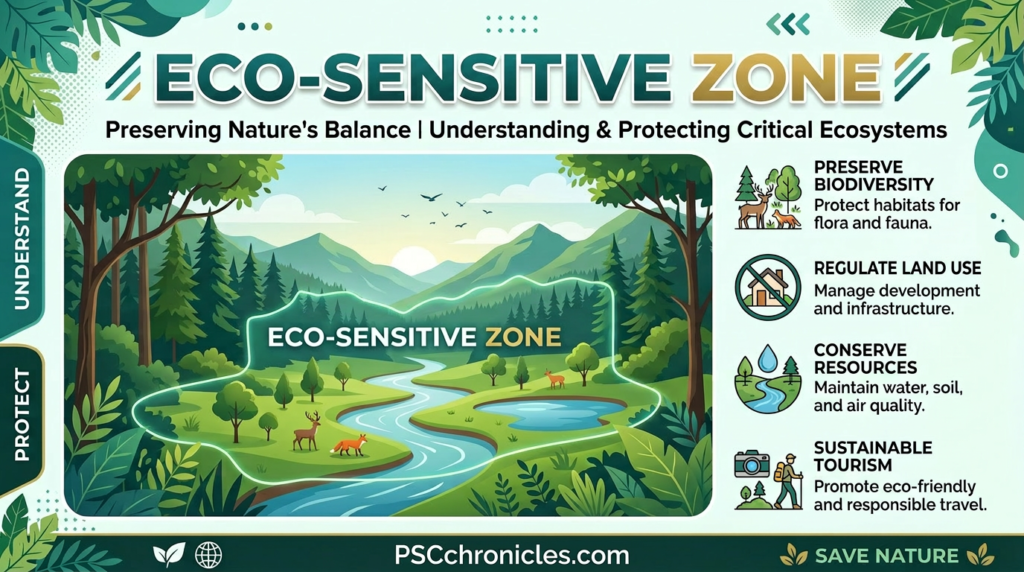
Eco-Sensitive Zones (ESZs) are buffer areas notified around Protected Areas (PAs) such as National Parks and Wildlife Sanctuaries to regulate human activities and protect fragile ecosystems.

They act as a β€œshock absorber” between:

  • High-protection zones (core forests)
  • Human-dominated landscapes (villages, towns)
eco sensitive zone

Legal Basis of ESZ

  • Declared under Environment (Protection) Act, 1986
  • Notified by Ministry of Environment, Forest and Climate Change (MoEFCC)
  • Based on Supreme Court directions (notably in T.N. Godavarman Thirumulpad vs Union of India)

Extent of ESZ

  • Typically ranges from 0 to 10 km around protected areas
  • In some cases, can exceed 10 km (based on ecological importance)

Regulation of Activities in ESZ

Prohibited Activities
  • Commercial mining
  • Setting up polluting industries
  • Major hydroelectric projects
Regulated Activities
  • Tourism activities
  • Construction activities
  • Expansion of roads
  • Use of natural resources
Permitted Activities
  • Organic farming
  • Rainwater harvesting
  • Eco-friendly livelihoods
  • Traditional practices

Eco-Sensitive Zones (ESZ) – Complete Notes for UPSC & State PSC Exams Read More Β»