📰 Today's Current AffairsRead Now →
📷 Follow on Instagram

PSC Chronicles Team

Basic Economic Concepts – 100 MCQs for UPSC, APPSC, TGPSC, State PSC exams and other competitive exams

Practice Questions on basic economy

Basic Economic Concepts – 100 MCQs for UPSC, APPSC, TGPSC, State PSC exams and other competitive exams

1. Which tax was NOT subsumed under GST?


2. Which of the following is measured by Gini Coefficient?


3. Factors leading to rupee depreciation include:


4. WTO replaced GATT in which year?


5. Priority Sector Lending target for domestic banks is:


6. Consumer Price Index (CPI) in India is released by:


7. Revenue Deficit is:


8. 1991 crisis saw forex reserves covering only:


9. Direct taxes differ from indirect taxes in that:


10. Depreciation is also called:


11. Which of the following is the correct formula for calculating Gross National Product (GNP)?


12. Foreign Exchange Reserves of India are maintained by:


13. Finance Commission recommends:


14. The FRBM Act was enacted in which year?


15. Which of the following correctly describes Green GDP?


16. Chelliah Committee recommended:


17. The Planning Commission was replaced by NITI Aayog in which year?


18. Which is Capital Expenditure?


19. Disinvestment proceeds are used for:


20. LPG reforms of 1991 included:


21. What is Core Inflation?


22. Frictional unemployment is:


23. Public goods are characterized by:


24. What is the relationship between Repo Rate and Reverse Repo Rate?


25. India calculates National Income using:


26. Cost-push inflation is caused by:


27. Per Capita Income of a country is calculated by dividing:


28. Lorenz Curve is used to measure:


29. Primary Deficit is calculated as:


30. Twin deficit refers to:


31. The Insolvency and Bankruptcy Code (IBC) was enacted in which year?


32. GST Council is a:


33. Open Market Operations (OMO) by RBI involve:


34. Headline Inflation refers to:


35. External debt does NOT include:


36. Quantitative Easing (QE) refers to:


37. Which is NOT a tool of fiscal policy?


38. State exclusive taxes include:


39. Anti-dumping duty is imposed when:


40. PPP means transfer of risk from government to:


41. Real Effective Exchange Rate (REER) takes into account:


42. What does Double Counting mean in National Income calculation?


43. Special Drawing Rights (SDRs) are issued by:


44. Which organization publishes the Periodic Labour Force Survey (PLFS) in India?


45. A Current Account Deficit (CAD) indicates that:


46. MPI does NOT include which component?


47. Inclusive Growth emphasizes:


48. Twin Balance Sheet Problem refers to:


49. Disguised unemployment is a situation where:


50. MSF rate is typically:


51. The Laffer Curve shows that:


52. Non-Performing Asset (NPA) is a loan where principal or interest remains overdue for more than:


53. According to original FRBM Act fiscal deficit target was:


54. SLR includes:


55. Fiscal Federalism implies:


56. Special Economic Zones (SEZs) in India are regulated by:


57. Which is included in Capital Account of BoP?


58. NITI Aayog was established through:


59. SARFAESI Act allows banks to:


60. Merit goods are:


61. Repo Rate is the rate at which:


62. The Phillips Curve shows the relationship between:


63. Human Development Index (HDI) is published by:


64. Trickle-Down theory suggests:


65. Black money is:


66. Which organization is responsible for calculating National Income in India?


67. FDI differs from FPI in that:


68. LAF corridor is bounded by:


69. Which price index is used by RBI for inflation targeting?


70. Which sector is NOT open to 100% FDI under automatic route?


71. Crowding Out Effect means:


72. GVA at basic prices equals:


73. Which is NOT a scheduled commercial bank?


74. Fiscal Deficit is defined as:


75. BEPS relates to:


76. Sustainable external debt to GDP ratio is below:


77. GDP Deflator is calculated as:


78. WPI versus CPI:


79. CRR is maintained as percentage of:


80. Helicopter Money involves:


81. Which is a Capital Receipt of Government?


82. Structural unemployment is caused by:


83. Disinvestment differs from privatization in that:


84. Net National Product at Factor Cost is also known as:


85. Factor Cost equals:


86. GFCF does NOT include:


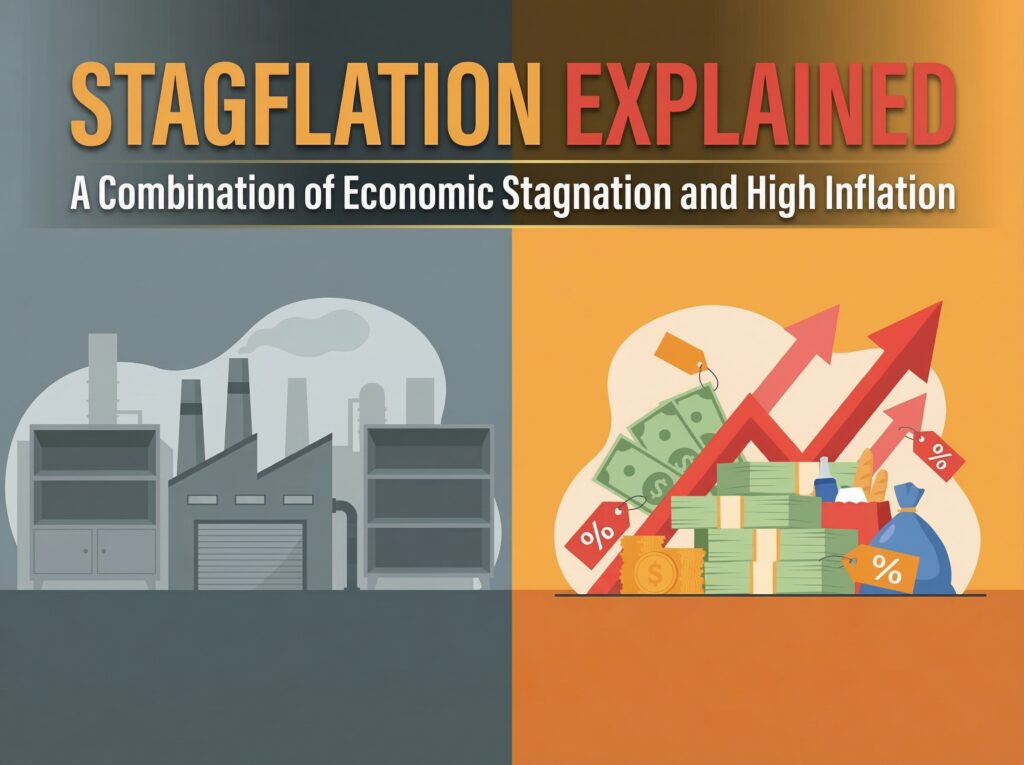
87. Stagflation refers to a situation of:


88. The Money Multiplier is calculated as:


89. Narrow Money (M1) includes:


90. Demand-pull inflation is caused by:


91. The Monetary Policy Committee (MPC) of RBI consists of how many members?


92. The Goods and Services Tax (GST) in India is a:


93. India is classified as a:


94. SDGs were adopted in which year with how many goals?


95. HDI is based on which indicators?


96. Which of the following is NOT included in the calculation of GDP?


97. IBC aims at:


98. The base year for calculating India’s GDP was revised from 2004-05 to 2011-12 in which year?


99. The term demographic dividend refers to:


100. Which committee recommended inflation targeting framework for RBI?


101. Current Account of BoP includes:


https://pscchronicles.com/50-mcqs-on-economic-planning-to-niti-aayog/: Basic Economic Concepts – 100 MCQs for UPSC, APPSC, TGPSC, State PSC exams and other competitive exams

Also practice: 50 MCQs on Economic Planning to NITI Aayog

Basic Economic Concepts – 100 MCQs for UPSC, APPSC, TGPSC, State PSC exams and other competitive exams Read More »

Asian Waterbird Census 2026 at Kolleru Wildlife Sanctuary – Notes for APPSC exams

The Asian Waterbird Census (AWC) was recently conducted at Kolleru Wildlife Sanctuary in Andhra Pradesh. This annual census helps monitor waterbird populations and assess the health of wetland ecosystems.

asian waterbird census 2026

Asian Waterbird Census:

  • The Asian Waterbird Census (AWC) is part of the global International Waterbird Census (IWC).
  • The IWC was launched in 1967 by Wetlands International.
  • Conducted every year during January (2nd & 3rd weeks).
  • Census period coincides with the mid-winter non-breeding season of migratory birds.

About Kolleru Lake:

Kolleru Lake is Asia’s largest shallow freshwater lake and one of the largest freshwater lakes in India. Located in Andhra Pradesh between the deltas of the Krishna and Godavari rivers, it is a vital ecological site designated as both a Wildlife Sanctuary (1999) and a Ramsar Wetland of International Importance (2002)

  • Water Sources: The lake is fed by seasonal streams like the Budameru and Tammileru and drains into the Bay of Bengal through the Upputeru outlet.
  • Biodiversity Hub: Known as a “Bird Heaven,” it serves as a critical stop on the Central Asian Flyway

Biodiversity Importance

  • Recognized as a major wetland ecosystem and bird habitat.
  • Key species:
    • Spot-billed (Grey) Pelican
    • Painted Stork
    • Open-billed Stork
    • Ibis
    • Siberian Crane

Protected Areas

  • Atapaka Bird Sanctuary is located within the Kolleru region.
  • Serves as a safe breeding and feeding ground for migratory birds.
https://www.thehindu.com/news/national/andhra-pradesh/asian-waterbird-census-in-ap-on-jan-5-and-6/article33489082.ece: Asian Waterbird Census 2026 at Kolleru Wildlife Sanctuary – Notes for APPSC exams

Asian Waterbird Census 2026 at Kolleru Wildlife Sanctuary – Notes for APPSC exams Read More »

Supreme Court Hearing on CAA Petitions from May 5 – Key Points for UPSC & PSC Exams

Why in News?

The Supreme Court of India has scheduled final hearings from May 5, 2026 on more than 250 petitions challenging the Citizenship (Amendment) Act, 2019 (CAA). The petitions question the constitutional validity of the Act, especially on grounds of alleged religious discrimination.

citizenship amendment act

Key Highlights:

  • The CAA amends the Citizenship Act, 1955.
  • It provides fast-track Indian citizenship to certain migrants facing religious persecution.
  • Eligible communities: Hindus, Sikhs, Buddhists, Jains, Parsis, and Christians.
  • Countries covered: Afghanistan, Bangladesh, and Pakistan.
  • Cut-off date: Migrants must have entered India on or before 31 December 2014.
  • It reduces the residency requirement for citizenship from 11 years to 5 years for eligible migrants.
  • Over 250 petitions challenge the Act’s constitutionality, mainly citing violation of Article 14 (Right to Equality). The Supreme Court will now conduct final hearings, which could have major constitutional implications
https://www.indiatoday.in/india/law-news/story/supreme-court-caa-final-hearing-may-5-iuml-plea-petitions-2870995-2026-02-19: Supreme Court Hearing on CAA Petitions from May 5 – Key Points for UPSC & PSC Exams

Supreme Court Hearing on CAA Petitions from May 5 – Key Points for UPSC & PSC Exams Read More »

Kerala Renaming to ‘Keralam’ Approved – Article 3 & State Name Change Procedure Explained for Exams

Why in News?

Union Cabinet has approved a proposal to rename Kerala as “Keralam”, initiating the constitutional process under Article 3 of the Indian Constitution.

keralam

Constitutional Basis:

Article 3 – Alteration of State Name

Parliament has the power to:

  • Form new states
  • Alter boundaries
  • Increase or decrease area
  • Change the name of a state

Article 4 – Supplemental Provisions

  • Any law under Article 3:
    • Amends the First Schedule (list of states)
    • Amends the Fourth Schedule (Rajya Sabha seats)
  • Such changes:
    • Are not considered Constitutional Amendments
    • Passed by simple majority

Step-by-Step Procedure to Change State Name:

  1. Presidential Recommendation:
    • Bill can be introduced in Parliament only with prior approval of the President.
  2. Reference to State Legislature:
    • President refers the Bill to the concerned State Legislature for its opinion.
  3. Non-Binding Opinion:
    • State’s views are not binding on Parliament.
  4. Parliamentary Approval:
    • Bill passed by simple majority in both Houses.
  5. Presidential Assent:
    • After approval, the President signs the Bill → Name change becomes official.
https://ddnews.gov.in/en/union-cabinet-approves-proposal-to-rename-kerala-as-keralam/: Kerala Renaming to ‘Keralam’ Approved – Article 3 & State Name Change Procedure Explained for Exams

Kerala Renaming to ‘Keralam’ Approved – Article 3 & State Name Change Procedure Explained for Exams Read More »

Rajya Sabha Elections 2026 – 37 Seats Notified | Composition, Tenure & Articles Explained

Why in News?

The Election Commission of India (ECI) has issued notification for elections to 37 Rajya Sabha seats, with polling scheduled in March 2026, as the terms of these members are expiring in April.

rajya sabha elections

Rajya Sabha – Key Features:

Maximum Strength: 245 members

  • 233 elected from States & UTs
  • 12 nominated by the President

Nature of House:

  • Permanent body (cannot be dissolved)
  • Ensures continuity in Parliament

Tenure:

  • Each member serves 6 years
  • 1/3rd members retire every 2 years (biennial elections)
  • Based on Article 83(1)

Composition & Representation:

  • Allocation of seats is based on population.
  • Governed by the Fourth Schedule of the Constitution.

Nominated Members (Article 80(3)):

  • 12 members nominated by the President of India.
  • Chosen from fields like:
    • Literature
    • Science
    • Art
    • Social Service
  • They may join a political party within 6 months of taking their seat
https://ddnews.gov.in/en/eci-announces-march-16-polling-for-37-rajya-sabha-seats-across-10-states/: Rajya Sabha Elections 2026 – 37 Seats Notified | Composition, Tenure & Articles Explained

Rajya Sabha Elections 2026 – 37 Seats Notified | Composition, Tenure & Articles Explained Read More »