

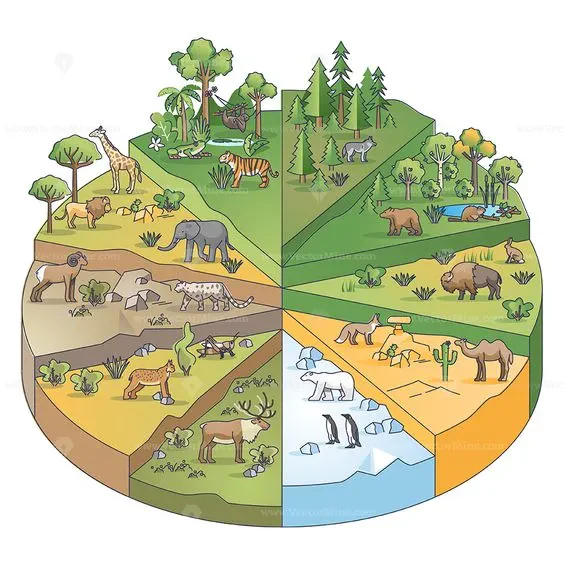
Practice Questions on Ecology Basics
Practice Questions on Ecology Basics
Please go to Practice Questions on Ecology Basics to view the testFor more Practice Questions on environment and ecology Click here
CMS COP15 Concludes in Brazil; 40 New Species Granted Protection
Why in News?
The 15th Conference of Parties (CMS COP15) to the Convention on the Conservation of Migratory Species (CMS) concluded in Campo Grande, Brazil, with a major decision to grant protection to 40 additional migratory species.

About CMS (Bonn Convention)
- Full Name: Convention on the Conservation of Migratory Species of Wild Animals
- Also known as: Bonn Convention
- Established under: United Nations Environment Programme (UNEP)
Key Features:
- An intergovernmental treaty
- Focuses on:
- Conservation of migratory species
- Protection of their habitats and migration routes
- Covers:
- Terrestrial animals
- Aquatic species
- Birds (avian species)
It is the only global convention dedicated exclusively to migratory species
CMS Appendices (Important for Exams)
Appendix I
- Includes species threatened with extinction
- Requires:
- Strict protection measures
- Ban on hunting or exploitation
Appendix II
- Includes species that:
- Need international cooperation
- Encourages:
- Agreements between countries for conservation
For more current affairs Click here
CMS COP15 Concludes in Brazil; 40 New Species Granted Protection Read More »
FOURTH SURVEY VESSEL (LARGE) ‘SANSHODHAK’ DELIVERED TO INDIAN NAVY AT GRSE KOLKATA
Why in News:
The Indian Navy has completed its Survey Vessel (Large) (SVL) Project with the induction of INS Sanshodhak, the fourth and final ship in the series
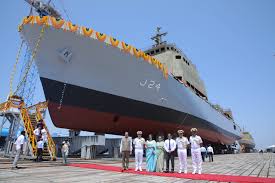
What is INS Sanshodhak?
- INS Sanshodhak is a Survey Vessel (Large)
- It is the fourth and final ship under the SVL project
- Designed for:
- Hydrographic surveys
- Mapping sea floors
- Supporting navigation safety
Survey Vessel (Large) Project
The SVL Project consists of four ships:
- INS Sandhayak
- INS Nirdeshak
- INS Ikshak
- INS Sanshodhak (final vessel)
For more Defence related current affairs, Click here
FOURTH SURVEY VESSEL (LARGE) ‘SANSHODHAK’ DELIVERED TO INDIAN NAVY AT GRSE KOLKATA Read More »
INS Malwan: Indigenous ASW Craft Boosts Navy
Why in News?
The Indian Navy has received ‘Malwan’, the second Anti-Submarine Warfare Shallow Water Craft (ASW SWC), built by Cochin Shipyard Limited (CSL). This induction significantly enhances India’s coastal security and underwater surveillance capabilities.
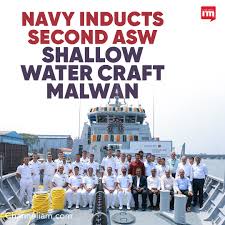
What is ASW SWC ‘Malwan’?
- Malwan is an indigenously built Anti-Submarine Warfare Shallow Water Craft
- Designed for:
- Detecting and neutralizing enemy submarines
- Operations in shallow coastal waters (littoral zones)
For more current affairs on Defence related issues, Click here
Samrat Samprati Museum Inaugurated in Gandhinagar
Why in News?
Prime Minister Narendra Modi inaugurated the Samrat Samprati Museum at Koba Tirth in Gandhinagar, Gujarat on the occasion of Bhagwan Mahavir Jayanti. The museum highlights the legacy of Samrat Samprati, a Mauryan emperor known for promoting Jainism
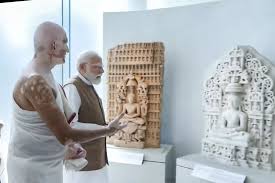
Who was Samrat Samprati?
- Period: c. 224–215 BCE
- Dynasty: Mauryan Dynasty
- Lineage:
- Grandson of Emperor Ashoka
- Son of Kunala
Key Contributions
- Promoted Jainism across India
- Converted to Jainism by monk Suhastin
- Disciple of Acharya Bhadrabahu
- Known for:
- Construction of Jain temples
- Spreading Jain teachings
- Commissioning lakhs of Tirthankara idols
For more current affairs on History and culture, Click here
Samrat Samprati Museum Inaugurated in Gandhinagar Read More »
YUVIKA: ISRO’s Young Scientist Programme Explained
Why in News?
The Government of India is actively promoting scientific awareness among students through initiatives like Yuva Vigyani Karyakram (YUVIKA). Highlighted by the Union Minister of State for Science & Technology, the programme plays a crucial role in inspiring school students to pursue careers in space science and STEM fields.
What is YUVIKA?
Yuva Vigyani Karyakram (YUVIKA), also known as the Young Scientist Programme, is an educational initiative launched by the Indian Space Research Organisation (ISRO).
Key Purpose
- To provide early exposure to space science and technology
- To encourage students to take up careers in STEM (Science, Technology, Engineering, Mathematics)
For more Current affairs on Science and Technology, Click here
YUVIKA: ISRO’s Young Scientist Programme Explained Read More »
Antariksh Venture Capital Fund (AVCF): India’s First Spacetech Fund
Why in News?
India has launched the Antariksh Venture Capital Fund (AVCF) to strengthen its growing spacetech ecosystem. This is the country’s first dedicated venture capital fund for the space sector, aimed at supporting startups
What is Antariksh Venture Capital Fund (AVCF)?
The Antariksh Venture Capital Fund (AVCF) is a specialized investment fund created to provide:
- Risk capital to spacetech startups
- Support for early-stage and growth-stage companies
- Funding for innovation in space technology and applications
Key Features of AVCF
1. Total Corpus
- Target fund size: ₹1,600 crore
- Initial committed amount: ₹1,005 crore (as of November 2025)
2. Anchor Investor
- Indian National Space Promotion and Authorization Centre (IN-SPACe)
- Committed ₹1,000 crore
- Acts as the primary institutional supporter
3. Fund Management
- Managed by SIDBI Venture Capital Limited (SVCL)
- SVCL is a subsidiary of:
- Small Industries Development Bank of India (SIDBI)
Institutional Background
IN-SPACe
- A regulatory and promotional body under the Department of Space
- Facilitates private sector participation in space activities
SIDBI
- Apex financial institution for MSME financing
- Supports entrepreneurship and innovation
For more current affairs on Science and Technology. Click here
Antariksh Venture Capital Fund (AVCF): India’s First Spacetech Fund Read More »
E20 Petrol with RON 95 Made Mandatory Across India
Why in News?
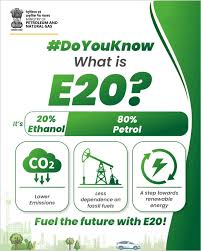
From April 1, 2026, the Government of India has implemented a major fuel reform by mandating the nationwide sale of E20 petrol (20% ethanol-blended fuel) with a minimum Research Octane Number (RON) of 95.
What is E20 Petrol?
E20 petrol is a blended fuel consisting of:
- 80% conventional petrol
- 20% ethanol (biofuel)
Key Features
- Ethanol Source:
- Derived from agricultural products like:
- Sugarcane
- Maize (corn)
- Other food grains
- Derived from agricultural products like:
- Renewable Fuel:
- Ethanol is a renewable and eco-friendly energy source
- Nationwide Implementation:
- Applicable across all States and Union Territories from April 2026
What is Research Octane Number (RON 95)?
- Definition:
- RON measures a fuel’s ability to resist engine knocking (premature combustion)
- RON 95 Explained:
- Indicates higher fuel stability
- Performs better under high pressure and temperature
- Previous Standard:
- Earlier petrol standard was RON 91
For more Science and Technology current affairs. Clickhere
E20 Petrol with RON 95 Made Mandatory Across India Read More »
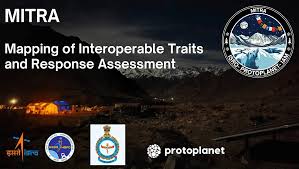
Mission MITRA: Preparing Gaganyatris for Space
Why in News?
India has launched Mission MITRA to evaluate astronaut-designates (Gaganyatris) for India’s first human spaceflight programme, Gaganyaan. The mission focuses on testing physical, psychological, and teamwork capabilities in extreme high-altitude conditions.
What is Mission MITRA?
- Full Form: Mapping of Interoperable Traits and Response Assessment (MITRA)
- Conducted by: ISRO
- Purpose: To assess astronauts’ ability to function effectively under extreme conditions
Key Features
- Four astronaut-designates involved:
- Shubhanshu Shukla
- Prashanth Balakrishnan Nair
- Ajit Krishnan
- Angad Pratap
- Testing Location: High-altitude regions of Ladakh
For more Science and technology current affairs. Click here