πŸ“° Today's Current AffairsRead Now →
📷 Follow on Instagram

Environment and Ecology Current Affairs

India to Ban New HFC Projects After 2027-Explained for UPSC and state PSC exams

India has taken a major step to tackle climate change by restricting the production of Hydrofluorocarbons (HFCs). The government has announced that no new environmental clearances will be granted for HFC projects after 2027. This aligns with India’s international climate commitments under the Kigali Amendment

kigali amendment

The Environment Ministry has decided:

  • No new environmental clearances for HFC production from January 1, 2028
  • No expansion of existing HFC manufacturing units after December 31, 2027

What are Hydrofluorocarbons (HFCs)?

Hydrofluorocarbons (HFCs) are organic compounds consisting of hydrogen, fluorine, and carbon atoms. They are entirely man-made synthetic gases developed as a non-ozone-depleting alternative to Chlorofluorocarbons (CFCs) and Hydrochlorofluorocarbons (HCFCs)

  • Ozone Depletion Potential (ODP): HFCs have zero ODP because they do not contain chlorine, which is the primary catalyst for ozone layer destruction.
  • Global Warming Potential (GWP): Despite being ozone-friendly, HFCs are potent greenhouse gases. Their GWP can be hundreds to thousands of times higher than carbon dioxide per unit mass.

India & Kigali Amendment

  • India ratified the Kigali Amendment in 2021
  • It is part of the Montreal Protocol
  • Aim:
    • Gradual reduction of HFC production and consumption

India falls under Group 2 (Developing Countries) and India’s target is

YearReduction Target
203210% reduction
203720% reduction
204230% reduction
204785% reduction

To study Montreal Protocol from exam point of view, Click here

India to Ban New HFC Projects After 2027-Explained for UPSC and state PSC exams Read More Β»

India Withdraws Bid for COP 33 (2028)

India has withdrawn its bid to host the 33rd Conference of Parties (COP 33) scheduled for 2028.

  • COP is the annual global climate summit held under the United Nations climate framework, where countries discuss actions to tackle climate change
unfccc psc

What is UNFCCC?

The United Nations Framework Convention on Climate Change (UNFCCC) is the main international agreement guiding global efforts to combat climate change.

Key Facts:

  • Adopted: 1992
  • Event: Earth Summit (Rio de Janeiro)
  • Objective: Stabilize greenhouse gas emissions to prevent dangerous climate change
  • Nature: Framework treaty (not legally binding emission targets)

Important Agreements under UNFCCC:

  • Kyoto Protocol
    • Legally binding emission reduction targets for developed countries
  • Paris Agreement
    • Aim: Limit global warming to well below 2Β°C, preferably 1.5Β°C

To study more about UNFCCC, Click here

India Withdraws Bid for COP 33 (2028) Read More Β»

Telangana’s Bharat Future City Project: NGT Refuses to Grant Stay:

Why in News:

National Green Tribunal (NGT) has refused to halt Telangana’sBharat Future City project, proposed over nearly 30,000 acres

national green tribunal

The petitioner alleged: Mandatory approvals were not obtained before starting activities and bypassed procedures under the Environmental Impact Assessment (EIA) framework

What is the Bharat Future City Project?

  • A large-scale urban development project proposed by the Telangana government
  • Spread across ~30,000 acres in 56 revenue villages covering 7 mandals
  • Located between Srisailam and Nagarjunasagar highways
  • Envisioned as a modern urban hub with infrastructure and economic activities

About NGT

  • Established under the NGT Act, 2010
  • A specialized environmental court for speedy justice

Key Features

  • Chairperson: Retired Supreme Court judge or Chief Justice of a High Court
  • Tenure: 5 years (no reappointment)
  • Nature of Proceedings:
    • Follows principles of natural justice
    • Not strictly bound by the Code of Civil Procedure
  • Time Limit:
    • Aims to dispose cases within 6 months
  • Jurisdiction:
    • Covers major environmental laws (Schedule I)
    • Excludes:
      • Wildlife (Protection) Act, 1972
      • Forest Rights Act, 2006
  • Appeal Mechanism:
    • Decisions can be appealed in the Supreme Court within 90 days

To know more about National Green Tribunal from exam point of view, Click here

Telangana’s Bharat Future City Project: NGT Refuses to Grant Stay: Read More Β»

Kali Tiger Reserve ESZ: Draft Notification Issued

The Union Ministry of Environment has issued a draft notification to declare an Eco-Sensitive Zone (ESZ) around the Kali Tiger Reserve in Karnataka

eco sensitive zone

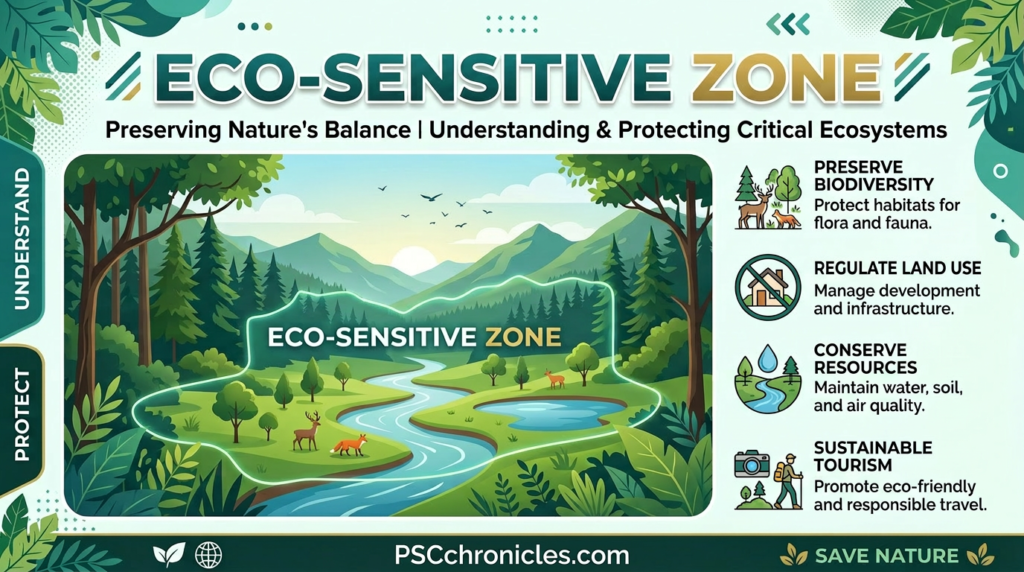
What are Eco-Sensitive Zones (ESZs)?

Eco-Sensitive Zones are buffer areas created around protected regions like: National Parks, Wildlife Sanctuaries and Tiger Reserves

Purpose:

  • Act as a shock absorber between protected areas and human activities
  • Reduce environmental pressure
  • Promote sustainable development

Legal & Statutory Basis

  • Declared under Section 3 of the Environment (Protection) Act, 1986
  • Though the term β€œESZ” is not directly mentioned in the Act, it is notified through rules under it.

Extent of ESZ

  • Generally extends up to 10 km from the boundary of protected areas
  • However, it is flexible depending on: Ecological sensitivity, Population density and local conditions.

Activities in ESZ

Prohibited Activities:
  • Commercial mining
  • Setting up sawmills
  • Large hydroelectric projects
Regulated Activities:
  • Tourism
  • Road expansion
  • Construction activities
Permitted Activities:
  • Eco-friendly practices
  • Organic farming
  • Sustainable livelihood activities

To know more about Eco sensitive zones from exam point of view, Click here

Kali Tiger Reserve ESZ: Draft Notification Issued Read More Β»

India Leads in Nagoya Protocol Compliance Certificates

Why in News?

India has emerged as a global leader in issuing Internationally Recognized Certificates of Compliance (IRCCs) under the Nagoya Protocol, contributing over 56% of all certificates worldwide.

nagoya protocol

What are IRCCs?

  • IRCC (Internationally Recognized Certificate of Compliance):
    • A digital certificate issued under the Nagoya Protocol
    • Confirms that access to genetic resources is:
      • Legal
      • Approved by authorities
      • Based on agreed benefit-sharing terms

Nagoya Protocol on Access and Benefit Sharing (2010)

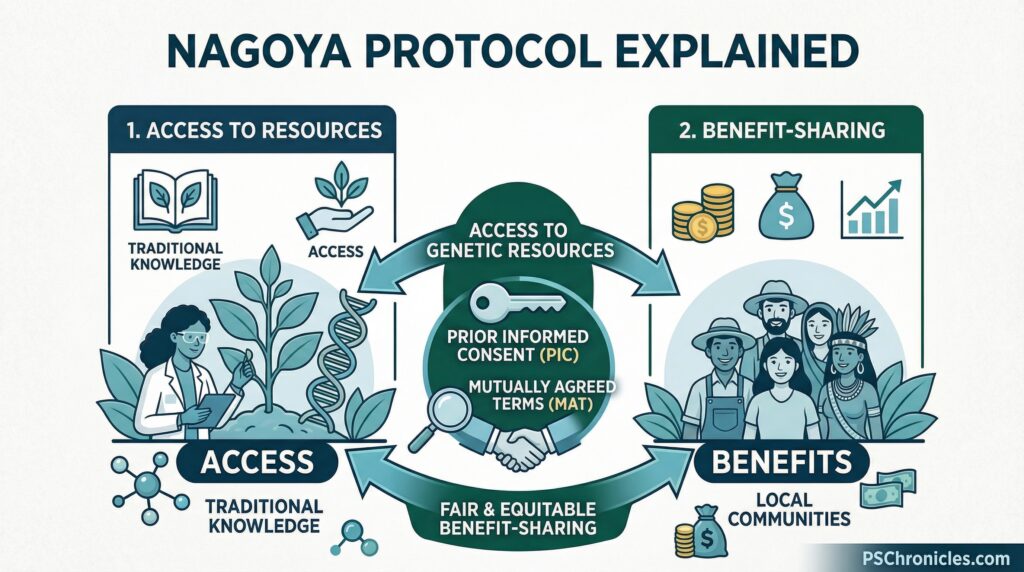
The Nagoya Protocol (2010) isΒ a legally binding international agreement under the Convention on Biological Diversity (CBD) that ensures fair sharing of benefits arising from the utilization of genetic resources and associated traditional knowledge.

  • It aims to prevent biopiracy by requiring users to obtain Prior Informed Consent (PIC) and establish Mutually Agreed Terms (MAT) with the provider country, ensuring benefits like royalties or research results are shared.
  • IRCCs are issued under this protocol

To know more about Convention on Biological Diversity, Click here

India Leads in Nagoya Protocol Compliance Certificates Read More Β»

CMS COP15 Concludes in Brazil; 40 New Species Granted Protection

Why in News?

The 15th Conference of Parties (CMS COP15) to the Convention on the Conservation of Migratory Species (CMS) concluded in Campo Grande, Brazil, with a major decision to grant protection to 40 additional migratory species.

cms cop15

About CMS (Bonn Convention)

  • Full Name: Convention on the Conservation of Migratory Species of Wild Animals
  • Also known as: Bonn Convention
  • Established under: United Nations Environment Programme (UNEP)

Key Features:

  • An intergovernmental treaty
  • Focuses on:
    • Conservation of migratory species
    • Protection of their habitats and migration routes
  • Covers:
    • Terrestrial animals
    • Aquatic species
    • Birds (avian species)

It is the only global convention dedicated exclusively to migratory species

CMS Appendices (Important for Exams)

Appendix I

  • Includes species threatened with extinction
  • Requires:
    • Strict protection measures
    • Ban on hunting or exploitation

Appendix II

  • Includes species that:
    • Need international cooperation
  • Encourages:
    • Agreements between countries for conservation

For more current affairs Click here

CMS COP15 Concludes in Brazil; 40 New Species Granted Protection Read More Β»

World Wetlands Day 2026 (Feb 2): Theme, Ramsar Convention & Montreux Record – Exam Notes

Why in News?

World Wetlands Day is observed on February 2, marking the anniversary of the Ramsar Convention (1971). The 2026 theme highlights traditional knowledge and cultural heritage linked to wetlands.

world wetlands day

Key Highlights:

  • Date: February 2 (every year).
  • Purpose: To raise awareness about the importance of wetlands for ecology, biodiversity, and livelihoods.
  • 2026 Theme:β€œWetlands and Traditional Knowledge: Celebrating Cultural Heritage”

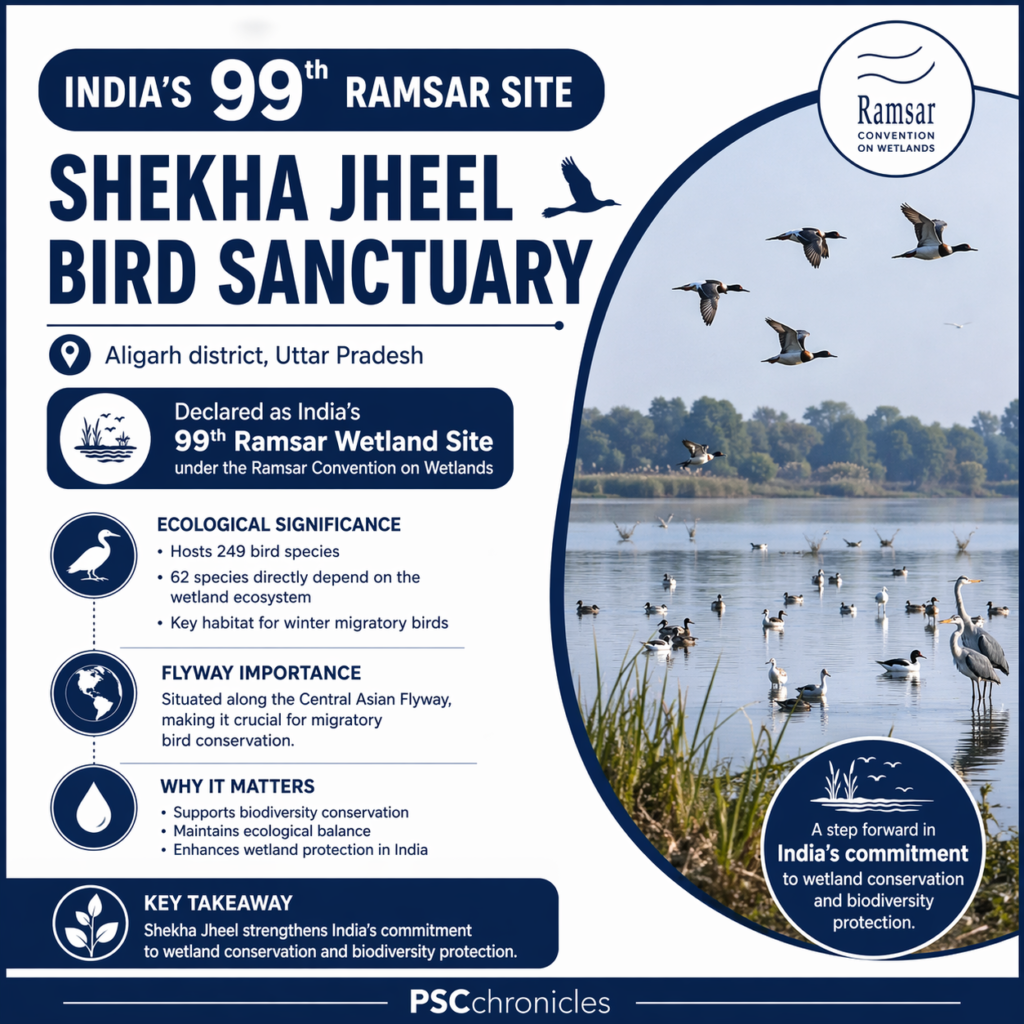
Ramsar Convention on Wetlands:

  • Signed on February 2, 1971 in Ramsar
  • It is the only global treaty focused on a specific ecosystem (wetlands)
  • India became a member on February 1, 1982
  • Objective: Conservation and wise use of wetlands

Montreux Record:

  • A register under the Ramsar Convention
  • Includes wetlands facing ecological threats due to human interference or pollution

Indian Sites in Montreux Record:

  • Keoladeo National Park
  • Loktak Lake
https://www.downtoearth.org.in/water/world-wetlands-day-2026-promoting-chilika-red-rice-can-help-enhance-food-and-livelihood-security-around-indias-first-ramsar-site: World Wetlands Day 2026 (Feb 2): Theme, Ramsar Convention & Montreux Record – Exam Notes

World Wetlands Day 2026 (Feb 2): Theme, Ramsar Convention & Montreux Record – Exam Notes Read More Β»

Project Tiger Completes 50 Years: Centre Forms Expert Groups for Policy Review

Why in News?

The Government of India has constituted four expert working groups to review five decades of tiger conservation policies under Project Tiger, marking its 50-year milestone.

project tiger

Project Tiger:

  • Project Tiger was launched on 1 April 1973.
  • The launch took place at Jim Corbett National Park.
  • It is a Centrally Sponsored Scheme.
  • Objective: To ensure a viable population of Bengal tigers in their natural habitats.
  • Recognized as the world’s largest species conservation programme.

Exam TIP: National Tiger Conservation Authority (NTCA):

  • Established in 2005 and given statutory status in 2006.
  • Formed under the Wildlife (Protection) Act, 1972.
  • Functions:
    • Supervises Project Tiger implementation
    • Strengthens tiger conservation efforts
  • Chaired by the Union Minister of Environment, Forest and Climate Change
https://www.newindianexpress.com/nation/2026/Feb/09/govt-forms-expert-groups-for-upgrade-of-50-year-old-project-tiger-scheme: Project Tiger Completes 50 Years: Centre Forms Expert Groups for Policy Review

Project Tiger Completes 50 Years: Centre Forms Expert Groups for Policy Review Read More Β»

GEF Approves $372 Million for Biodiversity Projects

Why in News?

The Global Environment Facility (GEF) has approved $372 million funding for 36 environmental projects in developing countries. The move supports global efforts to achieve biodiversity targets under the Kunming-Montreal Global Biodiversity Framework (2022)

global environment facility

Global Environment Facility:

Established in 1991, theΒ Global Environment Facility (GEF)Β isΒ the world’s largest multilateral fund dedicated to the environment. It serves as an independent financial mechanism for several major international conventions, helping developing countries and transition economies address urgent environmental challenges.Β 

GEF Supports 5 Major International Conventions:

  • Convention on Biological Diversity (CBD)
  • UN Framework Convention on Climate Change (UNFCCC)
  • UN Convention to Combat Desertification (UNCCD)
  • Stockholm Convention on Persistent Organic Pollutants (POPs)
  • Minamata Convention on Mercury

Kunming-Montreal Global Biodiversity Framework (KMGBF):

Kunming-Montreal Global Biodiversity Framework (KMGBF), also known as The Biodiversity Plan, is a landmark international agreement adopted on 19 December 2022 during the 15th Conference of the Parties (COP15) to the UN Convention on Biological Diversity (CBD). It is often described as the “Paris Agreement for Nature,” serving as the global roadmap to halt and reverse biodiversity loss by 2030

It has four global goals:

  • Restore and protect ecosystems & species
  • Ensure sustainable use of biodiversity
  • Fair and equitable sharing of genetic resource benefits
  • Mobilize finance, technology, and capacity-building
Exam Tip

KMGBF = 4 Goals (2050) + 23 Targets (2030) + 30Γ—30 Target

https://www.downtoearth.org.in/wildlife-biodiversity/gef-clears-372-million-for-environment-projects-biodiversity-in-sharp-focus: GEF Approves $372 Million for Biodiversity Projects

GEF Approves $372 Million for Biodiversity Projects Read More Β»

High Seas Treaty -Biodiversity Beyond National JurisdictionΒ (BBNJ), enters into force:

Why in News?

The High Seas Treaty, officially called the Biodiversity Beyond National Jurisdiction (BBNJ) Agreement, came into force on 17 January 2026. It is the first legally binding global agreement aimed at protecting marine biodiversity in areas beyond national jurisdiction

bbnj

Biodiversity Beyond National Jurisdiction (BBNJ) Agreement:

Biodiversity Beyond National Jurisdiction (BBNJ) Agreement, also known as the High Seas Treaty, is a legally binding international treaty under the United Nations Convention on the Law of the Sea (UNCLOS) designed to ensure the conservation and sustainable use of marine life in international waters

The agreement has four main pillars:

  • Marine Genetic Resources (MGRs): Ensures fair sharing of benefits (monetary and non-monetary) from marine resources in international waters.
  • Area-Based Management Tools (ABMTs): Enables creation of Marine Protected Areas (MPAs) to help achieve the 30% ocean protection target by 2030.
  • Environmental Impact Assessments (EIAs): Establishes global norms to assess environmental impacts of activities in the high seas.
  • Capacity Building & Technology Transfer: Supports developing countries in marine research and sustainable use of ocean resources.
https://www.pib.gov.in/PressReleaseIframePage.aspx?PRID=2031611&reg=3&lang=2#:~:text=Press%20Release:Press%20Information%20Bureau,implementation%20of%20the%20BBNJ%20Agreement.: High Seas Treaty -Biodiversity Beyond National JurisdictionΒ (BBNJ), enters into force:

High Seas Treaty -Biodiversity Beyond National JurisdictionΒ (BBNJ), enters into force: Read More Β»