πŸ“° Today's Current AffairsRead Now →
📷 Follow on Instagram

2026 current affairs

Savitribai Phule Birth Anniversary – First Female Teacher, Reforms & Key Facts for Exams

Why in News?

Prime Minister Narendra Modi paid tribute to Savitribai Phule on her 195th birth anniversary, recognizing her contributions to women’s education and social reform.

savitribai phule

Savitribai Phule:

Savitribai Phule was a pioneering Indian social reformer, educator, and poet from Maharashtra. she is often hailed as the “Mother of Indian Feminism” for her tireless work in advancing women’s rights and education.

  • Savitribai Phule is regarded as India’s first female teacher.
  • Along with her husband, Jyotirao Phule, she founded India’s first school for girls at Bhide Wada in Pune in 1848.
  • She played a vital role in theΒ Satyashodhak SamajΒ (“Society of Truth Seekers”) to promote social equality and challenge the caste hierarchy.
  • She founded Mahila Seva Mandal Β to raise awareness about women’s rights, the dignity of life, and human rights.
https://www.indiatoday.in/education-today/gk-current-affairs/story/savitribai-phule-10-facts-first-female-teacher-india-pioneered-womens-education-social-reform-2879679-2026-03-10: Savitribai Phule Birth Anniversary – First Female Teacher, Reforms & Key Facts for Exams

Savitribai Phule Birth Anniversary – First Female Teacher, Reforms & Key Facts for Exams Read More Β»

World Hindi Day 2026 – Date, Article 343, Official Language Explained

Why in News?

World Hindi Day 2026 is observed on January 10 to promote the global significance of the Hindi language and strengthen its international presence.

world hindi day

World Hindi Day was first celebrated in 2006. It commemorates the first World Hindi Conference (1975, Nagpur).

  • World Hindi Day: January 10 (Global promotion)
  • National Hindi Day: September 14 (Adoption of Hindi as official language in 1949)
Article 343:

Article 343 states:

  • Official language of the Union β†’ Hindi in Devanagari script
  • English allowed for 15 years (1950–1965) for official purposes

After 1965, English continued through

  • Official Languages Act, 1963

Ensures bilingual functioning (Hindi + English) in Union administration

https://indianexpress.com/article/when-is/vishwa-hindi-divas-2025-date-history-significance-theme-9770905/: World Hindi Day 2026 – Date, Article 343, Official Language Explained

World Hindi Day 2026 – Date, Article 343, Official Language Explained Read More Β»

Somnath Temple 1000 Years Since 1026 Attack – History, Mahmud of Ghazni & Key Facts

Why in News?

India is commemorating 1,000 years since the first recorded attack (1026 CE) on the Somnath Temple by Mahmud of Ghazni through events titled Somnath Swabhiman Parv (2026).

somnath temple

Somnath Temple:

The Somnath Temple, located in Prabhas Patan, Gujarat, is revered as the first of the twelve Jyotirlinga shrines of Lord Shiva. Often called the “Eternal Shrine,” it is famous for its resilience, having been destroyed and rebuilt many times throughout history.

1026 attack:
  • Led by Mahmud of Ghazni, ruler of the Ghaznavid Dynasty.
  • One of his 17 invasions into India (1000–1025 CE).
  • Targeted wealthy temples for plunder and religious motives

About Mahmud of Ghazni:

  • Ruler of Ghazni (present-day Afghanistan)
  • Conducted 17 raids into the Indian subcontinent
  • Focused on rich temple cities like Somnath
  • Al-Biruni accompanied Mahmud of Ghazni. Authored β€œKitab-ul-Hind”, a detailed account of Indian society and culture
https://www.pib.gov.in/PressReleasePage.aspx?PRID=2213128&reg=3&lang=2#:~:text=A%20Thousand%20Years%20of%20Deep%2Drooted%20Faith%20and%20Civilisational%20Pride&text=Somnath%20Swabhiman%20Parv%20(8%E2%80%9311,rich%20cultural%20and%20spiritual%20heritage.: Somnath Temple 1000 Years Since 1026 Attack – History, Mahmud of Ghazni & Key Facts

Somnath Temple 1000 Years Since 1026 Attack – History, Mahmud of Ghazni & Key Facts Read More Β»

Veer Bal Diwas – History, Significance & Key Facts for exams

Why in News?

India observed Veer Bal Diwas to commemorate the bravery and sacrifice of the sons of Guru Gobind Singh, highlighting their unwavering commitment to faith and courage.

veer bal diwas

Veer Bal Diwas honors the martyrdom of

  • Sahibzada Zorawar Singh (aged 9)
  • Sahibzada Fateh Singh (aged 7)
  • They were the youngest sons of Guru Gobind Singh.
  • The day highlights extraordinary courage and sacrifice at a young age.
  • Observed annually on December 26.

Β In 1704, the two young boys were captured by the Mughal Governor of Sirhind, Wazir Khan. Despite facing extreme pressure and the threat of death, they refused to renounce their faith and were eventually executed by being bricked alive into a wall.

https://www.pib.gov.in/PressNoteDetails.aspx?NoteId=156743&ModuleId=3&reg=3&lang=2: Veer Bal Diwas – History, Significance & Key Facts for exams

Veer Bal Diwas – History, Significance & Key Facts for exams Read More Β»

RBI Proposes BRICS Digital Currency Link – CBDC, e-Rupee & Cross-Border Payments Explained

Why in News?

The Reserve Bank of India (RBI) has recommended the government to include a proposal on linking Central Bank Digital Currencies (CBDCs) of BRICS nations in the 2026 BRICS Summit agenda to enhance cross-border payments

cbdc
  • RBI suggested integration of CBDCs among BRICS countries.
  • Aim: Enable faster, cheaper, and more efficient cross-border payments.
  • Could reduce dependence on the US dollar in global trade.

CBDC:

Central Bank Digital Currency (CBDC)Β is the digital form of a country’s fiat currency, issued and regulated by its central bank. It serves as a legal tender, equivalent to physical cash, and is a direct liability of the central bank rather than a commercial bank

  • In India, CBDC is known as the e-Rupee (eβ‚Ή).
  • It is a legal tender and a direct liability of RBI, unlike cryptocurrencies.
Types of CBDC in India:
  1. Retail CBDC (eβ‚Ή-R):
    • Used by general public (individuals & businesses)
    • For daily transactions
    • Stored in digital wallets via banks
  2. Wholesale CBDC (eβ‚Ή-W):
    • Used by financial institutions
    • For interbank settlements
    • Useful in government securities market
https://www.thehindu.com/opinion/editorial/building-bridges/article70534042.ece: RBI Proposes BRICS Digital Currency Link – CBDC, e-Rupee & Cross-Border Payments Explained

RBI Proposes BRICS Digital Currency Link – CBDC, e-Rupee & Cross-Border Payments Explained Read More Β»

India GDP Growth Expected at 7.4% in FY26 – First Advance Estimates, GDP vs GNP Explained

Why in News?

India’s real GDP growth is projected at 7.4% for FY26, according to the government’s First Advance Estimates, despite global uncertainties like US tariff pressures
gdp

GDP-Explained

Gross Domestic Product (GDP) measures the total value of goods and services produced within a country’s borders in a given time period.

It is a key indicator of economic performance and growth.

  • GDP = Total value of final goods and services produced within India
  • Includes Net Indirect Taxes (GST – Subsidies) added to GVA
  • Excludes intermediate goods to avoid double counting
Types of GDP

Nominal GDP:

  • Measured at current market prices
  • Does not adjust for inflation

Real GDP:

  • Adjusted for inflation/deflation
  • Reflects actual growth in output
GDP vs GNP
FeatureGDPGNP
DefinitionProduction within countryIncome of nationals globally
FocusDomestic territoryOwnership (citizens/companies)
Includes foreign companies in IndiaYesNo
Includes income earned abroadNoYes
Examples:
  • A foreign company producing goods in India β†’ counted in India’s GDP
  • An Indian company earning income abroad β†’ counted in India’s GNP
https://indianexpress.com/article/business/economy/fy26-real-gdp-growth-seen-at-7-4-budget-prep-to-build-on-data-10460105/: India GDP Growth Expected at 7.4% in FY26 – First Advance Estimates, GDP vs GNP Explained

India GDP Growth Expected at 7.4% in FY26 – First Advance Estimates, GDP vs GNP Explained Read More Β»

India’s CPI Inflation Rises to 1.33% in December 2025 – Key Facts, Types & CPI vs WPI

Why in News?

India’s retail inflation, based on the Consumer Price Index (CPI), increased to 1.33% in December 2025, up from 0.71% in November, as per data released by the National Statistical Office under the Ministry of Statistics and Programme Implementation.

cpi inflation

Consumer Price Index:

Consumer Price Index (CPI)Β measures the average change over time in the prices paid by consumers for a representative “basket” of goods and services. It is the primary tool used to measureΒ inflationΒ and assess the cost of living

In India’s revised 2024 series, the basket includesΒ 358 itemsΒ classified under 12 divisions

  • Food and Beverages (46%):Β Still the largest component, though its relative weight has slightly declined.
  • Housing (10%):Β Now includes maintenance and water supply in its composite index.
  • Services:Β Coverage has expanded to 50 items, including digital services like OTT subscriptions.
Types of CPI:

CPI (Combined):

  • Covers both rural and urban populations

CPI – Industrial Workers (IW):

  • Released by Labour Bureau
  • Used to calculate Dearness Allowance (DA)

CPI – Agricultural Labourers (AL) / Rural Labourers (RL):

  • Also released by Labour Bureau
CPI vs WPI
Feature CPI WPI
Price LevelRetail (Consumer level)Wholesale (Producer level)
CoverageGoods + ServicesOnly Goods
WeightageHigh weight to FoodHigh weight to Manufactured Goods
Used byRBI for policyEconomic analysis
https://www.pib.gov.in/PressReleasePage.aspx?PRID=2213736&reg=3&lang=1: India’s CPI Inflation Rises to 1.33% in December 2025 – Key Facts, Types & CPI vs WPI

India’s CPI Inflation Rises to 1.33% in December 2025 – Key Facts, Types & CPI vs WPI Read More Β»

RBI Strengthens Priority Sector Lending (PSL) Norms – Key Highlights, Targets & Exam Notes

Why in News?

The Reserve Bank of India (RBI) has introduced amendments to the Priority Sector Lending (PSL) guidelines to improve credit flow monitoring and strengthen financial inclusion

priority sector lending (psl)

Priority Sector Lending (PSL)

Priority Sector Lending (PSL) is a regulatory framework mandated by the Reserve Bank of India (RBI) requiring banks to direct a specific portion of their credit to sectors that are essential for the country’s development but often lack adequate access to formal finance.

  • It ensures that crucial sectors which often face credit shortages receive adequate financing.
  • It is a key tool for achieving financial inclusion and balanced development.

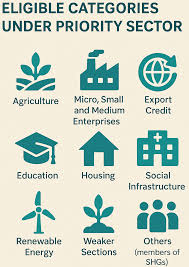
PSL Sectors:

  • Agriculture
  • Micro, Small and Medium Enterprises (MSMEs)
  • Export Credit
  • Education
  • Housing
  • Social Infrastructure
  • Renewable Energy
  • Weaker Sections (included under β€œOthers”)
PSL Targets:

Domestic Commercial Banks:

  • Must allocate 40% of Adjusted Net Bank Credit (ANBC) to priority sectors.

Regional Rural Banks (RRBs) & Urban Cooperative Banks:

  • Higher target of 75% of ANBC due to their role in rural and inclusive banking.
https://www.newindianexpress.com/business/2026/Jan/19/rbi-tightens-psl-norms-asks-banks-to-get-external-auditor-certification: RBI Strengthens Priority Sector Lending (PSL) Norms – Key Highlights, Targets & Exam Notes

RBI Strengthens Priority Sector Lending (PSL) Norms – Key Highlights, Targets & Exam Notes Read More Β»

Union Cabinet Approves β‚Ή5,000 Crore Equity Infusion into SIDBI to Boost MSME Credit Growth

Why in News?

Union Cabinet has approved a β‚Ή5,000 crore equity infusion into SIDBI to enhance credit availability for MSMEs and ensure the institution maintains a strong financial position amid expanding lending operations.

sidbi
  • The infusion will strengthen SIDBI’s lending capacity.
  • Helps maintain a healthy Capital to Risk-Weighted Assets Ratio (CRAR).

SIDBI (Small Industries Development Bank of India):

  • Established in 1990 under an Act of Parliament.
  • Acts as the principal financial institution for MSME promotion, financing, and development. Coordinates with other institutions involved in MSME financing.
  • Plays a vital role in industrial growth, employment generation, and exports.
Capital to Risk-Weighted Assets Ratio (CRAR):
  • Also known as Capital Adequacy Ratio (CAR).
  • Measures a bank’s capital in relation to its risk-weighted assets (RWA). Indicates the financial strength and stability of a bank.
  • A higher CRAR means better ability to absorb losses.
  • Governed by Basel Accords issued by the Basel Committee on Banking Supervision (BCBS).
https://pscchronicles.com/small-industries-development-bank-of-india-sidbi-topic-explained/: Union Cabinet Approves β‚Ή5,000 Crore Equity Infusion into SIDBI to Boost MSME Credit Growth

Union Cabinet Approves β‚Ή5,000 Crore Equity Infusion into SIDBI to Boost MSME Credit Growth Read More Β»

Payments Regulatory Board (PRB) Holds First Meeting in Mumbai – Key Exam Notes

Why in News?

The first meeting of the Payments Regulatory Board (PRB) was held in Mumbai under the chairmanship of the RBI Governor.

payments regulatory board

Payments Regulatory Board:

Payments Regulatory Board (PRB)Β isΒ a six-member statutory body within theΒ Reserve Bank of India (RBI)Β established to regulate and oversee the country’s payment and settlement systems. It became operational by replacing the earlier Board for Regulation and Supervision of Payment and Settlement Systems (BPSS).

  • Composition: Chaired by the RBI Governor (currently Sanjay Malhotra), it includes two other RBI representatives and three nominees from the Central Government.
  • Focuses on regulation and supervision of digital and non-cash payment systems.
  • Decisions are made by a majority vote; the Chairperson holds a casting vote in case of a tie. The board must meet at leastΒ twice a year
https://www.newsonair.gov.in/rbi-governor-sanjay-malhotra-chairs-first-meeting-of-payments-regulatory-board-meeting/: Payments Regulatory Board (PRB) Holds First Meeting in Mumbai – Key Exam Notes

Payments Regulatory Board (PRB) Holds First Meeting in Mumbai – Key Exam Notes Read More Β»