D K Shivakumar was sworn in as Chief Minister of Karnataka. The oath was administered by Governor Thaawarchand Gehlot.
Key Facts for Prelims
Chief Minister is appointed by the Governor under Article 164.
Governor normally appoints the leader of the majority party or coalition.
Oath of office and secrecy is administered by the Governor.
Forms of oath are given in the Third Schedule.
The Council of Ministers is collectively responsible to the Legislative Assembly.
Static Link: Article 164
Article 164 deals with appointment of Chief Minister and other ministers in states. Though the Constitution does not prescribe the exact selection process, parliamentary convention guides the Governor.
Quick Revision Table
Term
Exam Meaning
Article 164
Appointment of CM and ministers
Governor
Appoints CM and administers oath
Third Schedule
Forms of oaths and affirmations
Collective responsibility
Ministerial responsibility to Assembly
Trap / Confusing Points
Confusion
Correct Point
CM elected directly?
No, CM is appointed by Governor based on majority support.
Oath in Second Schedule?
No, oath forms are in Third Schedule.
Practice MCQs
1. CM is appointed under: A. Article 164 B. Article 356 C. Article 32 D. Article 280 Answer: A
2. CM oath is administered by: A. Governor B. Speaker C. CJI D. President only Answer: A
3. Oath forms are in: A. Third Schedule B. Tenth Schedule C. Fifth Schedule D. First Schedule Answer: A
4. Council of Ministers is responsible to: A. Legislative Assembly B. Supreme Court C. UPSC D. CAG Answer: A
5. CM selection is mainly based on: A. Majority support B. Age C. Wealth D. Lok Sabha seat Answer: A
To learn current affairs from exam point of view, Click here.
Karnataka Chief Minister, D K Shivakumar, Article 164, Governor, Third Schedule, Oath of Office, UPSC Current Affairs, APPSC, TGPSC
APCNF Food Planet Prize became important for exams after Andhra Pradesh Community Managed Natural Farming won the 2026 Food Planet Prize, a major global environmental award for food-system transformation.
Key Facts for Prelims
APCNF stands for Andhra Pradesh Community Managed Natural Farming.
It is implemented through Rythu Sadhikara Samstha (RySS).
The programme promotes chemical-free, community-led and climate-resilient farming.
The Food Planet Prize is given by the Curt Bergfors Foundation.
The 2026 award carries USD 1.5 million for the winner.
What is the Food Planet Prize?
The Food Planet Prize is a global environmental award focused on transforming food systems. It was established by Swedish entrepreneur and philanthropist Curt Bergfors through the Curt Bergfors Foundation.
What is APCNF?
APCNF is a women-led agroecology and natural farming programme launched in Andhra Pradesh in 2016. It encourages farmers to move away from synthetic fertilisers and pesticides towards nature-based farming.
Static Link: Natural Farming and Agroecology
Natural farming: Reduces dependence on external chemical inputs.
Agroecology: Applies ecological principles to farming systems.
Climate resilience: Improves soil health, water retention and local resilience.
Women collectives: Important for community mobilisation and last-mile adoption.
Quick Revision Table
Term
Exam Meaning
APCNF
Andhra Pradesh model of community-led natural farming
RySS
State institution implementing APCNF
Food Planet Prize
Environmental award for food-system transformation
Agroecology
Ecology-based approach to agriculture
Natural farming
Farming with reduced chemical dependence
Trap / Confusing Points
Confusion
Correct Point
APCNF vs organic farming
APCNF is a specific Andhra Pradesh community-managed natural farming programme.
Food Planet Prize vs World Food Prize
Food Planet Prize focuses on environmental transformation of food systems.
RySS vs ICAR
RySS is Andhra Pradesh’s implementation body for APCNF.
Practice MCQs
1. APCNF is mainly associated with which sector? A. Defence B. Agriculture C. Space D. Banking Answer: B
2. Food Planet Prize is linked to transformation of: A. Food systems B. Election systems C. Tax systems D. Defence systems Answer: A
3. RySS is associated with: A. Natural farming B. Missile defence C. Legal aid D. BRICS finance Answer: A
4. APCNF is best described as: A. Chemical-intensive farming B. Community-managed natural farming C. Irrigation treaty D. MSP scheme Answer: B
5. Agroecology means: A. Ecology-based farming B. Digital currency C. Air defence D. Court reform Answer: A
Exam Takeaway
APCNF should be studied as a model linking agriculture, environment, climate resilience, women-led collectives and sustainable development.
To learn current affairs from exam point of view, Click here.
The BRICS Technical Meeting of the Disaster Risk Reduction Working Group commenced in Puri, Odisha, on June 3, 2026, under India’s BRICS Presidency 2026.
The meeting is important for exams because it connects three areas:
International relations: BRICS and Global South cooperation
Disaster management: disaster risk reduction and climate resilience
Governance: Odisha’s disaster management model
Key Facts for Prelims
Point
Exam-Relevant Fact
Event
BRICS Disaster Risk Reduction Working Group technical meeting
Place
Puri, Odisha
Dates
June 3-5, 2026
Hosted under
India’s BRICS Presidency 2026
Main focus
Disaster risk reduction, climate resilience, early warning, resilient infrastructure
Why Odisha?
Known for cyclone preparedness, early warning systems, evacuation planning and disaster response
Static link
Sendai Framework for Disaster Risk Reduction 2015-2030
Why the Puri Meeting Matters?
The Puri meeting highlights disaster risk reduction as a major area of BRICS cooperation. This is important because climate change is increasing the frequency and intensity of extreme weather events such as cyclones, floods, heatwaves and droughts.
For India, the meeting is significant because:
India is holding the BRICS Chairship in 2026.
India’s BRICS theme is Building for Resilience, Innovation, Cooperation and Sustainability.
Disaster risk reduction fits directly under the Resilience pillar.
Odisha’s cyclone management model is being showcased internationally.
Odisha Model of Disaster Management
Odisha is frequently cited as an important case study in disaster preparedness because the state has improved its ability to manage cyclones and other natural disasters.
Important features:
Multi-hazard early warning systems
Cyclone shelters and evacuation planning
Community-level preparedness
Coordination between state agencies and local administration
Use of technology for alerts and response
Focus on reducing loss of life during cyclones
What is BRICS?
BRICS is an intergovernmental grouping of major emerging economies. It began as BRIC with Brazil, Russia, India and China. South Africa joined later, making it BRICS.
For exams, BRICS is important because it represents:
Voice of the Global South
Reform of global governance institutions
South-South cooperation
Alternative development finance through the New Development Bank
Cooperation in economy, technology, health, agriculture, climate, disaster management and security
BRICS Membership
The original BRICS members are Brazil, Russia, India, China and South Africa.
Recent expansion added Egypt, Ethiopia, Iran, United Arab Emirates and Indonesia.
Institutional Pillars of BRICS
New Development Bank
The New Development Bank was established by BRICS countries. The agreement for establishing the bank was signed during the 6th BRICS Summit in Fortaleza, Brazil, in 2014.
Headquarters: Shanghai, China
Focus: Infrastructure and sustainable development projects
Earlier known as: BRICS Development Bank
Membership: Open beyond BRICS countries
Exam importance: Alternative development finance institution linked to Global South
Contingent Reserve Arrangement
The BRICS Contingent Reserve Arrangement was also signed in Fortaleza, Brazil, in 2014.
Purpose:
Provides financial support during short-term balance of payments pressure
Helps member countries face global liquidity shocks
Acts as a financial safety mechanism
India and BRICS 2026
India is holding the BRICS Chairship in 2026 and will host the 18th BRICS Summit in 2026.
India’s BRICS 2026 theme is Building for Resilience, Innovation, Cooperation and Sustainability.
India’s focus areas include disaster risk reduction, agriculture and food security, health cooperation, energy security, supply chain resilience, innovation and emerging technologies, and reform of global governance institutions.
Interconnected Static Subject: Sendai Framework
The Sendai Framework for Disaster Risk Reduction 2015-2030 is a global framework adopted in Sendai, Japan, in 2015.
Its four priorities are:
Understanding disaster risk
Strengthening disaster risk governance
Investing in disaster risk reduction for resilience
Enhancing disaster preparedness for effective response and Build Back Better in recovery
Response happens after disaster; DRR focuses on reducing risk before disaster
NDB vs CRA
NDB funds development projects; CRA provides liquidity support
BRICS vs BIMSTEC
BRICS is a global/emerging economy grouping; BIMSTEC is a Bay of Bengal regional grouping
Sendai Framework vs Paris Agreement
Sendai deals with disaster risk reduction; Paris Agreement deals with climate change
Odisha Model
Known mainly for disaster preparedness, early warning and cyclone response
Saudi Arabia in BRICS
Membership/status should be checked with latest official/exam source due to differing reporting
Practice MCQs
1. The BRICS Disaster Risk Reduction Working Group technical meeting in June 2026 was held in which Indian city?
A. Bhubaneswar B. Puri C. Visakhapatnam D. New Delhi
Answer: B. Puri
Explanation: The BRICS Disaster Risk Reduction Working Group technical meeting commenced in Puri, Odisha, on June 3, 2026.
2. The New Development Bank was established by BRICS countries through an agreement signed at which summit?
A. Durban Summit, 2013 B. Fortaleza Summit, 2014 C. Ufa Summit, 2015 D. Goa Summit, 2016
Answer: B. Fortaleza Summit, 2014
Explanation: The agreement establishing the New Development Bank was signed during the 6th BRICS Summit at Fortaleza, Brazil, in 2014.
3. The Sendai Framework is primarily related to:
A. Climate finance B. Disaster risk reduction C. Nuclear disarmament D. Biodiversity conservation
Answer: B. Disaster risk reduction
Explanation: The Sendai Framework for Disaster Risk Reduction 2015-2030 provides global priorities for reducing disaster risks and losses.
4. Which of the following best describes the BRICS Contingent Reserve Arrangement?
A. A global environmental treaty B. A defence cooperation pact C. A financial safety mechanism for liquidity and balance of payments pressure D. A permanent BRICS Parliament
Answer: C. A financial safety mechanism for liquidity and balance of payments pressure
Explanation: CRA was created to help BRICS countries manage short-term liquidity and balance of payments pressures.
5. Which Indian state is being highlighted for its disaster management model in connection with the BRICS DRR meeting in Puri?
A. Gujarat B. Odisha C. Kerala D. Maharashtra
Answer: B. Odisha
Explanation: Odisha’s disaster management model, especially cyclone preparedness and early warning, is being showcased during the BRICS DRR meeting.
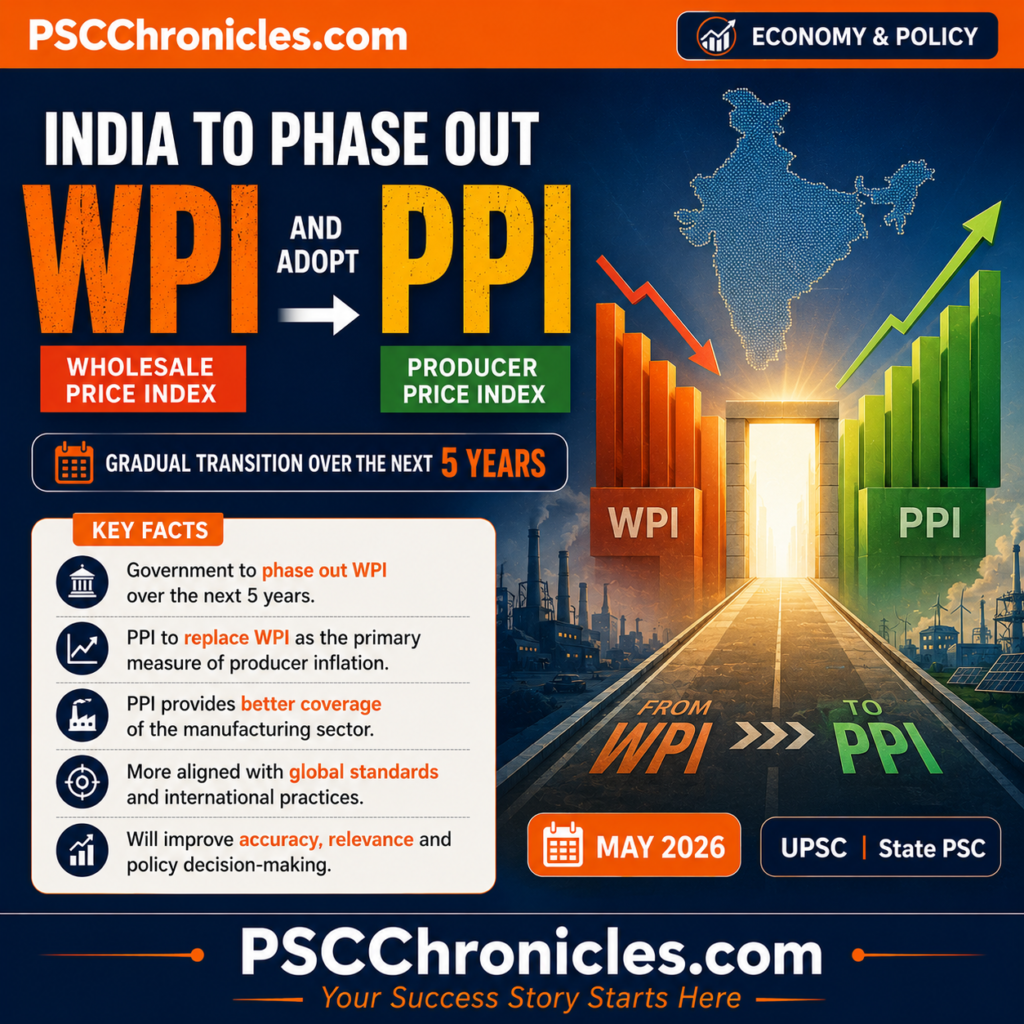
The government has decided to gradually phase out the Wholesale Price Index (WPI) over the next five years and replace it with the Producer Price Index (PPI).
The Producer Price Index 2026 aims to provide a more comprehensive assessment of inflation by covering goods, inputs and services.
What is Producer Price Index (PPI)?
The Producer Price Index (PPI) measures changes in prices received by producers for goods and services at different stages of production. Unlike WPI, it captures price movements across manufacturing inputs, outputs and services, making it a more comprehensive indicator of producer inflation
Components of PPI
The new PPI framework consists of three indices:
Output PPI – Measures prices received by producers for finished goods.
Input PPI – Measures prices paid by producers for raw materials and intermediate goods.
Services PPI – Tracks producer prices in service sectors such as banking, insurance, telecom, railways and aviation.
WPI vs PPI
Feature
WPI
PPI
Coverage
Goods only
Goods and Services
Stage Measured
Wholesale level
Multiple stages of production
Services Included
No
Yes
Input Prices
No
Yes
Inflation Measurement
Limited
More comprehensive
International Practice
Less common
Widely used globally
Significance
The Producer Price Index 2026 aligns India’s inflation measurement system with international standards. By covering services and production inputs, it provides a more realistic picture of cost pressures in the economy. The transition will also help policymakers, businesses and researchers better assess inflation trends and formulate economic policies
Quick Revision points
Topic
Fact
New Inflation Indicator
Producer Price Index (PPI)
Existing Index
Wholesale Price Index (WPI)
Transition Period
5 years
Revised WPI Base Year
2022-23
Previous WPI Base Year
2011-12
PPI Components
Output PPI, Input PPI, Services PPI
Services Covered Initially
Banking, Insurance, Telecom, Railways, Aviation
Key Advantage
Covers both goods and services
WPI Coverage
Goods only
Nodal Department
DPIIT
Practice MCQs
Q1. Which index is proposed to replace the Wholesale Price Index (WPI) in India?
a) CPI b) GDP Deflator c) Producer Price Index d) Industrial Production Index
Answer: (c) Producer Price Index — PPI will gradually replace WPI over five years.
Q2. The revised WPI series released by DPIIT uses which base year?
a) 2011-12 b) 2017-18 c) 2020-21 d) 2022-23
Answer: (d) 2022-23 — The revised WPI adopts 2022-23 as the new base year.
Q3. Which of the following is NOT a component of the new PPI framework?
a) Output PPI b) Input PPI c) Services PPI d) Consumer PPI
Answer: (d) Consumer PPI — The new framework includes Output, Input and Services PPI.
Q4. A major advantage of PPI over WPI is that it includes:
a) Retail prices only b) International trade data c) Goods and services prices d) Consumer expenditure data
Answer: (c) Goods and services prices — PPI provides broader coverage than WPI.
To know more about current affairs from exam point of view, Click here
To know more about Producer Price Index, Click here
DRDO and the Indian Air Force (IAF) successfully conducted flight tests of the RudraM-II air-to-surface missile.
The RudraM-II Missile Test 2026 demonstrated the missile’s capability to engage enemy targets from long stand-off distances. The indigenous weapon system is designed to strengthen India’s suppression of enemy air defence capabilities.
What is RudraM-II Missile?
RudraM-II is an indigenous air-to-surface anti-radiation missile developed by DRDO for the Indian Air Force.
Key features include:
Designed to detect and destroy enemy radar emissions.
Capable of striking targets at distances of 300–350 km.
Travels at hypersonic speeds up to Mach 5.5.
Can carry warheads weighing up to 200 kg.
Launched from fighter aircraft against high-value enemy assets.
What is an Anti-Radiation Missile?
An anti-radiation missile (ARM) is a precision-guided weapon designed to locate and destroy enemy radar systems, air defence networks, communication stations and electronic emitters.
Such missiles play a crucial role in Suppression of Enemy Air Defences (SEAD) missions by neutralizing radar-guided threats before air operations.
Quick Revision Points-RudraM-II Missile
Topic
Fact
Missile Name
RudraM-II
Developed By
DRDO
Service User
Indian Air Force (IAF)
Missile Type
Air-to-Surface Anti-Radiation Missile
Maximum Speed
Mach 5.5
Strike Range
300–350 km
Payload Capacity
Up to 200 kg
Primary Role
Destruction of enemy radar systems
Warfare Domain
Suppression of Enemy Air Defences (SEAD)
Practice MCQs on Rudram II missile:
Q1. RudraM-II is classified as which type of missile?
a) Surface-to-air missile b) Ballistic missile c) Air-to-surface anti-radiation missile d) Anti-tank missile
Answer: (c) Air-to-surface anti-radiation missile — It is designed to destroy radar-emitting targets.
Q2. What is the approximate strike range of RudraM-II?
a) 100 km b) 200 km c) 300–350 km d) 500 km
Answer: (c) 300–350 km — The missile can engage targets from stand-off distances.
Q3. RudraM-II has been developed by which organisation?
a) HAL b) ISRO c) BEL d) DRDO
Answer: (d) DRDO — The missile is an indigenous DRDO-developed weapon system.
Q4. The primary purpose of an anti-radiation missile is to destroy:
a) Tanks b) Aircraft carriers c) Radar and electronic emitters d) Submarines
Answer: (c) Radar and electronic emitters — Anti-radiation missiles target radar signals and air defence systems.
To study current affairs from exam point of view, Click here
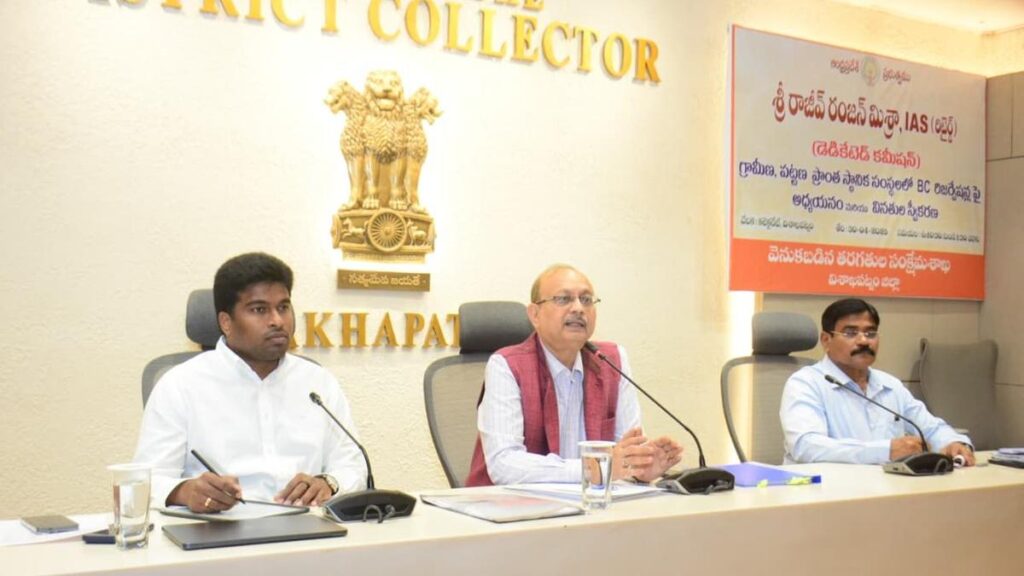
The AP BC Reservation Commission 2026, headed by Rajeev Ranjan Mishra, is expected to submit its report to the Andhra Pradesh government by July 15, 2026
The single-member commission was constituted to conduct an empirical study on the nature and extent of backwardness among Backward Classes (BCs) for determining political reservations in local body elections.
The exercise assumes significance as the state government seeks to provide 34% reservation for BCs in local self-government institutions.
Its key tasks include:
Assessing the socio-economic status of BC communities.
Determining the BC population ratio in constituencies.
Providing data to justify political reservations in local body elections.
Ensuring compliance with Supreme Court guidelines on reservation policies.
Interconnected concept: Triple Test
The “Triple Test” is a three-condition procedural framework mandated by the Supreme Court of India that a state government must satisfy before providing Other Backward Classes (OBC) reservations in local body elections (panchayats and municipalities)
The concept was first outlined by a Constitution Bench in the case of K. Krishna Murthy v. Union of India (2010) and later solidified as a mandatory rule in Vikas Kishanrao Gawali v. State of Maharashtra (2021)
Set up a dedicated Commission: States must appoint a special committee to conduct a rigorous empirical inquiry into the nature and implications of backwardness in local bodies.
Specify proportion of reservation: States must specify the exact quota required for each local body based on the Commission’s data to avoid aggregate over-reservation.
Adhere to the 50% cap: The total reservation for Scheduled Castes (SCs), Scheduled Tribes (STs), and OBCs combined must not exceed 50% of the total seats
The AP BC Reservation Commission 2026 has been constituted to fulfill the first requirement of the Triple Test.
Constitutional Basis
Political reservations in Panchayats and Municipalities are governed by:
Article 243D – Reservation in Panchayats.
Article 243T – Reservation in Municipalities.
Quick revision
Topic
Fact
Commission Name
Rajeev Ranjan Mishra Commission
Objective
Empirical study on Backward Classes (BCs)
Purpose
Determine BC reservations in local body elections
Proposed BC Reservation
34%
Legal Requirement
Compliance with Supreme Court’s Triple Test
Triple Test – Step 1
Dedicated Commission for empirical inquiry
Triple Test – Step 2
Reservation proportion based on Commission recommendations
Triple Test – Step 3
Total SC/ST/OBC reservations not to exceed 50%
Constitutional Provision (Panchayats)
Article 243D
Constitutional Provision (Municipalities)
Article 243T
Key Data Collected
BC population ratio and socio-economic status
Importance
Provides legal basis for BC political reservations
Q1. The Rajeev Ranjan Mishra Commission (AP BC Reservation commission 2026) in Andhra Pradesh was constituted primarily for which purpose?
a) Delimitation of constituencies b) BC reservation empirical study c) Caste census d) Municipal finance reforms
Answer: (b) BC reservation empirical study — The commission was formed to assess backwardness for local body reservations.
Q2. Which constitutional provision deals with reservation in Panchayats?
a) Article 243G b) Article 243W c) Article 243D d) Article 280
Answer: (c) Article 243D — It provides for reservations in Panchayats.
Q3. The first condition of the Triple Test requires:
a) State-wide caste census b) Parliamentary approval c) Dedicated commission and empirical inquiry d) Constitutional amendment
Answer: (c) Dedicated commission and empirical inquiry — This is the first requirement laid down by the Supreme Court.
Q4. The AP government aims to provide what percentage of reservation for BCs in local bodies?
a) 27% b) 30% c) 34% d) 50%
Answer: (c) 34% — The proposed reservation is 34%.
To study current affairs from exam point of view, Click here
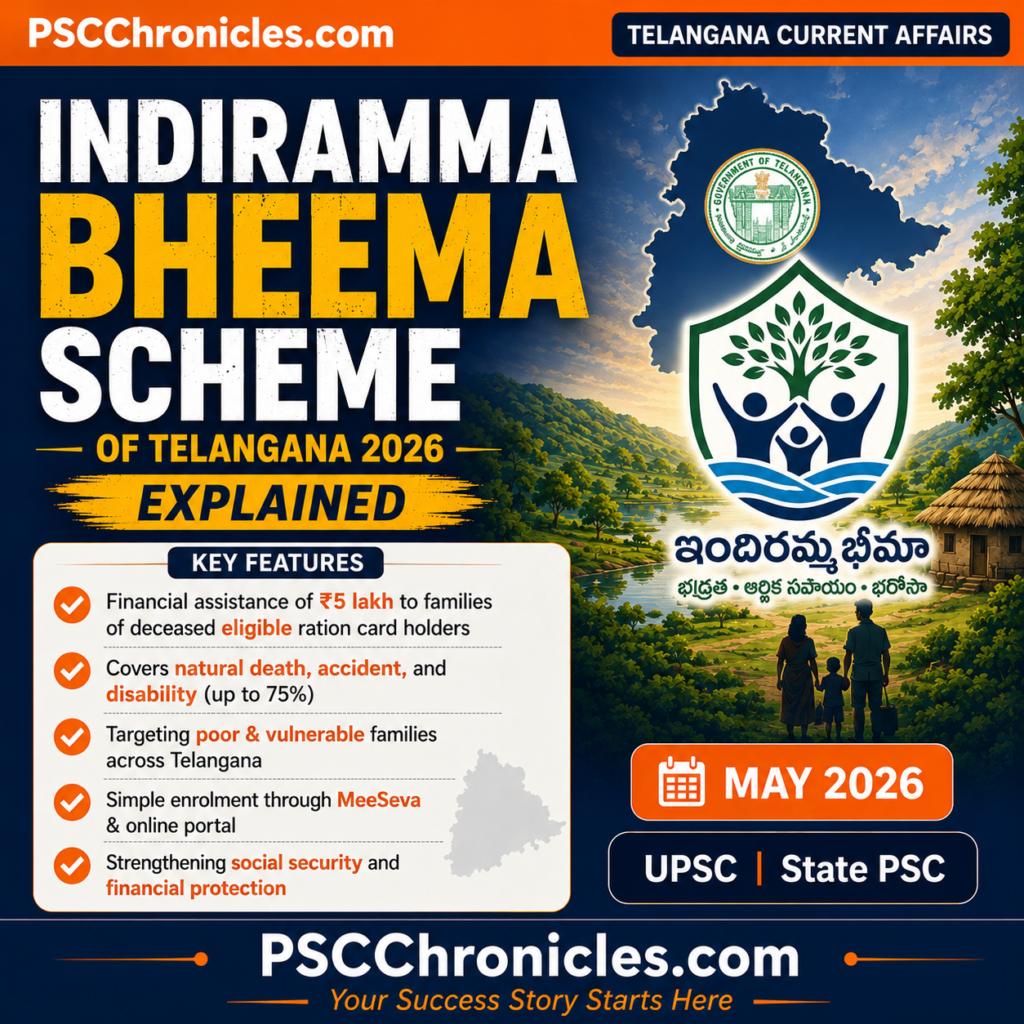
The Telangana government launched the Indiramma Kutumba Jeevitha Bheema Pathakam (Indiramma Bheema Scheme) on June 2, 2026, coinciding with the state’s State Formation Day celebrations.
The Indiramma Bheema Scheme 2026 aims to provide financial security to families in the event of the death of their primary earning member.
The scheme is designed as a major social security initiative for poor and middle-class households across Telangana.
Key Features of the Scheme
Provides ₹5 lakh financial assistance to the nominee upon the death of the family’s primary breadwinner.
Covers approximately 1.15 crore poor and middle-class families across Telangana.
Functions as a social security programme aimed at reducing financial vulnerability.
An estimated budget of ₹4,000 crore allotted in state budget
Quick Revision Box
Particular
Details
Scheme Name
Indiramma Kutumba Jeevitha Bheema Pathakam
Launch Date
June 2, 2026
State
Telangana
Occasion
State Formation Day
Budget Allocation
₹4,000 crore (approx.)
Insurance Assistance
₹5 lakh
Beneficiaries
1.15 crore families
Objective
Financial protection for families after death of breadwinner
Practice MCQs
Q1. The Indiramma Kutumba Jeevitha Bheema Pathakam was launched by which state government?
a) Andhra Pradesh b) Telangana c) Karnataka d) Tamil Nadu
Answer: (b) Telangana — The scheme was launched by the Telangana government.
Q2. How much financial assistance is provided under the Indiramma Bheema Scheme 2026 upon the death of the primary breadwinner?
a) ₹2 lakh b) ₹3 lakh c) ₹5 lakh d) ₹10 lakh
Answer: (c) ₹5 lakh — The nominee receives ₹5 lakh as financial assistance.
Q3. Approximately how many families are covered under the scheme?
a) 50 lakh b) 75 lakh c) 90 lakh d) 1.15 crore
Answer: (d) 1.15 crore — The scheme covers around 1.15 crore families.
Q4. The Indiramma Bheema Scheme 2026was launched on which occasion?
a) Republic Day b) Independence Day c) Telangana State Formation Day d) Constitution Day
Answer: (c) Telangana State Formation Day — It was launched on June 2, 2026.
To study current affairs from exam point of view Click here
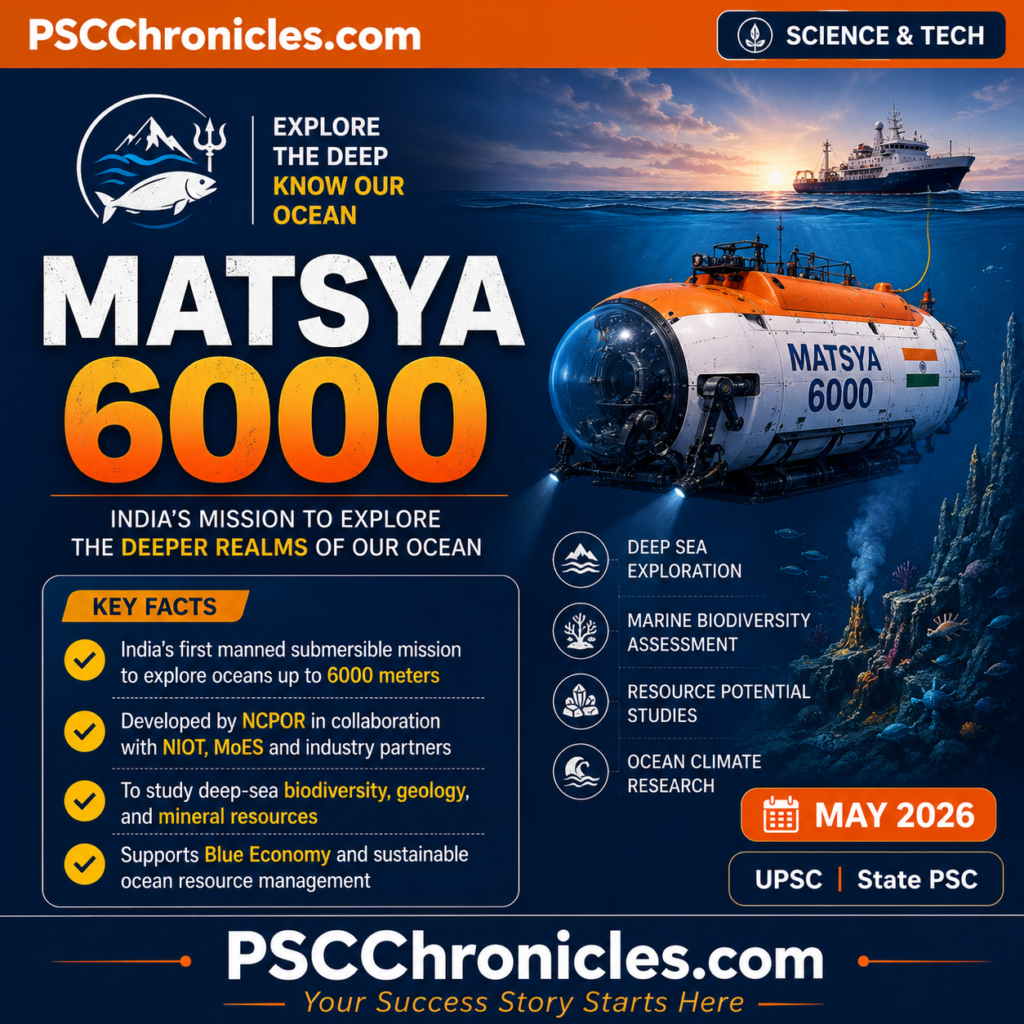
India’s first indigenously developed manned deep-sea submersible, Matsya 6000, is expected to begin initial ocean operations this year with shallow-water demonstrations up to 500 metres, according to the National Institute of Ocean Technology (NIOT).
The development is part of the Samudrayaan Project under the Deep Ocean Mission of the Ministry of Earth Sciences.
The submersible will support marine biodiversity studies and exploration of deep-sea mineral resources.
What is Matsya 6000?
Matsya 6000 is India’s first human-carrying deep-sea submersible designed to transport scientists into the deep ocean.
Key features include:
Diving capability up to 6,000 metres
Capacity to carry a crew for scientific missions
12–16 hours of normal underwater operations
96-hour emergency life-support system
Indigenous technology developed by NIOT, Chennai
The submersible is expected to facilitate exploration of polymetallic nodules and other mineral resources located in the deep ocean.
Background: Deep Ocean Mission
The Deep Ocean Mission was launched in 2021 by the Ministry of Earth Sciences to develop technologies for sustainable exploration and utilization of ocean resources.
Major Components of Deep Ocean Mission
Development of technologies for deep-sea mining and manned submersibles.
Ocean climate change advisory services.
Exploration and conservation of deep-sea biodiversity.
Deep Ocean Survey and Exploration.
Energy and freshwater generation from oceans.
Advanced Marine Station for Ocean Biology.
Samudrayaan Project
The Samudrayaan Project is a flagship initiative under the Deep Ocean Mission focused on manned deep-sea exploration. Matsya 6000 serves as its primary technological platform for carrying scientists to extreme ocean depths.
Significance
The launch of Matsya 6000 Ocean Operations 2026 will strengthen India’s capabilities in deep-sea exploration and resource assessment. It supports strategic access to critical minerals found in the seabed and advances research on marine ecosystems. The project also contributes to India’s long-term blue economy objectives and technological self-reliance in ocean sciences.
Quick Revision Box
Particular
Details
Project
Matsya 6000 Ocean Operations 2026
Developed by
National Institute of Ocean Technology (NIOT), Chennai
Ministry
Ministry of Earth Sciences (MoES)
Associated Programme
Samudrayaan Project
Mission
Deep Ocean Mission
Initial Demonstration Depth
500 metres
Maximum Diving Capacity
6,000 metres
Operational Endurance
12–16 hours
Emergency Life Support
96 hours
Key Objectives
Deep-sea mining, biodiversity mapping, blue economy
Practice MCQs
Q1. Matsya 6000 has been developed by which organisation?
a) ISRO b) DRDO c) NIOT d) CSIR
Answer: (c) NIOT — The National Institute of Ocean Technology developed Matsya 6000.
Q2. Matsya 6000 is associated with which project?
a) Mausam Project b) Samudrayaan Project c) Sagarmala Project d) Project Varuna
Answer: (b) Samudrayaan Project — It is India’s manned deep-sea exploration initiative.
Q3. What is the maximum diving capability of Matsya 6000?
a) 500 m b) 2,000 m c) 4,000 m d) 6,000 m
Answer: (d) 6,000 m — The submersible is designed for deep-ocean exploration up to 6,000 metres.
Q4. The Deep Ocean Mission was launched in which year?
a) 2019 b) 2020 c) 2021 d) 2022
Answer: (c) 2021 — The mission was launched by the Ministry of Earth Sciences.
To study more current affairs from exam point of view, Click here
India has emerged as the global leader in issuing Internationally Recognized Certificates of Compliance (IRCCs) under the Nagoya Protocol on Access and Benefit Sharing (ABS).
Core Exam-Oriented Analysis
The Nagoya Protocol is a supplementary agreement to the Convention on Biological Diversity (CBD) adopted during the 1992 Rio Earth Summit.
Its primary objective is to ensure the fair and equitable sharing of benefits arising from the utilization of genetic resources.
Key Features of the Nagoya Protocol
Adopted in 2010 at Nagoya, Japan.
Came into force in 2014.
Functions under the Convention on Biological Diversity (CBD).
Focuses on:
Access to genetic resources
Benefit-sharing mechanisms
Protection of indigenous and local community knowledge
What are IRCCs?
Internationally Recognized Certificates of Compliance (IRCCs) are official digital permits issued under the Nagoya Protocol.
These certificates confirm that:
Genetic resources were accessed legally.
Prior Informed Consent (PIC) was obtained.
Mutually Agreed Terms (MAT) were established.
IRCCs help prevent biopiracy and ensure that local communities receive benefits from the commercial use of biological resources and traditional knowledge.
India’s Institutional Framework under Biological Diversity Act, 2002
India implemented the CBD and Nagoya Protocol through the Biological Diversity Act, 2002. The institutional mechanism setup under this act is
1. National Biodiversity Authority (NBA)
Statutory authority headquartered in Chennai.
Grants approvals for access to biological resources by:
Foreign individuals
Foreign companies
NRIs
2. State Biodiversity Boards (SBBs)
Operate at the state level.
Regulate commercial utilization of biological resources within states.
3. Biodiversity Management Committees (BMCs)
Established by local bodies such as panchayats and municipalities.
Prepare People’s Biodiversity Registers (PBRs).
Protect traditional knowledge and ensure benefit-sharing for local communities.
Prelims Booster:
Convention on Biological Diversity (CBD)
The Convention on Biological Diversity was adopted during the Rio Earth Summit, 1992.
It has three major objectives:
Conservation of biodiversity
Sustainable use of biological resources
Fair and equitable sharing of benefits arising from genetic resources
India is a party to the CBD.
Important Concepts for Exams
Biopiracy
Unauthorized commercial exploitation of biological resources or traditional knowledge without compensation to indigenous communities.
People’s Biodiversity Registers (PBRs)
These are detailed records documenting:
Local flora and fauna
Traditional medicinal knowledge
Indigenous conservation practices
PBRs are maintained by Biodiversity Management Committees (BMCs).
The Exam Trap
The Trap: The examiner may state that the Nagoya Protocol was adopted during the Rio Earth Summit in 1992.
The Fact: The Convention on Biological Diversity (CBD) was adopted in 1992, while the Nagoya Protocol was adopted later in 2010 in Japan.
The Trap: Questions may confuse the roles of NBA and State Biodiversity Boards.
The Fact: The NBA handles access requests from foreign entities, while SBBs regulate commercial utilization within states.
Question 1: Current Affairs Focus
Which of the following statements regarding the Nagoya Protocol is correct?
A) It was adopted during the Stockholm Conference of 1972
B) It focuses on fair and equitable sharing of benefits arising from genetic resources
C) It deals exclusively with climate finance
D) It is administered by the World Trade Organization
Correct Answer: B
Detailed Explanation: The Nagoya Protocol is a supplementary agreement under the Convention on Biological Diversity (CBD). It specifically addresses the fair and equitable sharing of benefits arising from the utilization of genetic resources. It was adopted in 2010 in Nagoya, Japan. Therefore, Option B is correct.
Option A is incorrect because the Stockholm Conference dealt mainly with environmental protection.
Option C is incorrect because climate finance is linked more with UNFCCC mechanisms.
Option D is incorrect because the protocol functions under CBD, not WTO.
To study current affairs from exam point of view, Click here
US President Donald Trump stated that countries such as Saudi Arabia, Qatar, Egypt, Turkiye, and Pakistan should normalize relations with Israel under an expanded Abraham Accords 2026 framework.
The proposal was linked to broader negotiations aimed at ending the Iran-Israel conflict in West Asia
The statement has renewed global attention on the Abraham Accords, which were originally brokered by the United States in 2020 to establish diplomatic and economic relations between Israel and Arab nations. The accords reshaped Middle East diplomacy and altered long-standing regional alignments.
Key Facts About Abraham Accords 2026
Aspect
Details
Agreement Name
Abraham Accords
Brokered By
United States
Year of Original Signing
2020
Initial Signatories
Israel, UAE, Bahrain
Later Signatories
Sudan, Morocco
Current Context
Linked by Trump to Iran peace negotiations
Core Objective
Israel normalization with Arab nations
Strategic Impact
Shift in West Asian geopolitical alliances
Formation of I2U2 Group
The Abraham Accords also contributed to the emergence of the I2U2 Group, comprising India, Israel, UAE, and the USA.
Practice MCQs
Q1. The Abraham Accords were originally signed in: a) 2018 b) 2019 c) 2020 d) 2022
Answer: (c) — The agreements were brokered by the United States in 2020.
Q2. Which among the following was NOT an initial signatory to the Abraham Accords? a) Israel b) UAE c) Bahrain d) Morocco
Answer: (d) — Morocco joined later after the initial agreements.
Q3. The I2U2 Group includes which of the following countries? a) India, Israel, UAE, USA b) India, Iran, UAE, USA c) India, Israel, UK, USA d) India, Israel, UAE, UK
Answer: (a) — I2U2 consists of India, Israel, UAE, and the USA.
Q4. The Abraham Accords mainly relate to: a) Nuclear disarmament b) Climate financing c) Israel normalization with Arab nations d) Global trade reforms
Answer: (c) — The accords aim at normalizing relations between Israel and Arab countries.
To study more current affairs from exam point of view, Click here