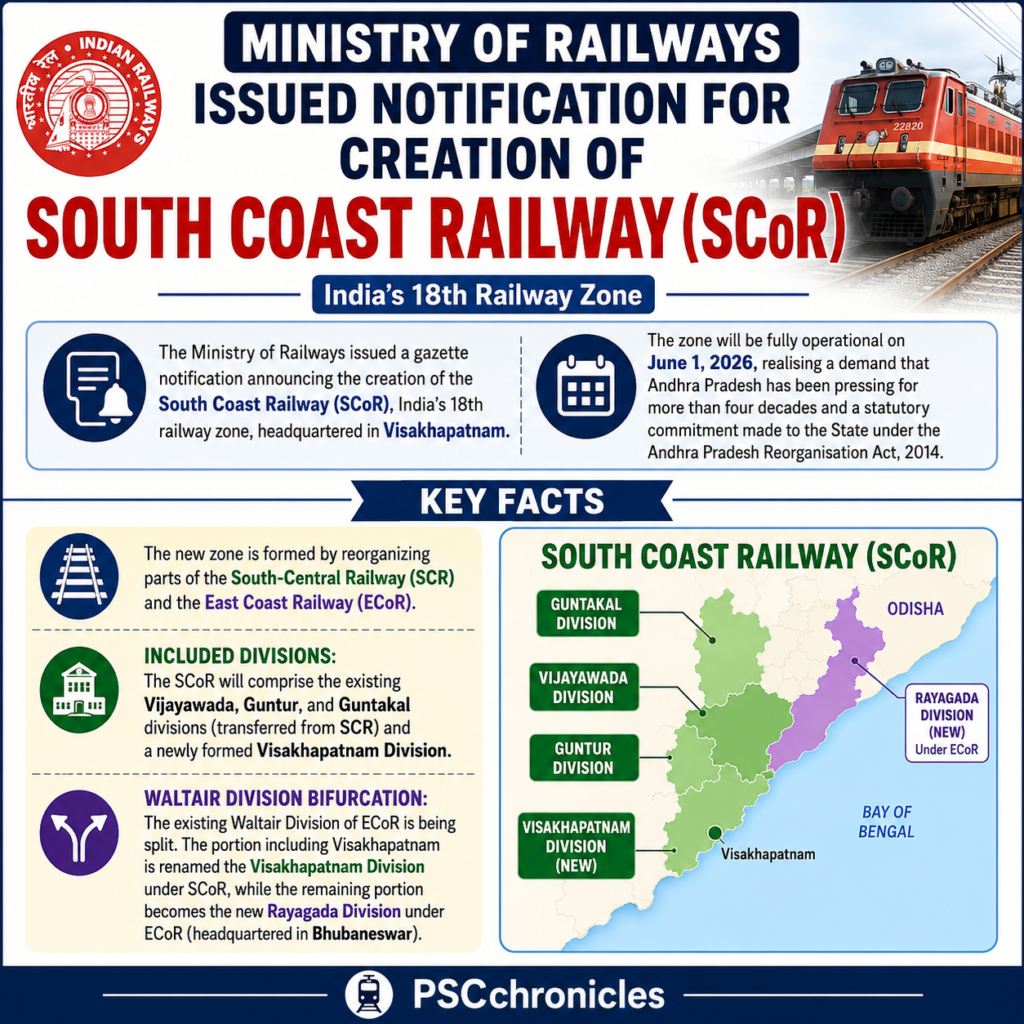
The Ministry of Railways has issued a gazette notification for the creation of the South Coast Railway (SCoR), making it India’s 18th railway zone.
The newly formed South Coast Railway Zone will have its headquarters at Visakhapatnam, Andhra Pradesh
The zone is scheduled to become fully operational from June 1, 2026. The move fulfils a long-pending demand of Andhra Pradesh and also implements a commitment made under the Andhra Pradesh Reorganisation Act, 2014.
Key Highlights of South Coast Railway Zone
Formation of the New Zone
The South Coast Railway Zone has been created by reorganising parts of the existing railway zones:
South Central Railway (SCR)
East Coast Railway (ECoR)
This administrative restructuring aims to improve railway operations, connectivity, and regional development in Andhra Pradesh.
Divisions Included in SCoR
The new railway zone will consist of:
Vijayawada Division (transferred from SCR)
Guntur Division (transferred from SCR)
Guntakal Division (transferred from SCR)
Newly formed Visakhapatnam Division
These divisions are strategically important for passenger and freight transportation in South India.
Practice Questions
Which city has been selected as the headquarters of the South Coast Railway Zone?
a) Vijayawada
b) Visakhapatnam
c) Guntur
d) Tirupati
The South Coast Railway Zone became India’s ______ railway zone.
a) 16th
b) 17th
c) 18th
d) 19th
Which railway division was bifurcated for the creation of the South Coast Railway Zone?
a) Vijayawada Division
b) Waltair Division
c) Guntakal Division
d) Secunderabad Division
Under which Act was the commitment for a separate railway zone to Andhra Pradesh made?
a) Railway Act, 1989
b) Andhra Pradesh Reorganisation Act, 2014
c) States Reorganisation Act, 1956
d) Indian Railways Act, 2005
To study current affairs from exam point of view, Click here
Indian pop star Diljit Dosanjh recently highlighted the 1914 Komagata Maru incident, bringing renewed attention to this significant chapter of Indian colonial and freedom movement history. The incident is important for UPSC and State PSC Prelims under the topics of Modern Indian History and Indian Freedom Struggle.
What Was the Komagata Maru Incident?
The Komagata Maru Incident of 1914 refers to the episode in which Canadian authorities denied entry to 376 Indian migrants — mostly Sikhs from Punjab — who had travelled to Vancouver, Canada aboard a Japanese steamship named Komagata Maru. The refusal was rooted in Canada’s racially discriminatory immigration laws of the time.
Key Facts at a Glance
Detail
Information
Ship Name
Komagata Maru (Japanese steamship)
Year
1914
Chartered by
Baba Gurdit Singh
Total Passengers
376 (mostly Sikhs from Punjab)
Route
Hong Kong → Vancouver, Canada
Arrival at Vancouver
May 23, 1914
Duration of Standoff
~2 months
Return to India
September 27, 1914 (Budge Budge, near Kolkata)
Deaths at Budge Budge
20 passengers killed in clash with British police
Canadian Apology
2016 (PM Justin Trudeau, in Parliament)
Background: Racist Immigration Laws in Canada
In the early 20th century, Canada enacted several discriminatory immigration laws specifically targeting South Asians. The most important among these was the Continuous Journey Regulation of 1908, which required immigrants to travel directly from their country of origin to Canada — a rule deliberately designed to exclude Indians, since no direct steamship service existed between India and Canada at the time. This effectively barred most Indian migrants from settling in Canada, despite their status as British subjects.
The Voyage and Two-Month Standoff
Baba Gurdit Singh, a Sikh businessman, chartered the Japanese vessel Komagata Maru to directly challenge these discriminatory immigration laws. The ship departed Hong Kong carrying 376 passengers — predominantly Sikhs from Punjab along with some Muslims and Hindus. On arriving at Vancouver on May 23, 1914, Canadian immigration authorities refused to allow the passengers to disembark. A tense two-month standoff followed, during which passengers faced severe shortages of food, water, and basic necessities. Ultimately, the Canadian government forced the ship to return to India without any passengers being permitted to land.
The Budge Budge Tragedy
On September 27, 1914, the Komagata Maru arrived at Budge Budge (near Kolkata, then Calcutta). British colonial authorities, suspicious that the passengers were linked to anti-colonial political agitation and the Ghadar Movement, attempted to escort them directly to Punjab under police custody. This triggered a violent confrontation between the returning passengers and British police, resulting in the deaths of 20 passengers. Several others were arrested and sentenced under sedition laws.
Connection to the Ghadar Movement
The Komagata Maru incident was closely intertwined with the Ghadar Movement — an Indian revolutionary organisation founded in 1913 in San Francisco by Lala Har Dayal. The Ghadar Party sought to overthrow British rule in India by organising Indian migrants abroad. British authorities feared that the returning Komagata Maru passengers would fuel revolutionary activities in India, which in part explains the aggressive British response at Budge Budge.
Important Personalities
Name
Role / Significance
Baba Gurdit Singh
Chartered the Komagata Maru; led the voyage as a challenge to racist Canadian immigration laws
Lala Har Dayal
Founder of the Ghadar Movement (1913), which was linked to the political context of the incident
Justin Trudeau
Canadian PM who formally apologised in Parliament in 2016 for Canada’s role in the incident
Canada’s Formal Apology (2016)
In 2016, Canadian Prime Minister Justin Trudeau offered a formal apology in the Canadian Parliament for the Government of Canada’s role in the Komagata Maru incident. This was acknowledged as an act of racial discrimination against Indian — particularly Sikh — migrants. Earlier, Canadian PM Stephen Harper had expressed regret in 2008, but the 2016 apology by Trudeau was the first formal apology in Parliament.
Key Points to Remember for UPSC & State PSC Prelims
Komagata Maru was a Japanese steamship (not Indian-owned)
Chartered by Baba Gurdit Singh, a Sikh businessman
Carried 376 passengers — predominantly Sikhs from Punjab
Arrived at Vancouver on May 23, 1914
The discriminatory law involved: Continuous Journey Regulation, 1908
Standoff lasted approximately 2 months with severe food and water shortage
On return, 20 passengers were killed at Budge Budge (near Kolkata) on September 27, 1914
Closely linked to the Ghadar Movement (founded 1913, San Francisco, by Lala Har Dayal)
Canada formally apologised in 2016 (PM Justin Trudeau, in Parliament)
Previously appeared in UPSC Prelims under Modern Indian History / Freedom Struggle
Why This Topic Matters for Prelims
The Komagata Maru incident has featured in UPSC Civil Services Preliminary examinations in the context of the Indian freedom movement and the history of overseas Indian communities. Questions typically focus on the year of the incident, the name of the ship’s charterer (Baba Gurdit Singh), the Continuous Journey Regulation, the deaths at Budge Budge, and the connection to the Ghadar Movement. It also connects to broader themes of racial discrimination, Indian diaspora, and colonial history.
The Buddha Relics Leh event has gained national and international attention as the sacred Piprahwa relics of Lord Buddha have arrived in Leh (Ladakh). This marks a historic spiritual occasion, as these relics are being exhibited outside their permanent home in India for the first time
What are the Sacred Piprahwa Relics of Buddha?
The relics were originally discovered at Piprahwa (Uttar Pradesh).
They are believed to be the mortal remains of Lord Buddha. These relics are considered extremely sacred in Buddhism.
Their display in Leh strengthens the spiritual connection between Buddhism and Ladakh.
About Gautama Buddha
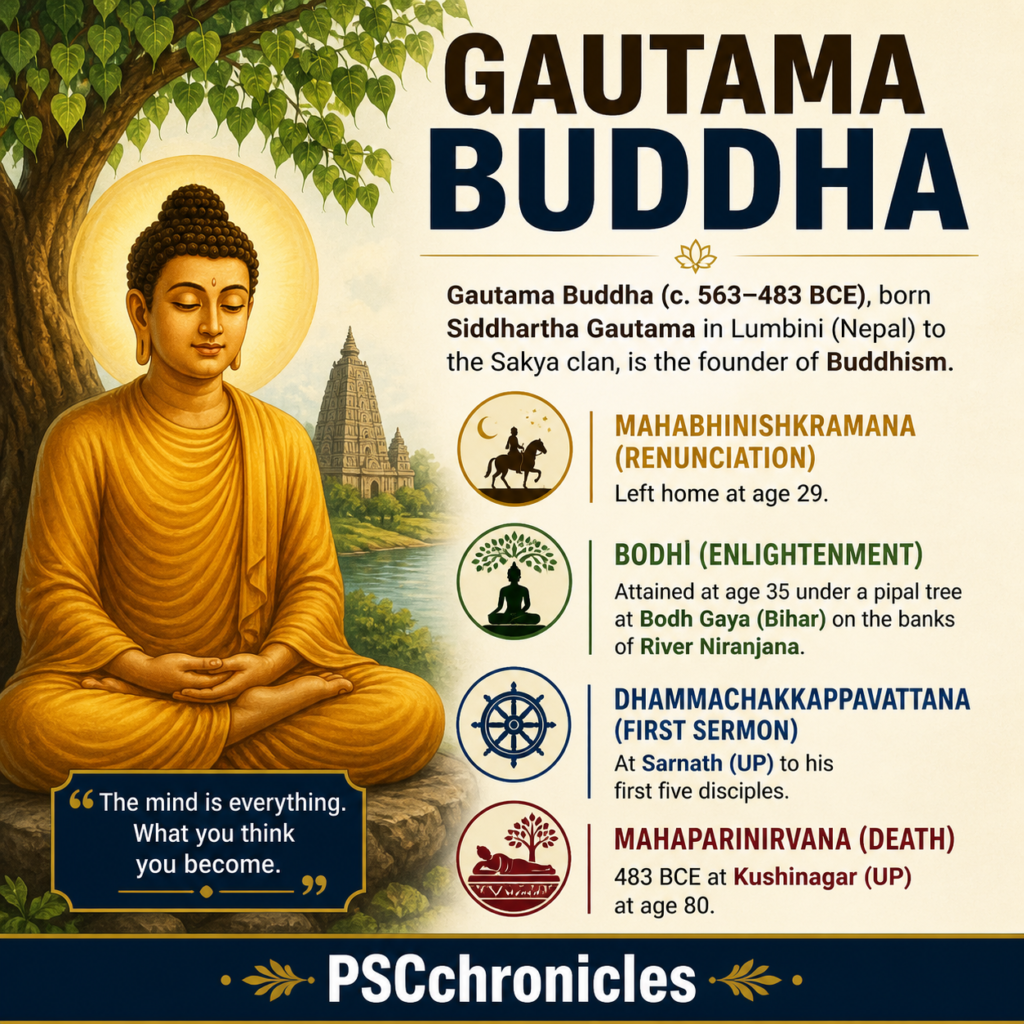
Gautama Buddha (c. 563–483 BCE) was born as Siddhartha Gautama in Lumbini (present-day Nepal) to the Sakya clan.
He is the founder of Buddhism, one of the world’s major religions.
Key Events in Buddha’s Life
Mahabhinishkramana (Renunciation): Left home at age 29.
Bodhi (Enlightenment): Attained at 35 under the Bodhi tree at Bodh Gaya, near River Niranjana.
First Sermon (Dhammachakkappavattana): Delivered at Sarnath.
Mahaparinirvana (Death): At Kushinagar at age 80 (483 BCE).
Major sects in Buddhism:
Hinayana (Theravada): Focuses on original teachings of Buddha and individual salvation.
Mahayana: Emphasizes idol worship, Bodhisattvas, and universal salvation.
Key Differences
Theravada is more conservative and text-based.
Mahayana is more inclusive and devotional.
Four Buddhist Councils and Their Importance
First Council: Held at Rajgriha under Ajatashatru; compilation of Sutta Pitaka and Vinaya Pitaka.
Second Council: Held at Vaishali under Kalasoka; led to split into Theravada and Mahasanghika.
Third Council: Held at Pataliputra under Ashoka; compilation of Abhidhamma Pitaka.
Fourth Council: Held in Kashmir under Kanishka; final division into Mahayana and Hinayana.
Important Symbols in Buddhism
Birth: Lotus and Bull
Renunciation: Horse
Enlightenment: Bodhi Tree
First Sermon: Dharmachakra (Wheel)
Mahaparinirvana: Stupa
Practice Questions
The Piprahwa relics are associated with which religion? a) Jainism b) Buddhism c) Hinduism d) Sikhism
Buddha attained enlightenment at which place? a) Sarnath b) Lumbini c) Bodh Gaya d) Kushinagar
The First Buddhist Council was held at: a) Vaishali b) Pataliputra c) Rajgriha d) Kashmir
Which symbol represents Buddha’s first sermon? a) Lotus b) Stupa c) Wheel d) Horse
To study more current affairs from exam point of view: Click here
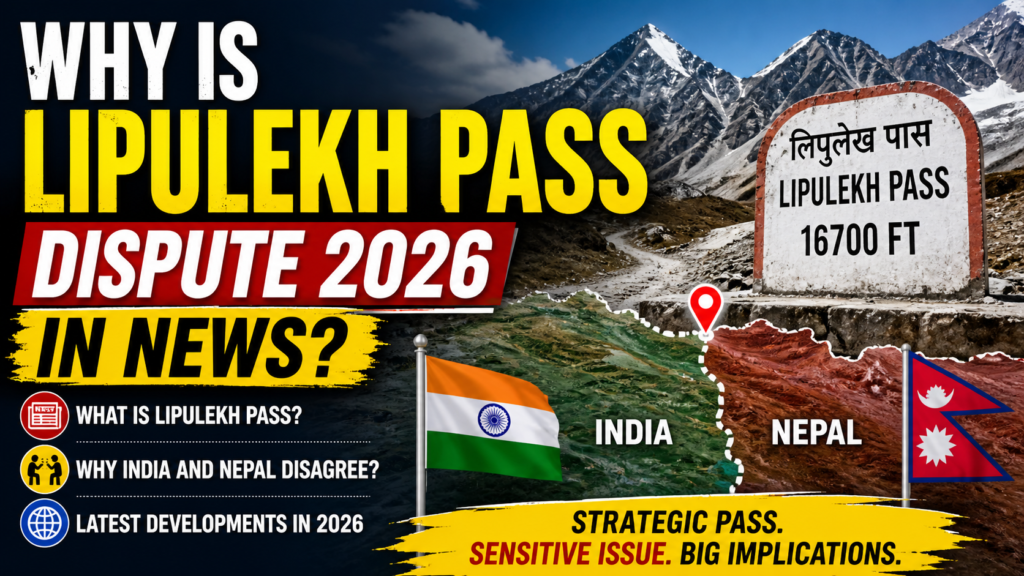
The Lipulekh Pass Dispute has come into focus after Nepal objected to India and China planning to conduct the Kailash Mansarovar Yatra through the Lipulekh Pass. The Nepal government, led by Balen Shah, raised concerns over sovereignty and territorial claims.
What is the Lipulekh Pass Dispute?
The Lipulekh Pass Dispute revolves around differing interpretations of the India-Nepal border near the tri-junction area.
Key Points of the Dispute
Nepal claims that the Lipulekh Pass falls within its territory based on historical maps and river origins.
India maintains that the area has traditionally been under its administrative control.
The dispute intensified after India inaugurated a road to Lipulekh in 2020 to facilitate the Kailash Mansarovar Yatra.
The issue also involves China, as the pass connects to Tibet (China-controlled region).
About Lipulekh Pass
Geographical Features
Located in Pithoragarh district, Uttarakhand.
Situated at an altitude of approximately 5,334 meters (17,500 feet).
Lies at the tri-junction of India, Nepal, and Tibet (China).
Part of the Kumaon Himalayas.
River Association
Associated with the Kali River (Mahakali/Sharda).
The river forms a major part of the India-Nepal boundary.
The origin of this river is central to the boundary dispute.
Strategic and Economic Importance
Serves as a key route for the Kailash Mansarovar Yatra.
Connects India to Taklakot (Purang) in Tibet.
Holds strategic military importance due to proximity to China.
Facilitates trade and pilgrimage routes.
Historical Background: Treaty of Sugauli
The roots of the Lipulekh Pass Dispute lie in the Treaty of Sugauli.
Signed on 2 December 1815.
Agreement between the British East India Company and the Kingdom of Nepal.
Ended the Anglo-Nepalese War (1814–1816).
Defined the Kali River as the western boundary of Nepal.
Core Issue
The dispute arises due to different interpretations of the Kali River’s origin:
Nepal claims the river originates from Limpiyadhura, placing Lipulekh within Nepal.
India considers the origin near Kalapani, placing Lipulekh within Indian territory.
Practice Questions
Which river forms the basis of the India-Nepal boundary dispute in the Lipulekh region? a) Ganga b) Brahmaputra c) Kali River d) Indus
The Treaty of Sugauli (1815) was signed between Nepal and which entity? a) British Crown b) East India Company c) Mughal Empire d) China
Lipulekh Pass is located in which Indian state? a) Himachal Pradesh b) Uttarakhand c) Sikkim d) Arunachal Pradesh
The Lipulekh Pass connects India to which Tibetan town? a) Lhasa b) Shigatse c) Taklakot d) Gyantse
To study current affairs from exam point of view, Click here
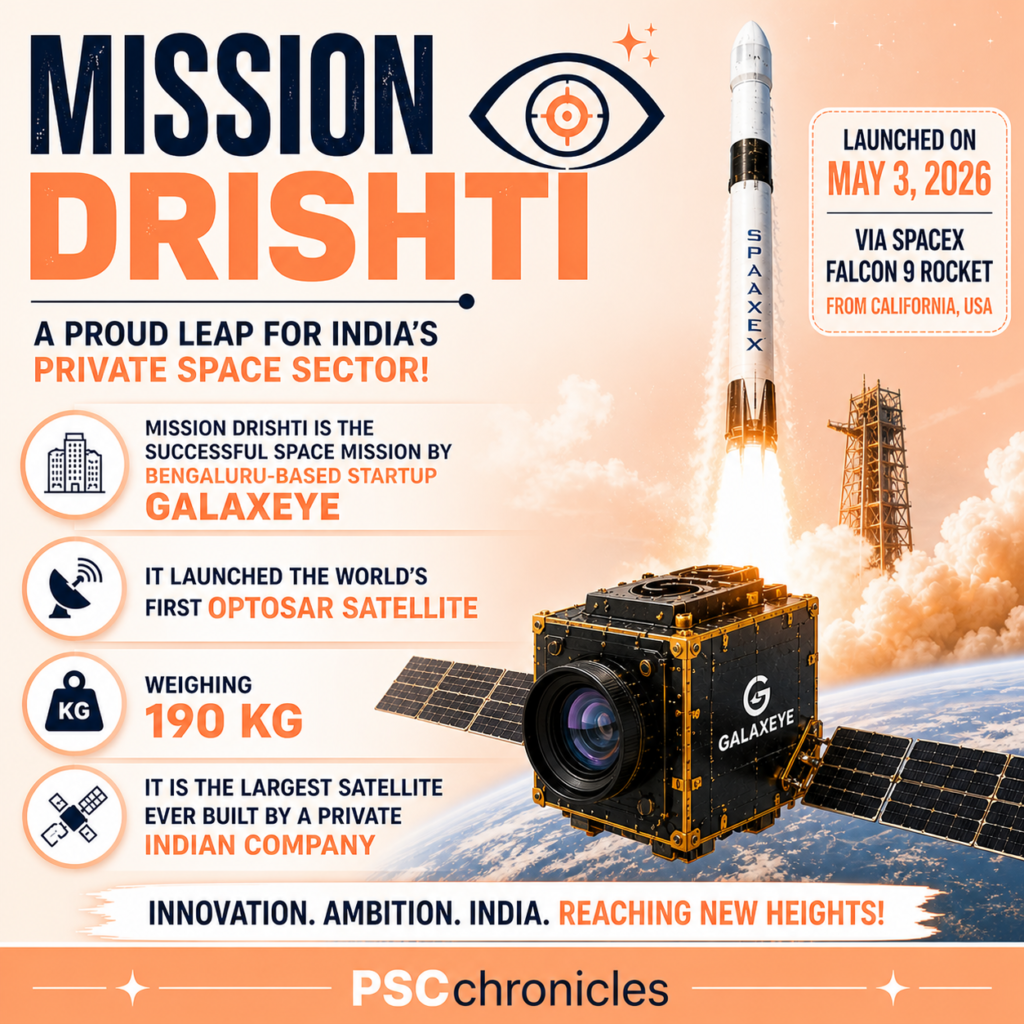
The Mission Drishti Satellite has gained attention after its successful launch by Bengaluru-based startup GalaxEye. It was launched aboard a Falcon 9 rocket by SpaceX from Vandenberg, California. This mission marks a significant milestone in India’s private space sector, showcasing cutting-edge Earth observation technology.
The satellite is considered India’s largest privately developed Earth observation satellite
What is Mission Drishti Satellite?
Mission Drishti Satellite is an advanced Earth observation satellite that uses OptoSAR technology, a unique combination of Synthetic Aperture Radar (SAR) and Electro-Optical (EO) sensors. This hybrid system enables high-quality imaging in all weather conditions.
Key Features of Mission Drishti Satellite
OptoSAR Technology: First satellite globally to combine SAR and EO sensors on a single platform.
All-Weather Capability: Can capture images even through clouds and during night-time.
High Resolution: Provides images with a resolution of 1.2 to 1.8 metres.
Orbit Altitude: Operates at approximately 500 km above Earth.
Weight: Around 190 kg, making it the largest private satellite in India.
What is OptoSAR Technology?
Understanding SAR and EO Sensors
Synthetic Aperture Radar (SAR): Uses microwave signals to capture images regardless of weather or light conditions.
Electro-Optical (EO): Uses visible and infrared light for high-resolution daytime imaging.
The integration of both technologies in Mission Drishti allows seamless data collection, improving accuracy and reliability.
Advantages of OptoSAR Technology
Continuous monitoring in all weather conditions
Improved disaster management capabilities
Enhanced border surveillance and security
Better agricultural and environmental monitoring
Significance of Mission Drishti Satellite
The launch of Mission Drishti Satellite highlights India’s growing capabilities in the private space sector.
Strategic Importance
Strengthens India’s position in space technology innovation
Reduces dependence on foreign satellite data
Supports national security and disaster management
Economic Importance
Boosts the NewSpace ecosystem in India
Encourages private investments in the space industry
Opens opportunities for commercial satellite services
About GalaxEye
GalaxEye is a Bengaluru-based startup focused on advanced Earth observation technologies. It aims to provide high-resolution, real-time data using innovative satellite systems like Mission Drishti.
The company is part of India’s emerging private space ecosystem, supported by policy reforms and organisations like IN-SPACe.
Practice Questions
Which company developed the Mission Drishti Satellite? a) ISRO b) DRDO c) GalaxEye d) HAL
What is the key feature of Mission Drishti Satellite? a) Nuclear propulsion b) OptoSAR technology c) Cryogenic engine d) GPS navigation
At what altitude does Mission Drishti Satellite operate? a) 200 km b) 500 km c) 1000 km d) 1500 km
What does SAR stand for? a) Satellite Analysis Radar b) Synthetic Aperture Radar c) Space Application Radar d) Signal Amplification Radar
Mission Drishti Satellite is important for which sector? a) Agriculture only b) Defence only c) Space and Earth observation d) Banking
To study more current affairs from exam point of view, Click here
To Practice static Questions from exam point of view, Click here
Why Did INCOIS Win the Disaster Management Award 2025?
Indian National Centre for Ocean Information Services (INCOIS) has been honoured with the prestigious Subhas Chandra Bose Aapda Prabandhan Puraskar (SCBAPP) 2025. This award recognizes its exceptional role in disaster management, especially in providing early warning systems for ocean-related hazards.
Announced on: January 23, 2025 (Birth anniversary of Netaji Subhas Chandra Bose)
Ministry: Ministry of Earth Sciences (MoES)
Category: Institutional Award for outstanding disaster management
About INCOIS
Full Form: Indian National Centre for Ocean Information Services
Established under: Ministry of Earth Sciences (MoES)
Headquarters: Hyderabad
Nature: Autonomous organization
Key Functions:
INCOIS provides life-saving early warning services for tsunamis, storm surges, and high waves. It serves fishermen, coastal communities, and disaster management agencies with real-time ocean information. Its ocean state forecast system and potential fishing zone advisories have made it a critical institution for marine safety and disaster risk reduction across the Indian coastline.
About Subhas Chandra Bose Aapda Prabandhan Puraskar (SCBAPP)
The SCBAPP is a national award instituted by the Government of India to honor individuals and organizations for outstanding contributions to disaster management in India.
Key Features:
Announced on: January 23 every year
Occasion: Birth anniversary of Netaji Subhas Chandra Bose
Categories: Individual and Institutional
Cash Prize (Institutional): ₹51 lakh
Cash Prize (Individual): ₹15 lakh
Administered by: National Disaster Management Authority (NDMA)
Significance of INCOIS Winning SCBAPP 2025
India has one of the longest coastlines in the world — over 7,500 km — making ocean disaster preparedness critical. INCOIS’s early warning systems have directly saved thousands of lives by alerting coastal communities before tsunamis and cyclones strike. Its advanced Potential Fishing Zone (PFZ) advisories also help fishermen avoid dangerous sea conditions, reducing accidental deaths at sea. Winning the SCBAPP 2025 underlines the government’s recognition of science-backed disaster management.
Exam Relevance — APPSC, TSPSC & UPSC
This topic is highly relevant for APPSC Group 1, Group 2, TGPSC Group 1, and UPSC Prelims and Mains across the following areas: Science & Technology (Ocean Services), Disaster Management, Awards & Honours (Current Affairs), and Environment & Ecology. Expect questions on the full form of INCOIS, the ministry it falls under, the prize amount of SCBAPP, and the date of announcement.
Practice Questions
Which organization won the Subhas Chandra Bose Aapda Prabandhan Puraskar 2025? (Ans: INCOIS)
INCOIS is an autonomous body under which ministry? (Ans: Ministry of Earth Sciences)
On which date is the SCBAPP announced every year? (Ans: January 23)
What is the cash prize for the Institutional category of SCBAPP? (Ans: ₹51 lakh)
Where is the headquarters of INCOIS? (Ans: Hyderabad)
To study more environment and disaster management current affairs from an exam perspective, Click here.
UNESCO has joined hands with the Sikkim state government to document the traditional Ru-Soam bridges — indigenous cane suspension footbridges built by the Lepcha community — located within the Khangchendzonga Biosphere Reserve (KBR). This initiative aims to preserve and recognize this extraordinary example of indigenous engineering knowledge before it is lost to modernization.
📌 UPSC Relevance: GS Paper I – Art & Culture | GS Paper III – Environment & Ecology | Prelims – Static GK & Current Affairs
What are Ru-Soam Bridges?
Ru-Soam are traditional bamboo and cane suspension footbridges crafted by the Lepcha community of Sikkim. These structures are a testimony to centuries of accumulated indigenous knowledge in natural material engineering.
Located within the Khangchendzonga Biosphere Reserve, Sikkim
Recognized as a remarkable example of Traditional Ecological Knowledge (TEK)
Why is UNESCO Documenting Ru-Soam?
UNESCO’s documentation effort is part of a broader mission to safeguard intangible cultural heritage worldwide. The specific objectives include:
Preserving intangible cultural heritage and indigenous technical knowledge
Recognizing the Lepcha community’s ecological and engineering contributions
Integrating indigenous knowledge systems into sustainable development frameworks
Safeguarding this knowledge from being lost as modernization advances
About the Lepcha Community
The Lepcha are one of the indigenous communities of Sikkim, classified as a Particularly Vulnerable Tribal Group (PVTG) in India. They have coexisted with the Khangchendzonga ecosystem for centuries, developing unique knowledge systems for construction, agriculture, and ecological management. Their Ru-Soam bridges are not just infrastructure — they are a living cultural tradition.
The Khangchendzonga Biosphere Reserve is a critical interconnected topic for UPSC aspirants. Here are the key facts:
Feature
Details
Location
Sikkim, India
UNESCO World Heritage Site
Designated in 2016
Heritage Type
India’s first and only “mixed” heritage site (natural + cultural)
UNESCO Biosphere Reserve
Part of UNESCO World Network of Biosphere Reserves since 2018
Key Feature
Home to Mt. Khangchendzonga — the world’s 3rd highest peak (8,586 m)
Tribal Communities
Lepcha, Bhutia, Limbu — all with deep cultural ties to the landscape
💡 Prelims Tip: KBR is India’s FIRST and ONLY “mixed” UNESCO World Heritage Site — recognised for both its outstanding natural values AND cultural heritage. Designated in 2016. Do not confuse this with the Biosphere Reserve status (2018).
Key Facts for Quick Revision
Ru-Soam = Traditional cane/bamboo suspension bridges of Sikkim
Built by: Lepcha community (indigenous PVTG tribe of Sikkim)
Andhra Pradesh Community Managed Natural Farming (APCNF) programme has achieved global recognition by becoming a finalist for the prestigious Food Planet Prize 2026
What is APCNF?
APCNF (Andhra Pradesh Community Managed Natural Farming) is a flagship programme of the Andhra Pradesh government.
Launched in: 2016
Implemented by: Rythu Sadhikara Samstha (RySS)
Objective:
Transition all 60 lakh farmers in the state to chemical-free natural farming
Promote agroecology-based sustainable agriculture
Key Features of APCNF
World’s largest agroecology programme
Covers over 18 lakh farmers
Spans around 9 lakh hectares (as of 2026)
Focuses on:
Zero chemical inputs
Soil health restoration
Climate-resilient agriculture
Awards & Recognition:
Won Gulbenkian Prize for Humanity (2024)
Finalist for Food Planet Prize 2026
About Food Planet Prize
Recognized as the world’s largest environmental award
Prize Amount: $1.5 million USD
Established in 2019
Founded by the Curt Bergfors Foundation
Prelims Focus
APCNF launch year: 2016
Implementing agency: RySS
Largest agroecology programme in the world
Food Planet Prize founder: Curt Bergfors Foundation
Prize amount: $1.5 million
To study more current from exam point of view, Click here
To study AP related current from exam point of view, Click here
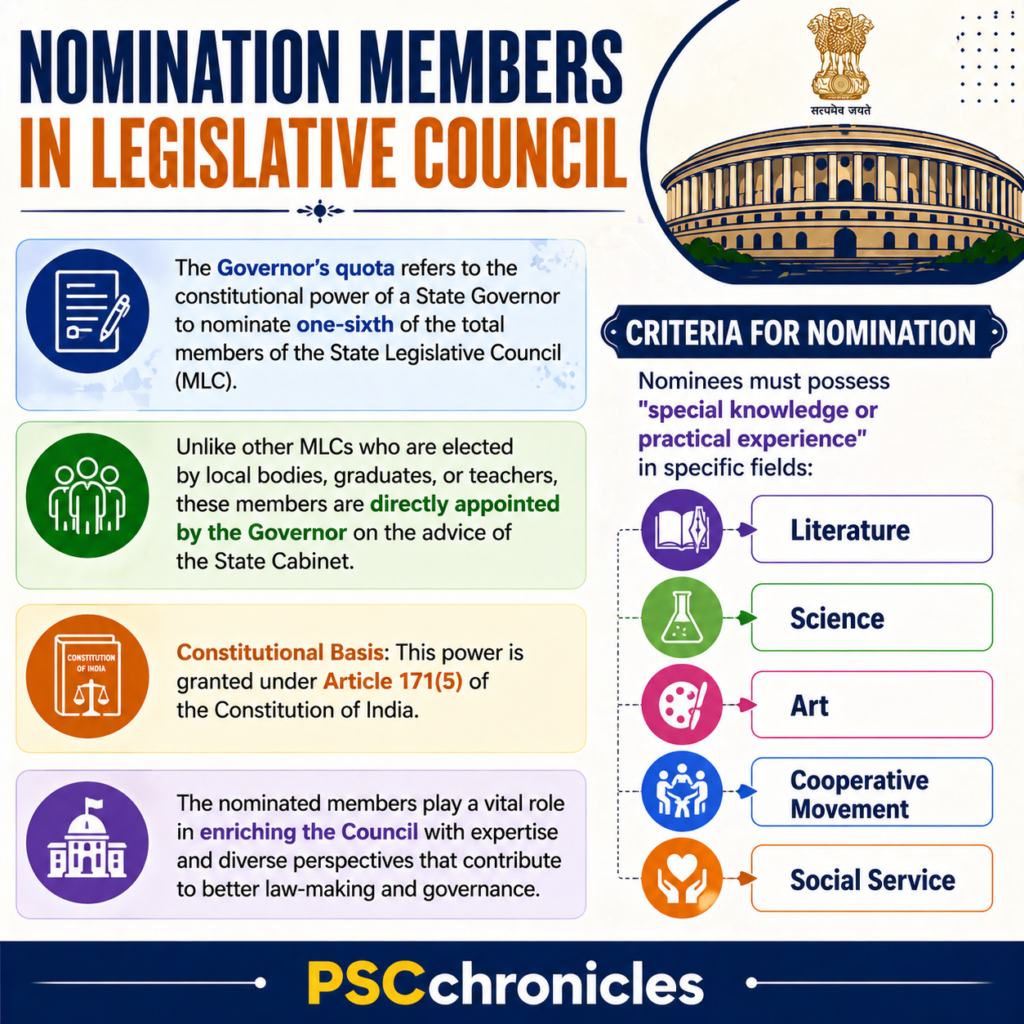
The Governor of Telangana has approved the nomination of two prominent personalities to the State Legislative Council under the Governor’s quota. The nominated members are:
M. Kodandaram – Academic and social activist
Mohammad Azharuddin – Former cricketer
Governor’s Quota in Legislative Council
Constitutional Basis
Governed by Article 171(5) of the Indian Constitution.
It empowers the Governor to nominate members to the State Legislative Council (MLC).
Key Features of Governor’s Quota
The Governor can nominate 1/6th of the total members of the Legislative Council.
These members are:
Not elected
Directly appointed by the Governor
Based on the advice of the State Cabinet
Eligibility Criteria for Nomination
Nominees must have special knowledge or practical experience in the following fields:
Literature
Science
Art
Cooperative Movement
Social Service
About Legislative Council (Quick Facts)
It is the Upper House of the State Legislature.
Not all states have a Legislative Council.
Members are elected through:
Local bodies
Graduates
Teachers
MLAs
Plus nominated members (Governor’s quota)
To study more Telangana related current affairs, Click here
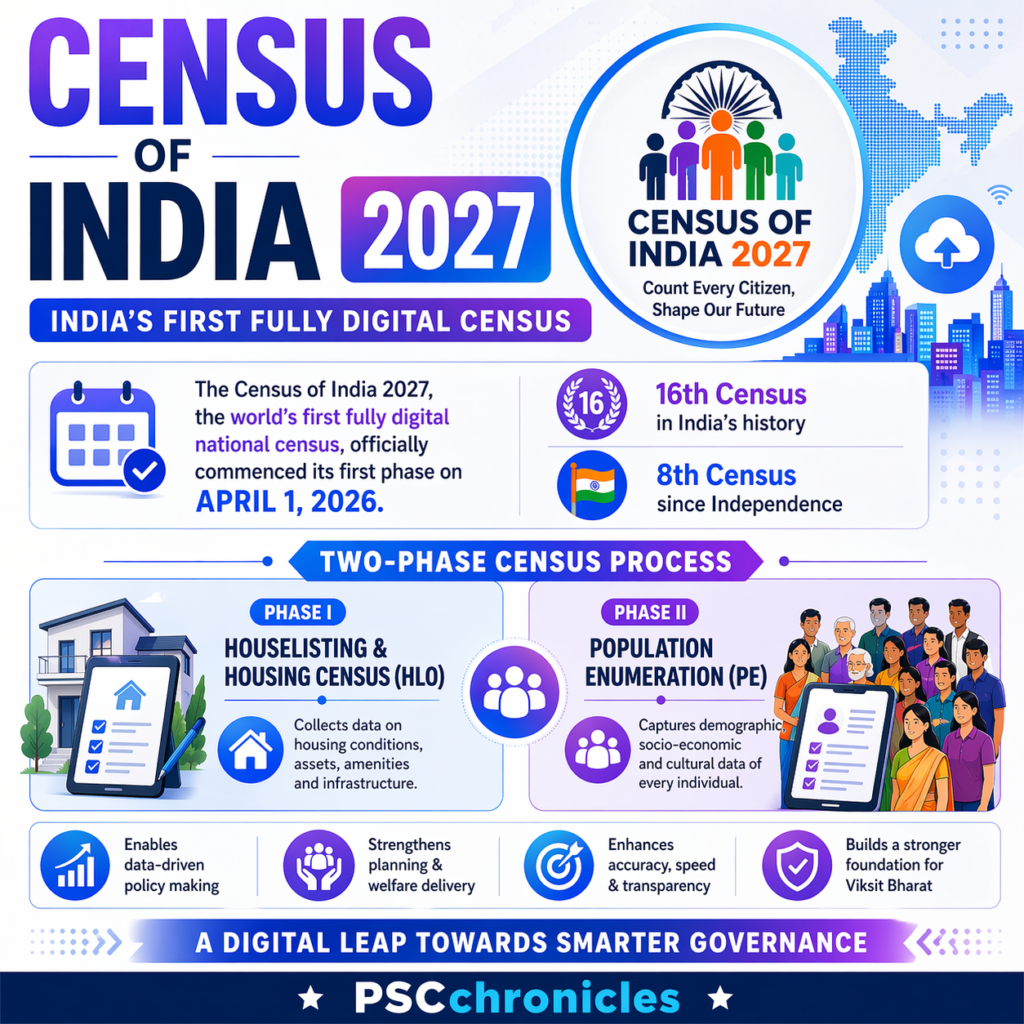
India has launched Census 2027, marking a historic shift as the world’s first fully digital national census. The exercise began on April 1, 2026, and plays a crucial role in policy-making, planning, and governance.
Key Highlights of Census 2027
First-ever fully digital census in the world
Started on April 1, 2026
It is the 16th Census of India
It is the 8th census after independence
Conducted under the authority of the Registrar General and Census Commissioner of India
Two Phases of Census 2027
Phase I: Houselisting & Housing Census (HLO)
Timeline: April 1, 2026 – September 30, 2026
Purpose:
Listing all buildings and households
Collecting data on:
Housing conditions
Basic amenities (water, electricity, sanitation)
Household assets
Phase II: Population Enumeration (PE)
Timeline: February 2027
Reference Date: March 1, 2027
Purpose:
Collecting individual-level data, such as:
Age
Gender
Education
Occupation
Socio-economic details
Background: Census in India
Conducted every 10 years (Decennial Census)
First census in India: 1872 (non-synchronous)
First complete census: 1881 (under British rule)
Last census: 2011 (2021 census delayed due to COVID-19)
To study more National issues from exam point of view, Click here