πŸ“° Today's Current AffairsRead Now →
📷 Follow on Instagram

April 2026 current affairs

Lok Sabha Rejects 131st Amendment Bill-2026

Why in News?

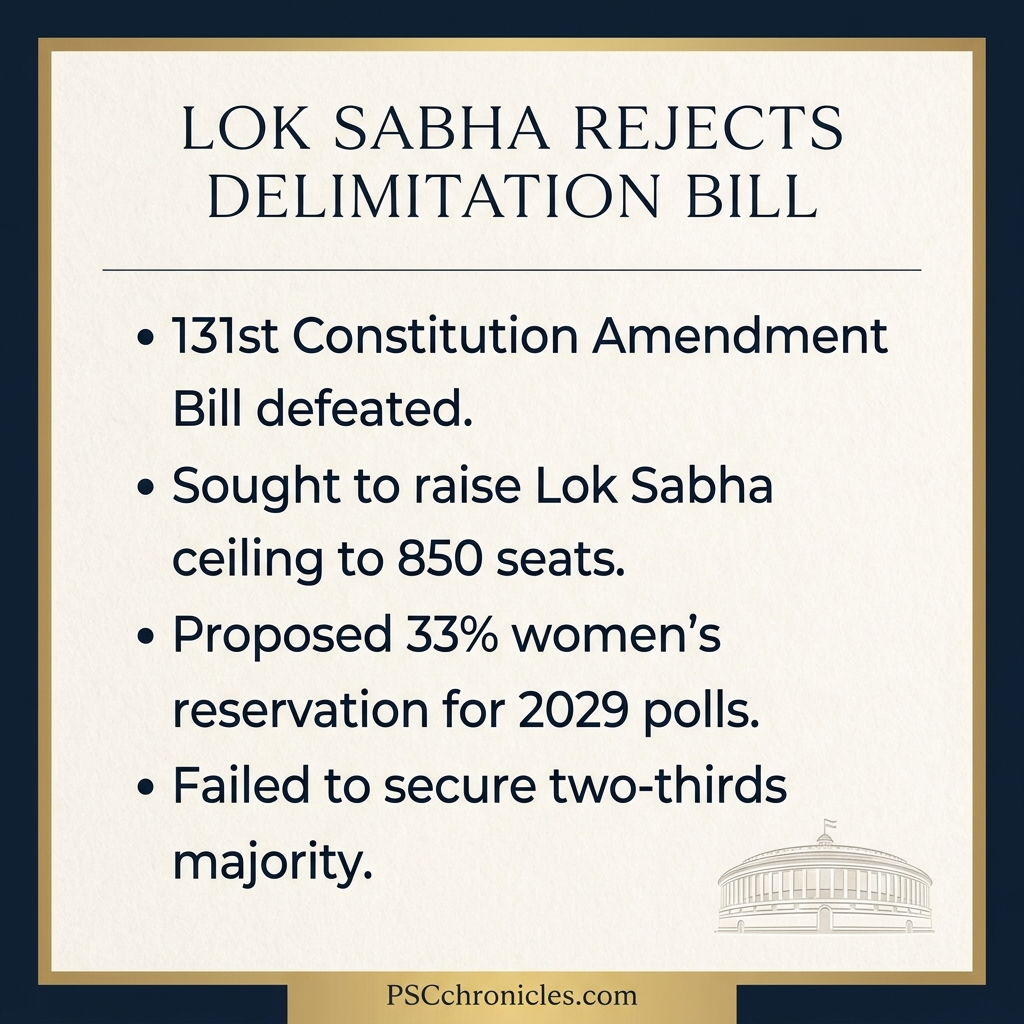
The Lok Sabha recently rejected the 131st Amendment Bill, which proposed increasing the strength of the House and implementing 33% reservation for women. The bill failed as it could not secure the required special majority.
loksabha rejectes delimitation

Key Highlights of the Bill

  • Purpose of the Bill
    • Increase Lok Sabha strength to 850 seats
    • Implement 33% reservation for women before the 2029 general elections
  • Outcome
    • The bill was defeated in Lok Sabha
    • Failed to secure the required special majority
  • Aftermath
    • Government withdrew:
      • Delimitation Bill, 2026
      • Union Territories Laws (Amendment) Bill, 2026

What is Special Majority?

A Special Majority in Parliament refers to a higher level of approval required for important decisions, especially constitutional amendments under Article 368.

  • ItΒ refers toΒ any voting requirement other than simple, absolute, or effective majorities, typically requiring at least a two-thirds majority of members present and voting. I

Delimitation Controversy Explained

What is Delimitation?

  • It is the process of redrawing boundaries of constituencies based on population changes.
  • Usually based on Census data.
Core Issue in This Case
  • The bill linked women’s reservation to a new delimitation exercise based on the 2011 Census.
  • Opposition raised concerns that:
    • Southern states (with controlled population growth) may lose representation
    • Northern states may gain more seats

To study polity from exams point of view, Click here
Lok Sabha Rejects 131st Amendment Bill-2026 Read More Β»

AP Animal Shelters Plan 2026: 5 Per District Explained

Why in News?

Andhra Pradesh government has announced a major initiative to improve animal welfare and public safety by setting up five animal shelters in every district. This step addresses the rising issue of stray and abandoned animals, especially in urban and semi-urban areas

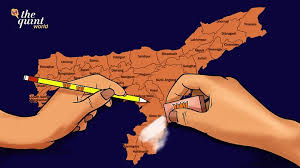
ap map

Key Highlights of the Scheme

  • 5 Shelters per District
    Every district in Andhra Pradesh will have five dedicated animal shelters.
  • Purpose
    • Manage stray, abandoned, and seized animals
    • Reduce road accidents and public safety risks
    • Ensure humane treatment of animals
  • Location
    • Shelters will be set up near constituency headquarters for easy access and monitoring.
  • Funding Source
    • Funded under the Viksit Bharat – Guarantee for Rozgar and Ajeevika Mission (Gramin) (VB-G RAM G).

What is VB-G RAM G Scheme?

The Viksit Bharat – Guarantee for Rozgar and Ajeevika Mission (Gramin) (VB-G RAM G) is a major rural employment scheme introduced in 2025, replacing the Mahatma Gandhi National Rural Employment Guarantee Act (MGNREGA).

πŸ“Œ Key Features

  • Increased Employment Guarantee
    • Provides 125 days of wage employment per rural household (earlier 100 days under MGNREGA)
  • Funding Pattern
    • 60:40 (Centre : State)
    • 90:10 for special category states
    • 100% central funding for Union Territories without legislatures
  • Agricultural Pause
    • Introduces a 60-day work pause during peak farming seasons
      πŸ‘‰ Helps prevent labour shortages in agriculture
  • Focus Areas (4 Pillars)
    • Water security
    • Rural infrastructure (linked with PM Gati Shakti)
    • Livelihood assets
    • Climate resilience

To study AP current affairs for AP government exams, Click here

AP Animal Shelters Plan 2026: 5 Per District Explained Read More Β»

Gerrymandering Explained

Why in New?

Leaders from parties like Congress and the DMK have accused the government of using the Women’s Reservation Act as a “cover” for gerrymandering.

gerrymandering

Gerrymandering is the practice of manipulating electoral constituency boundaries to favor a particular political party, group, or candidate.

  • It distorts fair representation in elections
  • Often done during the process of delimitation (redrawing constituencies)
  • Undermines the principle of free and fair elections

Types of Gerrymandering

1. Packing

  • Concentrating opposition voters into a few constituencies
  • Example: One party wins overwhelmingly in few seats, wasting votes

2. Cracking

  • Splitting opposition voters across many constituencies
  • Prevents them from forming a majority anywhere

3. Kidnapping

  • Moving a strong opponent’s voters into another constituency
  • Weakens their electoral base

To study more polity current affair, from exam point of view, Click here

Gerrymandering Explained Read More Β»

Women’s Reservation Act 2026: 33% Quota Comes into Force

Why in News:

The Women’s Reservation Act, 2023 officially came into force on April 16, 2026, marking a major step toward improving women’s representation in Indian politics. This law provides 33% reservation for women in key legislative bodies.

nari shakti vandan adhiniyam

What is the Women’s Reservation Act?

  • The Act is formally known as the Constitution (One Hundred and Sixth Amendment) Act, 2023.
  • Popularly called the Nari Shakti Vandan Adhiniyam.
  • Notified by the Union Ministry of Law and Justice on April 16, 2026.

Key Features of the Act

1. Reservation Provision

  • Provides 33% reservation for women in: Lok sabha and State Legislative Assemblies

2. Exclusions

  • Does NOT apply to: Rajya Sabha and State Legislative Councils (Legislative Council/Upper Houses)

3. Rotation of Seats

  • Reserved seats will rotate after delimitation.
  • Ensures fair distribution of reservation across constituencies.

4. Duration

  • Reservation will be in force for 15 years.
  • Parliament may extend it if required.

5. Implementation Timeline

  • Act passed in 2023.
  • Came into effect on April 16, 2026 through official notification.

To study Polity current affairs from exam point of view, Click here

Women’s Reservation Act 2026: 33% Quota Comes into Force Read More Β»

Supreme Court on Ashoka Chakra Guidelines (2026 Explained)

Why in News?

The Supreme Court of India declined to entertain a petition seeking the formulation of guidelines for displaying the Ashoka Chakra on the national flag. The Court chose not to intervene, indicating no need for additional directions.

ashoka chakra

Key Highlights of the Case

  • The petition requested the Court to direct the Central Government to frame specific rules for the display of the Ashoka Chakra.
  • The Supreme Court refused to entertain the plea.
  • The Court did not find sufficient grounds to issue directions in this matter.
  • Existing provisions under the Flag Code of India already govern the use and display of the national flag

Ashoka Chakra – Key Facts

  • Inspired from the Lion Capital of Ashoka at Sarnath (Mauryan period)
  • Adopted on 22 July 1947.
  • Located at the center of the white band in the Indian National Flag
  • Color: Navy Blue
  • Shape: 24-spoked wheel

To study more Polity current affairs, from exam point of view, Click here

Supreme Court on Ashoka Chakra Guidelines (2026 Explained) Read More Β»

PM MUDRA Yojana 2026: 11 Years completed

Why in News?

India celebrates 11 years of the Pradhan Mantri MUDRA Yojana (PMMY), launched on 8 April 2015. The scheme aims to provide collateral-free loans to micro and small businesses, promoting entrepreneurship and financial inclusion.

pm mudra yojana

Pradhan Mantri MUDRA Yojana (PMMY)

  • Launch Date: 8 April 2015
  • Type: Flagship Central Government Scheme
  • Objective: β€œFund the Unfunded”
  • Ministry: Department of Financial Services, Ministry of Finance

Loan Categories under PMMY

Shishu

  • Loan up to β‚Ή50,000
  • For new or early-stage entrepreneurs

Kishore

  • Loan from β‚Ή50,001 to β‚Ή5 lakh
  • For growing businesses

Tarun

  • Loan from β‚Ή5 lakh to β‚Ή10 lakh
  • For established enterprises

Tarun Plus (New Category)

  • Loan from β‚Ή10 lakh to β‚Ή20 lakh
  • For entrepreneurs who successfully repaid Tarun loan

To study Indian economy current affairs from exam point of view, Click here

PM MUDRA Yojana 2026: 11 Years completed Read More Β»

India Sends BCG Vaccines to Afghanistan

Why in News?

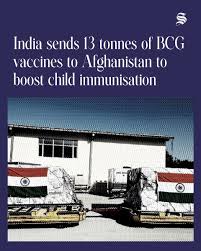
India has sent 13 tonnes of BCG (Bacille Calmette-GuΓ©rin) vaccines along with essential materials to Afghanistan.
This initiative aims to strengthen Afghanistan’s child immunisation programme, especially in preventing tuberculosis (TB) among children.

india bcg afghanistan

Bacille Calmette-GuΓ©rin (BCG) Vaccine

  • Developed in 1921
  • Derived from: Mycobacterium bovis (attenuated strain)
  • Type: Live attenuated vaccine
  • It is the only licensed vaccine against TB

What is TB?

  • A bacterial infectious disease caused by Mycobacterium tuberculosis

Transmission

  • Spreads through airborne droplets
  • Occurs when an infected person-Coughs, Sneezes

Types of TB

Pulmonary TB
  • Affects the lungs
  • Most common and highly contagious
Extra-Pulmonary TB (EPTB)
  • Affects other organs:
    • Lymph nodes
    • Bones (Pott’s disease)
    • Kidneys
    • Brain

To study Science related current affairs from exam point of view, Click here

India Sends BCG Vaccines to Afghanistan Read More Β»

Telangana Caste Survey 2025: Complete Data

Why in News?

The Telangana government has officially published the results of its 2024–25 caste survey, one of the most extensive socio-demographic studies in India.

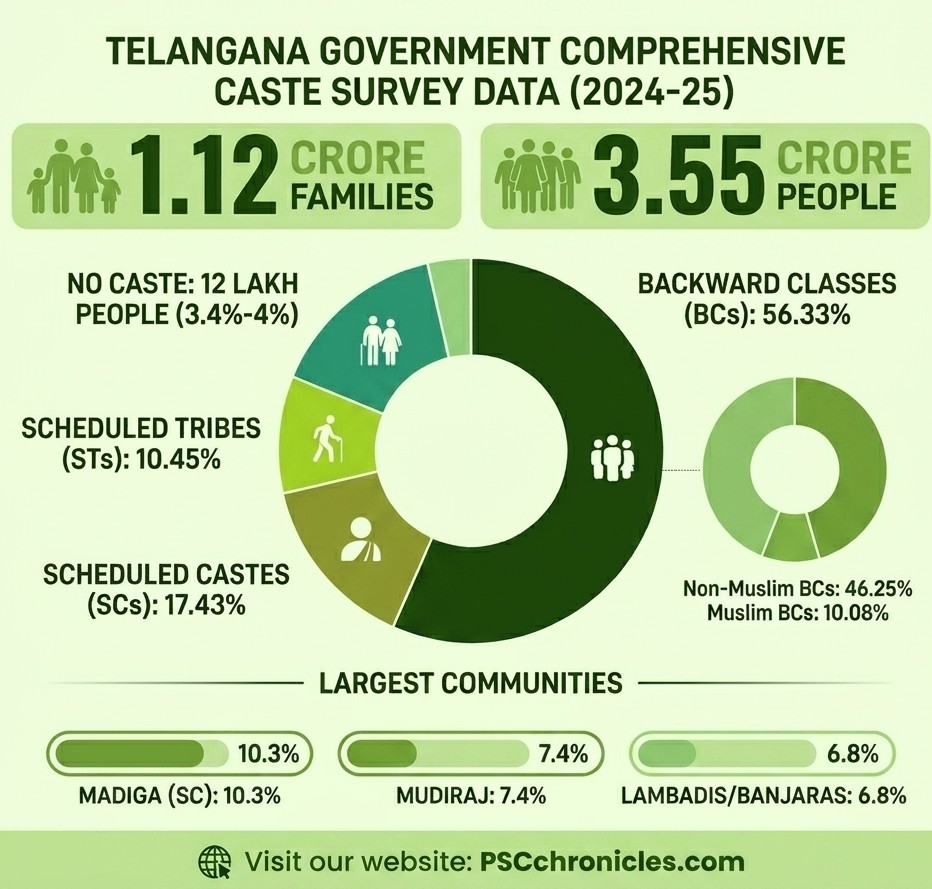
  • The survey covered 1.12 crore families and 3.55 crore people, offering crucial insights into the state’s caste composition.
telangana castes

Key Findings of the Survey

Population Coverage

  • Total Families Surveyed: 1.12 crore
  • Total Population Covered: 3.55 crore

Caste-wise Population Distribution

Backward Classes (BCs) – 56.33% (Largest Group)

  • Non-Muslim BCs: 46.25%
  • Muslim BCs: 10.08%
Scheduled Castes (SCs) – 17.43%
Scheduled Tribes (STs) – 10.45%
Other Castes (OCs) / General Category – 15.79%
  • Includes ~2.48% OC Muslims
No Caste Category
  • Around 12 lakh people (3.4%–4%) chose not to declare caste

Largest Individual Communities

  • Madiga (SC) – 10.3% (largest single community)
  • Mudiraj – 7.4%
  • Lambadis/Banjaras (ST) – 6.8%

To study more current affairs from exam point of view, Click here

Telangana Caste Survey 2025: Complete Data Read More Β»

KABIL Gets Argentina Clearance for Lithium exploration

Why in News?

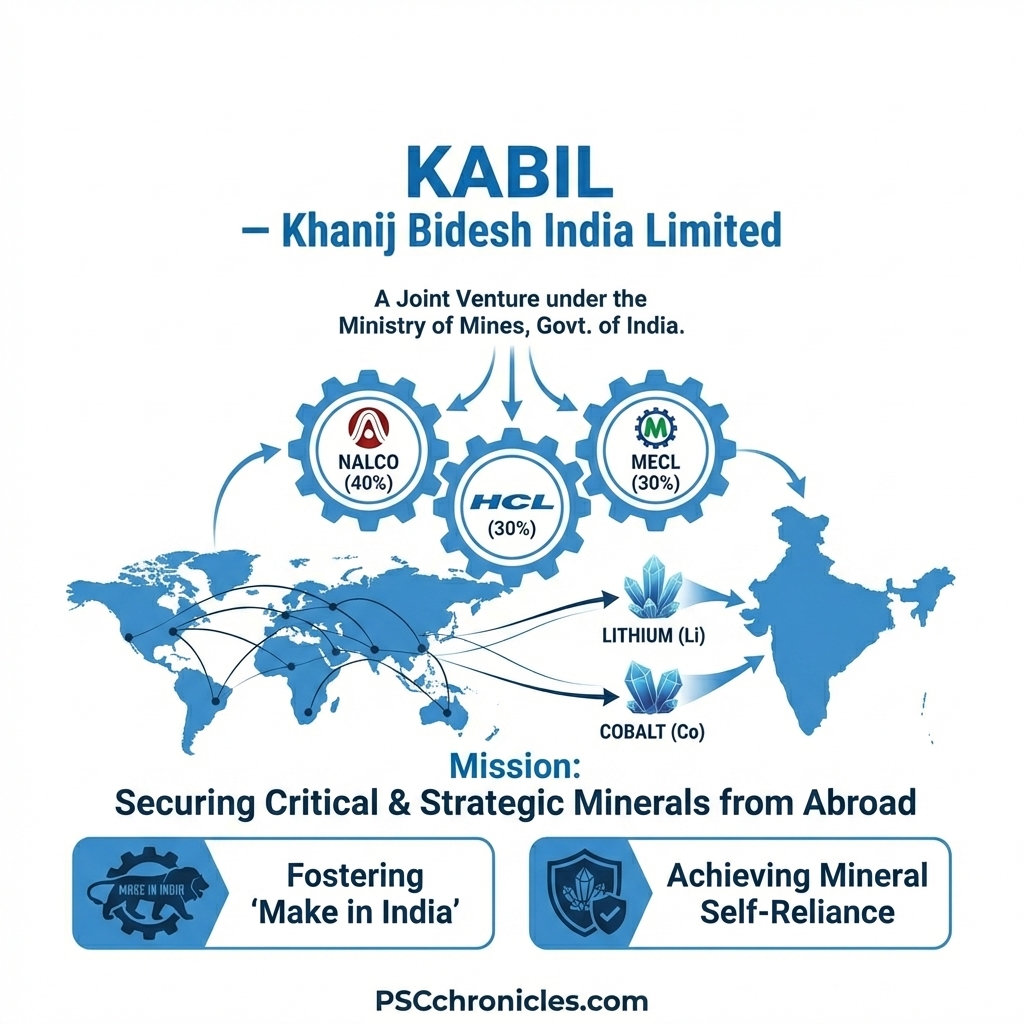
India has taken a major step toward securing critical minerals as Khanij Bidesh India Limited (KABIL) received environmental clearance from the Argentine government. This approval allows deep exploration of lithium-rich brine blocks in Argentina.

kabil

Why Lithium is Important?

  • Lithium is a key component in batteries
  • Essential for:
    • Electric Vehicles (EVs)
    • Renewable energy storage systems
    • Electronics and aerospace

Lithium is often called β€œWhite Gold” due to its strategic importance

About KABIL:

  • Established under the Ministry of Mines
  • A joint venture of three CPSEs:
    • National Aluminium Company Limited – 40%
    • Hindustan Copper Limited – 30%
    • Mineral Exploration and Consultancy Limited – 30%

Objectives of KABIL:

  • Identify and acquire overseas mineral assets
  • Explore and develop critical & strategic minerals

To study more National current affairs, from exam point of view, Click here

KABIL Gets Argentina Clearance for Lithium exploration Read More Β»

COP31 Vision 2026: TΓΌrkiye’s β€œFuture COP” Explained

Why in News?

TΓΌrkiye has proposed a new β€œCOP of the Future” vision for COP31 (2026) under the UNFCCC framework. This vision introduces an innovative partnership model with Australia and focuses on action-oriented climate governance

unfccc explained

What is COP31 and TΓΌrkiye’s New Vision?

  • COP31 refers to the 31st session of the Conference of Parties under the UN climate framework.
  • TΓΌrkiye will: Host the summit in Antalya and lead the Action Agenda
  • Australia will: Play a key role in negotiations

Understanding UNFCCC

The United Nations Framework Convention on Climate Change is the foundation of global climate governance.

Key Facts:

  • Adopted: 1992 at the Rio Earth Summit
  • Enforced: 1994
  • Members: 198 Parties (197 countries + EU)
  • Secretariat: Bonn, Germany

Objective:

  • Stabilize greenhouse gas (GHG) concentrations
  • Prevent dangerous human interference with climate systems

What is Conference of Parties (COP)

  • Supreme decision-making body of UNFCCC
  • Annual meeting of all member countries
  • First held in 1995 (Berlin)

Functions:

  • Review climate action progress
  • Negotiate new agreements
  • Set global climate targets

To know more about UNFCCC, from exam point of view, Click here

COP31 Vision 2026: TΓΌrkiye’s β€œFuture COP” Explained Read More Β»